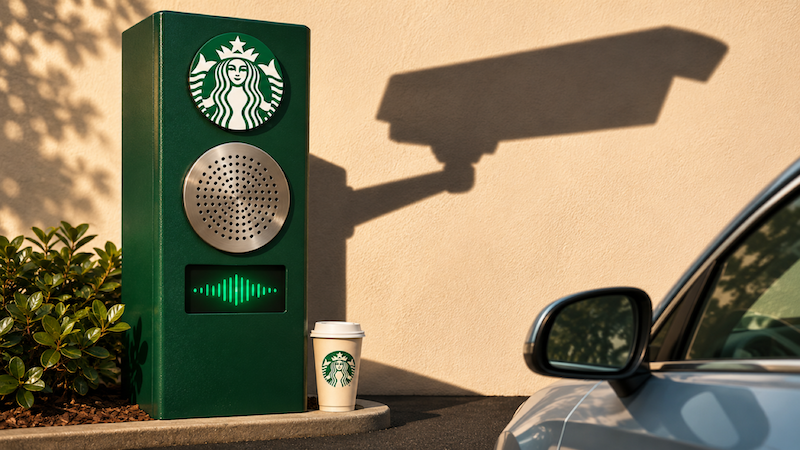
On Sunday afternoon, Unusual Whales posted that Starbucks plans to identify customers as they pull into the drive-thru, then show them personalized menus and speed up payment. The post passed 350,000 views within hours. The replies were a wall of "creepy" and "dystopian," and a follow-up from AutismCapital picked up another 54,000 views.
The news itself was more than two weeks old. On Starbucks' Oct. 29 earnings call, CEO Brian Niccol said the company is exploring experiences that "recognize participating customers as they arrive," show them personalized digital menus and make payment easier. He noted that roughly half of Starbucks customers use the drive-thru, and he called the work early. Gizmodo compared it to the personalized ads in Minority Report within days. Most people didn't notice until Sunday.
For brand leaders, what matters is how far apart Starbucks' likely plan and the public's reading of it ended up.
What Niccol actually described
The morning after the call, Niccol gave a plainer version to Yahoo Finance. "When you pull up to the drive-thru, if you're in our app, it will recognize you," he said, according to GeekWire. The board would pull up your usual order and the payment would go through your account. He called it a fast pass and framed it as a way to strengthen the relationship between baristas and regulars.
That sounds like a loyalty feature, and Starbucks has plenty of members to try it on. The company counted a record 36 million active Rewards members in the U.S. last quarter. What Starbucks hasn't said is how the recognition would work, where it will be tested, how customers will opt in or how long the data will be kept, as Reclaim The Net pointed out. With those questions open, people assumed the worst and pictured cameras scanning their faces.
Starbucks Korea already ran this experiment
The frustrating part for Starbucks is that its own Korean business has shown customers will sign up for this. Starbucks Korea launched My DT Pass in June 2018. Rewards members register their license plate in the app, and the drive-thru reads the plate and charges their card automatically. Within about two and a half years, more than 1.5 million members had registered, and roughly four in 10 drive-thru orders were going through the system.
Korean customers signed up because the deal was spelled out. You registered your own car, in your own app, to skip the payment step. McDonald's tested license-plate recommendations in the U.S. in 2019 under a similar permission model, RetailWire reported, and drew similar privacy worries. The technology in both cases was ordinary. Customers reacted to whether they understood the deal before they pulled in.
Recognition is the word that breaks trust
Customers mostly object to personalization they didn't see coming. Usercentrics found that 71% of consumers worry that AI-driven personalization feels intrusive. In a ThoughtSpot survey of more than 4,800 Americans, 91% found at least one kind of personalization intrusive, and real-time location tracking was among the most cited. The same research found people feel much less uneasy when they share information directly and on purpose.
Saving your usual order in the app fits that comfort zone. Being "recognized" as you pull in sounds like the store knew who you were before you said a word. Niccol's earnings-call language was written for investors who want to hear about personalization and higher tickets, and customers read it as a description of being watched.
The price question is coming
There's a second issue Starbucks hasn't touched yet. A menu board that changes for each driver can also change offers and prices for each driver. The Federal Trade Commission proposed a policy in August saying companies that use personal data to set prices should clearly disclose it, and it warned that secret personalized pricing could count as deceptive. Nothing Starbucks has said suggests it plans to do this. But once customers see a menu built for them, many will assume the prices are too, and the brand will have to answer that question whether it plans to or not.
Our take
Starbucks probably has a good feature here, and it described it badly. The fix starts with the language. "Recognize" is a word for security systems. "Save your usual so it's ready when you pull up" says the same thing in terms customers already like.
The consent has to be visible and specific. Customers should switch the feature on in the app, see exactly what it uses to identify them, whether that's the app's location, a license plate or something else, and be able to turn it off just as easily. Starbucks should also say out loud what it won't do. That means no cameras on faces, no tracking of drivers who haven't signed up, and no prices that change based on who's in the car. Few brands put promises like that in writing, so the ones that do stand out.
Starbucks also found out that earnings calls now reach customers. Anything a CEO says to analysts can be clipped and posted to millions of people. A sentence built to excite investors about personalization reached customers two weeks later without any of the context that might have reassured them. Any brand planning AI personalization in a physical space should write the customer-facing explanation first, before an executive describes the feature to Wall Street.