Eleven months ago, Disney planned to let the public play with its characters using generative AI. Now it is building models that only Disney’s own teams will ever touch.
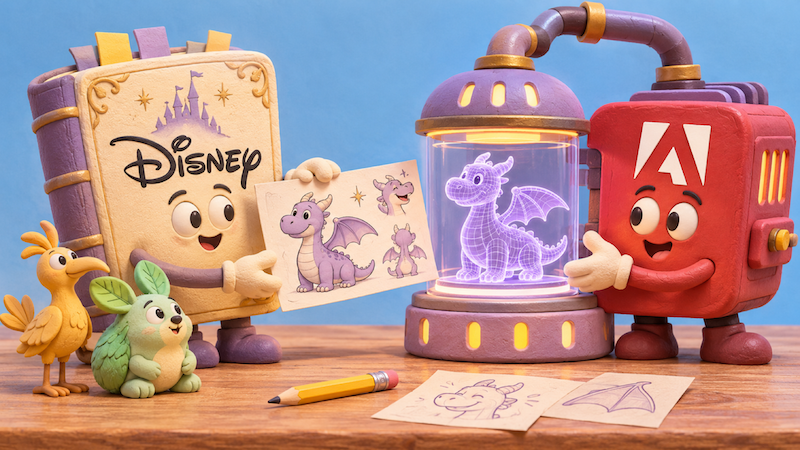
At Adobe MAX in Miami Beach on Monday, Adobe and The Walt Disney Company announced a multi-year strategic alliance that makes Adobe an Official AI Innovation Partner of the company. The core of the deal is Firefly Foundry, Adobe’s service for building custom generative models on a client’s own IP. The two companies will use it to build models trained on Disney’s character attributes, environments and visual styles, and those models stay inside Disney.
Anyone following Imagineering saw this coming. Axios reported in June that Imagineers were already using custom Firefly models built around Frozen, Moana, Lilo & Stitch and Cars to work up concepts for future rides. Monday’s news is about scale. A pilot inside one division now covers the parks, Disney Cruise Line, the film studio and ESPN.
What Disney signed at Adobe MAX
Disney gets early access to Firefly, Firefly Foundry, Premiere and Photoshop. Adobe is also assigning engineers and researchers to its production pipeline. According to Adobe’s announcement, Imagineering already runs two Foundry models. One turns hand-drawn sketches into rendered 2D concept art, and the other produces franchise-accurate creative assets for park development.
Adobe also joins StudioLAB, the Walt Disney Studios innovation hub, to work on internal creative workflows. At ESPN Edge, the companies will look at fan engagement and new uses for ESPN’s archive. Neither side disclosed financial terms.
Becca Vodnoy, Disney’s senior vice president of corporate alliances, opened her statement with a line that would fit almost any Disney press release: “Disney has always embraced innovation.” The past year shows Disney has been a lot more selective than that about which innovations it embraces, and on whose terms.
The Sora deal was the opposite bet
In December 2025, then-CEO Bob Iger announced a $1 billion equity investment in OpenAI. It came with a three-year license that would have put more than 200 Disney, Marvel, Pixar and Star Wars characters into Sora. Fans would write the prompts, and a curated selection of the results would stream on Disney+.
It never got that far. In March, OpenAI shut Sora down, and The Hollywood Reporter reported that Disney was exiting the entire agreement. TheWrap later reported that Disney walked away without making the investment.
The two deals point in opposite directions. The OpenAI deal sent Disney’s characters into someone else’s consumer app, where millions of strangers decided what Elsa did next. The Adobe deal keeps them in-house, inside models used only by Disney employees and built by a vendor whose whole pitch is that it trains on licensed material.
Disney wants AI it controls
The rest of Disney’s AI record follows the same pattern. As Axios noted in June, the company has sued Midjourney and MiniMax and sent Google a cease-and-desist letter over alleged infringement of its characters. Disney takes companies to court for training on its characters without permission. It pays a company to train models on them with permission.
That frame should travel well for any CMO with a brand worth protecting. Inside Disney, the open questions were who owns the model, what it learns from and who gets to prompt it. Firefly Foundry answers each in Disney’s favor. Sora answered none of them.
Adobe gets a showroom
A good portion of Adobe’s release is about marketing rights. Adobe gets to tell innovation stories from Walt Disney World, Disneyland, Disney Cruise Line, ESPN Edge and StudioLAB through global marketing activations, industry events and customer storytelling. It also gets a bigger presence across Disney’s media platforms. Adobe has signed the most valuable reference customer in entertainment.
It needed one. TechRadar pointed out in June that investors have grown skeptical of Adobe’s place in a market flooded with cheap generative tools. Foundry is how Adobe plans to compete without racing free image generators on price. It sells custom models with Adobe staff attached. When the service launched last October, Adobe said every project would come with applied AI scientists and engineers who co-develop the models. It named Imagineering and Home Depot as early users.
Agencies should read the staffing line
The sentence in Monday’s release that agency leaders should pay attention to is the one promising dedicated engineering and research resources for Disney’s production pipeline. That puts a software vendor in an embedded, ongoing creative-production role, the kind of retainer that has usually gone to agencies and production shops.
The money follows the model. A brand that owns a model trained on its own catalog needs people to train it, maintain it and keep its output on brand. At Disney, Adobe staff now hold that job. Agencies that want a seat in this workflow will have to build brand-model practices of their own or work inside a vendor’s tools on the vendor’s terms.
Brands face a more mundane problem. A custom model can only learn from what it’s given. Disney has decades of tightly managed character art. Most companies have a shared drive full of inconsistently tagged files and assets whose usage rights nobody has checked in years. That cleanup has to happen before anyone can buy what Disney just bought.
The artists haven’t signed off
Both companies leaned on artist-friendly language. Disney has called its approach to AI in Imagineering human-centered and artist-driven, and Adobe says artists remain central to how the models get used. Early reaction suggests that framing won’t settle much. Some of the first replies to Scott Gustin’s post about the deal were already asking what it means for the artists whose work trains these models.
Disney has been through this before. The Sora deal drew public criticism from artists and unions within days of its announcement. A private model used for concept art is much easier to defend than a public video generator. It still leaves the labor question open, and Disney’s creative staff will keep asking it.
Our take
Brands with valuable IP will use generative AI privately and on their own terms, and they will pay vendors to make that possible. Disney is the biggest name to commit to that publicly so far. Ask every AI vendor you work with what its models were trained on, and get the answer in writing. Start treating your brand archive as training data, because it is about to become exactly that. Then look at how your creative budget splits between agencies and AI vendors. Adobe just showed that a software company can now do work that used to belong to an agency.