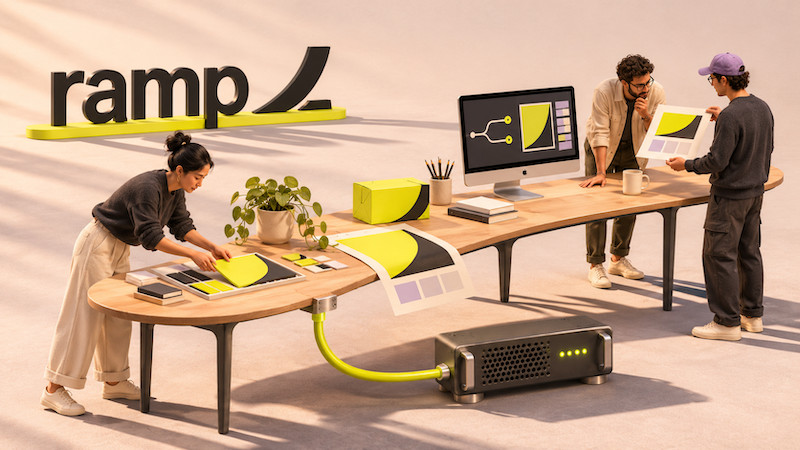
Paul Jun thinks most in-house creative teams work like a sandwich counter. Orders come in, sandwiches go out, and nobody has time to cook anything new.
Jun leads brand at Ramp, and on Tuesday morning he published part two of his "Brand as Software" essay on X. Part one, from September, made the case against the service-desk model, citing the 375-plus requests that landed in Ramp's brand Slack channel during his first six months. Part two is the build log. It covers the staffing changes, the internal agent Ramp now uses for most routine brand assets, and what Jun thinks executives have to change before any of it works somewhere else.
The timing is good. Marketing has spent most of this year arguing about the "marketing engineer," a builder role Profound formally named in April. Most of that debate has centered on growth and lifecycle automation. Jun is describing the same idea applied to brand, and he's describing something Ramp has already shipped.
The first fix was a staffing decision
When Jun joined Ramp ten months ago, his two senior brand designers were spending their days on decks and whitepapers. He moved them off that work right away and brought in contractors to cover production. Asking the designers to rebuild the brand system while the request queue kept running, he wrote, would have handed them a second job.
One of those contractors, Kyla, used Ramp's internal AI tools to automate roughly 90% of the company's whitepaper work by her second week. Then she asked Jun what she should work on next.
Ramp Creative does the production now
The system at the center of the essay is Ramp Creative, a Slack agent that makes decks, whitepapers, one-pagers, print pieces and product graphics. It also handles small edits, like changing a dollar sign to a euro or swapping in a customer's logo. Ramp is working on getting it to produce demos, reels and video.
Requests move through it in a fixed order. The agent picks an approved skill, which spells out the rules for that format and what can and can't change. It drops the requester's copy and approved images into the layout, a renderer builds the file, and automated tests check for broken dimensions, missing fonts and overflowing text before anything goes back to Slack. The brand team designs the reference examples in Figma. Skills live in an internal library called Dojo, and the agent runs on Inspect, the coding agent Ramp's engineers built in-house.
Gaps go to people. When someone asks for a format the agent hasn't learned, it attempts one anyway, an automation flags the miss, and a designer gets 24 to 48 hours to make proper examples for the agent to learn from. Big pieces, like the deck for Ramp's own conference, are still designed by hand, and the finished work gets fed back into the system afterward.
Jun calls the goal a "Michelin-star vending machine," and he's strict about the standard. For the formats it supports, he wrote, 80% isn't good enough. An agent that gets people most of the way trains them to ship rough work and wait for a designer to clean it up. If it fails a couple of times, people go back to prompting their own tools. He says he'd rather hire ten production designers than run a system that half works.
The results are Ramp's own, and they're specific
Jun offers several examples. A Ramp marketer, Sabrina, used the agent to produce and localize more than 80% of the assets for the company's UK launch. At OnRamp, Ramp's annual conference for finance leaders, which drew more than 1,200 people in San Francisco and 2,500 online this year, much of the last-minute editing ran through the agent. A member of the SEO team working on Router builds her own launch assets, landing pages and social posts with it.
Over the same ten months, Jun says, the team finished a brand refresh in four weeks and branded Ramp Labs, Stack, Glass, Inspect and Router while the company shipped Bill Pay, Accounts Receivable and an international expansion. He gives a lot of the credit to Ramp's talent and to its agency partner, Common Reality.
The Inspect launch is where he shows what the time bought. He ran customer conversations, engineering Q&A and old internal docs through a set of personal AI skills and had a brief within minutes. He pulled art direction from an archive of about 60,000 reference images he has collected over his career. The three weeks that followed went to debating messaging with product and engineering and to exploring more creative directions. Teams should fight about ideas in the first 20% of a project, Jun argues, while there's still time to execute the good one.
Jun wants brand funded like security
The organizational argument is the part CMOs should read closely. Ramp treats Ramp Creative as a product with internal customers. It has a dedicated backend engineer and a dedicated designer, and Jun works in the codebase himself. He splits the team into "artists" who invent the brand and "builders" who turn its repeatable decisions into agents, skills, tests and evaluations.
He goes further and says brand teams should be set up like security or infrastructure teams, with dedicated people, a budget, clear ownership, the authority to say no and accountability when something breaks. He concedes the comparison only goes so far. A bad deck won't sink a company overnight. His point is that the damage accumulates, and that a year after a rebrand, a company where everyone generates their own assets can end up looking like three different companies.
He also takes a swing at the old problem of measuring brand. A deck from the agent might cost about a dollar, he estimates, against $100 an hour for a person. He frames that as a way to keep scarce designers on harder problems, and he's careful not to pitch it as a headcount cut.
Our take
This is the most concrete account we've seen of a brand team rebuilt around AI, and it comes from the person who did the rebuilding. That makes it useful. It also means reading the numbers with some care. They're Jun's, and Ramp is an unusual place to run this experiment: an engineering-heavy company that ships constantly and built its own coding agent, which Jun says now handles more than 80% of its pull requests. Most marketing orgs can't borrow a backend engineer on request.
Jun is also upfront about what isn't finished. Designers still make every new reference example by hand, which he calls the current bottleneck, and he admits much of the team's best work from this year hasn't made it into the system yet.
For CMOs, the part worth copying is the order of operations. Jun took production off his best designers' desks before building anything, put an engineer on the system, and settled who makes the final creative call before the work started. If your brand team is still the last stop before launch, that's where to begin. The tooling comes later.