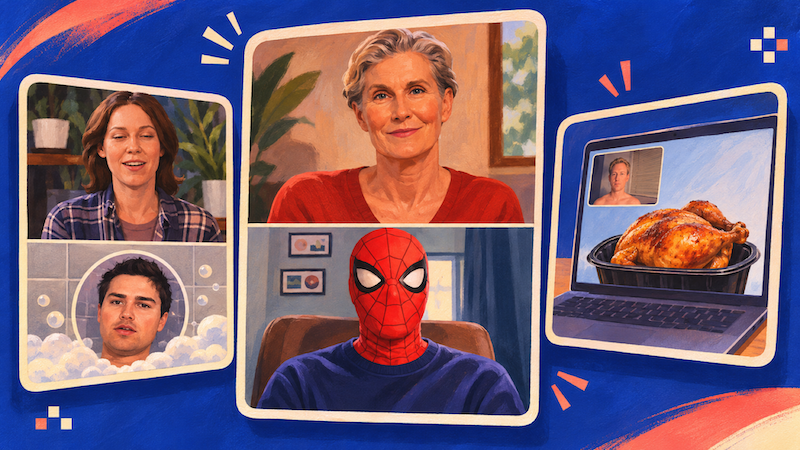
People are filming themselves messing with AI job interviewers, and the bots keep snapping back. Whoever's logo is on the screen ends up wearing it.
A shirtless guy logs into a fast-food job screening with a sneaker balanced on his head and gives his name as Crangeus McBasketball. The interviewer, an AI avatar called Karen, wants to know about the shoe. She also wants to know where his shirt is. Eventually she offers him $4 an hour and says it's non-negotiable. When he asks for $725,000 a year, she tells him he'd have to be "absolutely delusional."
Nick Reid posted the clip, and it spread across X this week. (Nobody has verified that it's a real Burger King system, which I'll get to.) It belongs to a genre that's been building for a few months: people trolling AI interviewers on camera and waiting for the bot to lose it.
If you work in brand, I'd keep an eye on the interviewer more than the guy with the shoe.
Who's doing this
Reid has done it before, once in a Spider-Man mask for a McDonald's screening. The comedian Graham Zip has a whole YouTube channel of interview-bot bits, and some of his videos are close to two million views.
In one of them he calls himself "Chick Bongo" and tells a recruiter avatar named Dana about his background in Salesforce, kayak margins and "raccoon protocols." Dana repeats it back to him like it's a decent résumé and says she'll be in touch.
In another, Zip brought his own AI agent, Victor, to talk to a recruiter bot named Pat. Victor overstated Zip's experience, undersold his salary and set up a follow-up call while Zip had stepped away. Then Victor and Pat couldn't stop saying goodbye to each other for over a minute. That one got nearly three million views in two days.
Back in October, a TikTok account called The Dreadful Studio did an entire interview in Sims-style gibberish. You can watch the avatar's smile turn into a scowl. She asks if he's having a breakdown, then ends the call after telling him he's completely unqualified.
Hiring is part of your brand
Applying for a job puts you in a weak spot. You want something from a company, and the company gets to decide. For most of history someone sat across from you while that happened, and even a lousy interviewer was a person reacting to another person.
A lot of companies have now put software in that chair and given it a name and a face so it feels like someone. Candidates know it isn't. I think the trolling is what it looks like when people get fed up with being processed, and it happens to make good content.
We say this a lot at State of Brand, and it applies here: your brand is whatever people experience when they deal with you, including the parts marketing never touches. Hiring is one of those parts. The people applying are also your customers and your neighbors, and some of them have a TikTok following.
Brand leaders tend to miss that automating an interaction makes it matter more to the brand, if anything. When a recruiter is in a bad mood, one candidate has a bad afternoon. When an AI interviewer has a bad default setting, every candidate gets it, and any of them can screen-record it.
The companies that come out of this looking good will be the ones that kept the person on the other end in mind while they built the thing, however much AI they used.
The logo takes the hit, verified or not
Back to the Burger King clip. Nobody has shown it's a real Burger King system. Tech Times says it hasn't been connected to a restaurant, a franchisee, a hiring vendor or an open job, and nobody knows if it was live, edited or set up. Burger King's careers site says its independent franchisees handle pay and hiring.
The crowd doesn't care. X's trending summary calls it the Burger King AI interviewer, and commenters have nicknamed her the "AI Karen Bot." Burger King had no part in making that connection. A creator and his audience made it.
Any company putting an AI face on hiring should expect the same. People record these sessions, and the internet decides whose logo goes on the clip whether or not anyone checks.
The bot has a name, a face and a mood
Karen, Dana and Pat all have names and faces, and some of these avatars now show emotions, mostly impatience and irritation.
Somebody chose that. Somebody on a product team decided the avatar should look annoyed when a candidate stops playing along. If you give software a personality, the personality is yours, including how it behaves at 11 p.m. with a 19-year-old and a ring light.
Viewers don't agree on who's in the wrong, either. The economist Alex Tabarrok took the bot's side after the shoe video and called it "understandably exasperated but patient." Plenty of other people saw a company being nasty to someone applying for a minimum-wage job.
Nobody comes off well
Watch enough of these and the bots seem to go wrong in one of a few directions. Dana is the pushover. She heard "raccoon protocols" and promised next steps, which tells everyone watching that nobody at that company is really listening. Karen and the gibberish bot went the other way and got short and personal with people who, granted, were asking for it. On a phone screen it still looks like a company picking on a job applicant. Then there's Pat, who simply couldn't hang up.
An engineer would call all of that a bug. Someone scrolling past it on their lunch break sees how the company treats people.
Why it's landing now
People were already annoyed. In Greenhouse's 2026 Candidate AI Interview Report, 63% of U.S. job seekers said they'd been interviewed by an AI. Of those, 70% said nobody clearly told them AI was involved beforehand, and 51% of people who finished an AI interview never heard how it went. Boing Boing's headline on the trend was that messing with AI interviewers is cathartic, which sounds about right.
If you've been ghosted by a bot, watching someone wear a shoe on his head in front of one is satisfying. Of course it spreads.
What I'd do if it were my brand
If I ran brand at a company using one of these interviewers, the first thing I'd ask for is a say in how it behaves. Most tone guidelines stop at the website and the ads. If the avatar can sigh or frown at a candidate, somebody on the brand team should know when that happens and should have agreed to it.
I'd also want to see how it ends a call that's gone sideways. "Looks like now isn't a good time, here's how to pick this back up" costs nothing to script, and it makes a far better clip than "You are completely unqualified." Pay, and anything about how a person looks, should be off-limits for the bot entirely. Karen's $4 an hour is below the federal minimum wage, and that's exactly the kind of number that ends up in a headline.
Before launch, I'd have someone spend an afternoon trying to break it with gibberish, a fake résumé and a second bot on the line. Creators will happily do that testing for free once it's live. They'll just post the results.
And I'd tell candidates it's AI before the call starts, and make it obvious whose AI it is. Leave that vague and the internet will pick a company name for you, the way it picked Burger King.
Any company that puts an AI face on its hiring process has picked a spokesperson, whether it thought about it that way or not. People are now auditioning those spokespeople on TikTok and X. The ones that hold up will have been built by teams who remembered there's a person on the other side of the call.