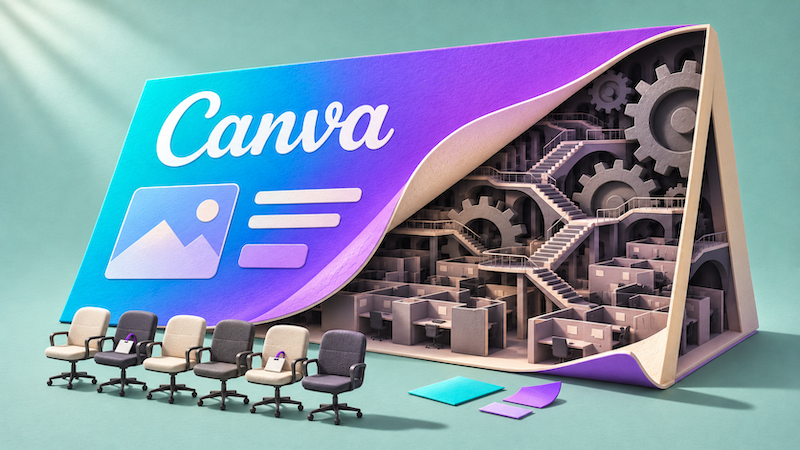
Canva is restructuring 1,271 roles, about 22 percent of its workforce, in a move co-founder and CEO Melanie Perkins described to staff as the hardest moment in the company's 13-year history. The number includes layoffs alongside people whose roles are changing and people being asked to move to central hubs, measured against a pre-cut headcount of roughly 5,800. Canva hasn't said how many of the 1,271 are leaving outright.
For most of the past decade, Canva was the company other software founders pointed to when someone said you couldn't grow fast and make money at the same time. It has been free-cash-flow positive for nine years, held $1.47 billion in cash at the end of June, and had never run a mass layoff before this week.
Perkins' memo doesn't claim AI is doing anyone's job at Canva, which puts it at odds with most of the big tech layoffs this year. Block tied its February cut of roughly 4,000 people, about 40 percent of staff, directly to AI tools. Meta let go of about 8,000 people in May to help pay for its AI push, then called off a planned second round after the AI agents meant to absorb the work underdelivered, according to Reuters.
What Perkins told staff
Perkins gave staff two reasons. According to Dealroom's summary of the memo, she said 2026 had been Canva's hardest year and that growth had slowed for the first time in a decade. She also argued that the company's structure had made it harder for teams to own work that crossed departments. Small changes wouldn't fix either problem, she concluded, and she wants to "refound" Canva around small teams with fewer handoffs and fewer layers of management.
Canva is folding Product, Growth and Platform into one product organization after finding that improving any one part of the product meant handoffs across all three groups. Specialist roles will get broader. Sydney becomes the main base for more product teams, and from January most hybrid staff will be expected in an office two to three days a week, a reversal for a company that described itself as remote-first.
New technology gets only a passing mention. Perkins wrote that it is changing what people make and what they expect from software, and Newsweek read that as a description of pressure on the business and its future hiring, with no suggestion that software is taking over the work of the people leaving. Canva's numbers since the summer support her version.
The AI hit came in August
Canva's AI problem showed up on the cost line first. In a letter to shareholders this summer, Perkins said the company had slowed the rollout of its AI tools after finding that the average cost of serving each AI request was too high, and Canva lowered its 2026 revenue growth forecast from 30 percent to 20 percent. Second-quarter revenue came in at $921.9 million, up 25.2 percent and below Canva's own guidance.
Investors repriced the company within days. Blackbird and Airtree marked Canva down from $42 billion to $34.9 billion, and the internal valuation that sets the price for employee share sales fell from $38.9 billion to $31 billion. Co-founder Cliff Obrecht has since pushed the expected IPO to 2027.
Canva says it has largely dealt with the cost side. Obrecht told Forbes Australia the company has cut the cost of serving AI by 90 percent, helped by in-house models such as the image model Canva Craft and by Leonardo.ai, the Sydney startup Canva bought in 2024. Our sister publication State of AI walked through the economics in September: a subscription priced once a year, sitting on top of compute that gets billed every time someone hits generate.
The free tier has competition now
Since its 2013 launch, Canva has sold the idea that anyone can make something professional-looking without training as a designer. A generous free tier carried it to 265 million monthly users, 31 million of whom pay, and to roughly $4 billion in annualized revenue by the end of 2025. People signed up for a free birthday invite or a slide template, and a share of them ended up on Pro or brought Canva into their company.
Over the past year the general-purpose assistants started making the same offer. ChatGPT and Gemini can turn a prompt into a poster or a presentation, and startups like Gamma have added image generation aimed squarely at Canva and Adobe customers. Adobe put Photoshop and Express inside ChatGPT last December. In September, Google made its Pics image app generally available to AI Pro and Ultra subscribers and to several Workspace tiers, with output going straight into Docs and Slides.
Someone who already has ChatGPT open at work can get a usable event flyer there without ever visiting canva.com, and Canva never gets the chance to turn that person into a paying customer. Spread across hundreds of millions of casual users, that leakage likely accounts for much of the slowdown Perkins described to staff.
Figma is feeling its own version of the squeeze on the cost side. Its free-cash-flow margin dropped from 27 percent to 14 percent between the first and second quarters of 2026, and it guided third-quarter growth to 36 percent, down from 48.
Where Canva is placing its bet
Canva has spent the year putting itself inside the assistants that threaten it. In February it connected Brand Kits to ChatGPT, so designs generated in a chat window pick up a company's own colors, fonts, logos and layouts, a week after launching the same connection in Claude. By then its MCP server had already produced more than 12 million designs across ChatGPT, Claude and Microsoft Copilot.
That moves Canva's value away from the editor and into the brand system underneath it, which is the argument its B2B CMO Meghan Gendelman made in an essay we covered in June. Canva's brand management page now leads with its own survey finding that 94 percent of marketers say AI is eroding brand consistency. Folding product, growth and platform into a single group makes sense for a company that expects more and more of its product to be used from inside someone else's software.
The buyers for that version of Canva are enterprise brand teams, and it already has them. According to State of AI's reporting, 95 percent of the Fortune 500 use Canva.
How it treated the people leaving
Departing employees get at least six months' salary, 12 months of healthcare where Canva currently provides it, and 12 months of its employee assistance program, extended to family members. They keep their Canva MacBooks and keep Slack and Gmail access until the end of the week so they can tell colleagues themselves. A new Canva Collective Fund will offer $10,000 grants to anyone who wants to start a business or a community project, with Canva taking no equity. Mark Di Stefano, who edits the Australian Financial Review's Rear Window column, called the package exceedingly generous. Wael Sabra, CEO of SiiRA, traced that generosity back to timing:
Canva "intervened early," while it was still in control of the business, and cut deep enough to look after the people leaving as well as the ones staying.
 Wael SabraCEO, SiiRA
Goodwill is most of Canva's brand, so the handling matters. At Meta, Reuters reported that repeated layoff warnings, along with a program that logged employees' clicks and keystrokes, hurt morale badly enough that the company paused the tracking. Most of Canva's customers will hear about this layoff from the people who went through it, and the package gives those people less to be angry about.
What it means for teams on Canva
If your team's creative work runs through Canva, the product you pay for is heading toward brand governance that plugs into whichever AI assistant your colleagues already use. Now is a good time to find out where your brand kit lives and who has the keys to it.
Plan for pricing to move. The Information has reported that Canva is shifting toward usage-based pricing and leaning on smaller, cheaper models, and Canva recently folded the previously free Remove.bg into its paid plans. Unlimited AI generation tucked into a flat seat price was always going to be hard to sustain, and Canva is unwinding it faster than most.
Brand leaders should also note where Canva now thinks the money is. An acceptable asset costs one prompt, so the company is reorganizing to sell the harder job of keeping thousands of AI-made assets consistent with a brand, and to sell it to the teams responsible for that work.
The memo is the first draft of the IPO pitch
Canva will go to public investors in 2027, and this week's memo is the earliest version of the story it will tell them. Perkins could have presented the cuts as an efficiency gain from AI, the framing Block used in February and the one markets have mostly rewarded. Instead she told staff that the company had slowed down and organized itself badly, an admission that will be hard to walk back.
Investors will hold her to it. Productivity claims are easy to repeat on an earnings call, but a company that blames its own structure has to show the new one working, and the first place anyone will check is growth. Canva has guided to 20 percent for 2026 and says its AI costs are down 90 percent. If the merged product organization can turn those savings into a free tier that keeps converting while ChatGPT and Google Pics give away image generation inside subscriptions people already pay for, the 2027 prospectus gets a lot easier to write.
If it can't, Canva goes public as the best-loved brand in design software with a growth rate that looks like everyone else's, and the November 10 all-hands will read in hindsight as the start of a longer correction.