Phoebe Bridgers Looked Like She Was Opting Out of Marketing. It Was the Most Orchestrated Campaign of the Year.
Six years of silence, a dozen unannounced shows, forty planetariums, and more than 300 record stores. Underneath the aesthetic is the most copyable partner playbook in recent memory.
Make State of Brand one of your go-to sources on Google

The line outside The Liberty in Roswell, New Mexico started forming at three in the morning on May 8. By sunrise it ran down North Virginia Avenue and around the corner onto Second Street. The Roswell Daily Record found people waiting under umbrellas in the heat, among them a woman who had flown in from Brooklyn. Nobody in that line had bought a ticket online, because there were no tickets online. There had been no announcement either, just a printed flyer stapled around downtown that fans photographed and passed around a few days earlier.
The Liberty holds 400 people. Phoebe Bridgers had not played a solo show in three years. The flyer said no phones.
Ninety-eight days later, her third album debuted simultaneously inside more than forty planetariums on four continents, and then again at midnight inside independent record stores in over 300 cities.
That distance, from a stapled flyer in a town of 48,000 to a coordinated global release staged in other people's buildings, is the story of the Lost Weekend campaign. It is also roughly the opposite of how the campaign has been covered.
What it actually took
The dominant read on this rollout is that Bridgers opted out. No social media, no interviews, no content, no algorithm to feed. A retreat from the machine.
She did give no interviews, and the campaign does feel handmade. But there was no retreat anywhere in it. Releasing Lost Weekend the way she released it required Spotify, Tidal, YouTube, Dead Oceans, COSM, Yondr, Laser Fantasy, a National Geographic photographer, a fine-art photographer, four music video directors, more than forty science museums and planetariums, and several hundred independent record shops. Most of those partners had to be recruited, scheduled, supplied with exclusive inventory, and briefed on a phone confiscation protocol.
So the campaign involved a great deal more marketing than a normal album cycle, arranged so that almost none of it arrived through a feed. The handmade quality was expensive to produce. Any growth team reading this as "go quiet and let the work speak" will go quiet, and nothing will happen.
The mechanism was something else, and it travels better than the vibe does.
Six years of stored demand
Punisher came out in June 2020 and turned Bridgers from a critically admired songwriter into a generational one. boygenius, her trio with Julien Baker and Lucy Dacus, released the record in 2023 and swept the 2024 Grammys. Then she stopped. After the ceremony she said she was taking the rest of the year off, and the hiatus ran through 2025. She barely posted to three million Instagram followers. In the days before Roswell, she cleared the account entirely.
Some of that was rest and some of it was grief. Her father died in 2023, and the album is substantially about him. Worth being careful here, because the campaign draws part of its power from the fact that the silence was not a marketing decision in origin.
It became one in application. By May 2026, Bridgers held something most brands never accumulate: a large, attentive audience that had received nothing from her in two years. The demand had nowhere to go. Fan accounts had spent the interim parsing her mother's Instagram comments for clues.
Every move that followed spent that reserve in increments and refused to spend it all at once. The rollout was not generating demand so much as metering demand that already existed. Whether that distinction applies to your business determines whether any of this is useful to you, and we will come back to it.
May: build the scarcity
The pop-up run covered a dozen-plus shows in roughly six weeks. After Roswell came Lubbock, then Jackson, Mobile, Macon, Greenville, Chattanooga, Lexington, Champaign, Toledo, Fargo.
Look at the map. No New York, no Los Angeles, no Austin, no Chicago. Mid-sized and small American cities that rarely get a Grammy-winning headliner in a 400-cap room, picked, as far as anyone can tell, for exactly that reason. In Roswell the show was front-page local news, and a fan told the paper it was a once-in-a-lifetime thing for the town. That coverage is unpurchasable in a major market, where the same show is a Tuesday.
Three operational choices defined the phase.
The announcements were analog. Flyers only, no posts, no email, no paid. Fans found the flyers, photographed them, and distributed the news themselves. Reach was entirely earned, and discovering the show was the thing worth posting about, which meant the no-social-media policy produced more social media than a post would have.
Purchase was physical. Tickets ran around $50, sold at the box office, first come, one per person. No platform, no fees, no resale, no scalpers. Nobody could buy their way in from a distance.
Phones were confiscated. Every show used Yondr pouches, with devices locked on entry. She debuted somewhere between three and six unreleased songs across the run, and almost nothing leaked. A handful of low-quality clips surfaced against what would normally be a full shadow catalog on YouTube within hours.
Together those choices amount to one decision: make the experience non-transferable. If you were not physically present you got nothing, no stream, no bootleg, no highlight. There was no consolation prize.
That constraint is what everything downstream monetizes.
June: the release valve
On June 1, posters appeared in New York subway stations announcing a Madison Square Garden show three days later. Tickets were one dollar.
Tidal presented the show. Registration ran through a lottery on Seated, an artist-direct ticketing platform, bypassing Ticketmaster and SeatGeek entirely. Winners paid a donation of $1, $5, $10 or $20, up to two tickets, with proceeds going to the Community Justice Exchange's Immigration Bond Freedom Fund, which posts bond for people held in immigration detention while their cases proceed.
Six weeks of extreme scarcity in rooms of 400 had built up pressure that a 20,000-seat room could partially discharge, and it discharged without breaking a single principle. Still announced analog. Still off-platform. Still not purchasable in any ordinary sense, since a lottery is a scarcity mechanic wearing an equity costume, though in this case it also produced a real donation flow and a real political statement.
The Lost Tour was announced the following day, with campaign photography by Gregory Crewdson, whose staged suburban tableaux are among the most recognizable images in American art photography. The album itself was not announced until June 24. The sequence matters: shows first, record second. Fans had been hearing this material live for seven weeks before they learned what it was called.
August: 350 partners
Between August 10 and 14, Lost Weekend played in full inside more than forty planetariums across thirty-four cities, twenty-five of them in North America and nine overseas across the UK, Ireland, Australia and New Zealand. Adler in Chicago. Morrison in San Francisco. Cité des Sciences in Paris. Melbourne Planetarium. Liberty Science Center in Jersey City, the largest dome in the country. Also the Museum of the Rockies in Bozeman, the Eugene Science Center, and a planetarium at Orange Coast College.
Each session paired the album with one of two dome presentations: a night-sky film by National Geographic photographer Babak Tafreshi, cut from two decades of nocturnal footage shot in nearly twenty countries with no CGI, or an immersive laser show by Laser Fantasy. Phones went into Yondr pouches. The whole thing ran about an hour. Bridgers did not attend, and the listings said so plainly, since this was not a performance.
Then on the night of August 13, independent record stores in more than 300 cities opened at 11 p.m. and played the album an hour before its official midnight release. Stores that hosted received an exclusive pressing, a white-label edition on Zodiacal Light vinyl, iridescent white shot through with blue and glitter, available only in the store, only during the event, only at participating shops. Some had black-light keychains and embossed stickers to give away.
That vinyl variant is the most instructive object in the campaign.
Co-marketing where the partner gets a logo placement and a shared blog post is a favor, not a partnership. Partners work the event when the event is theirs to profit from. Bridgers handed several hundred independent retailers a product nobody else on earth could sell, on a night when their competitors were closed, to a customer base that had waited six years and could not hear the record anywhere else at that hour. Those stores were running their own launch, with her inventory, in their own market, for their own margin.
Multiply by 300. The result is a national release built almost entirely out of other people's real estate, staff and customer relationships, with every partner commercially motivated to promote it locally.
The planetariums are the same structure with different economics. Institutions with dormant evening capacity, an existing local membership, and an audience they rarely reach otherwise. Both groups got the one thing that made participation worth the trouble, which was the ability to sell access to something scarce.
The scarcity Bridgers manufactured in May was not the campaign's message. It was the product she gave her partners to distribute.
What it cost, and who got left out
Two caveats belong in any honest version of this.
The rollout selected hard for the most devoted slice of the audience. The pop-up shows were divisive at the time, as The Forty-Five pointed out, and for good reason. Analog announcements plus in-person, first-come sales means access went to whoever could drop everything, travel to Roswell or Fargo, and sleep on a sidewalk. That filters for time, money, mobility and health. The Brooklyn fan who flew to New Mexico got in. The Roswell local with a Friday shift did not. Community-led strategy that rewards superusers is, by construction, excluding the median customer, and if your median customer is the one who signs contracts, that trade goes worse for you than it went for Bridgers.
The silence was also collateral she had and most companies don't. The music newsletter Capsule, which covered the rollout closely, put it well: not everyone can afford a gap like this. Artists with less leverage have to keep feeding the machine. A category leader who goes dark creates anticipation. A challenger who goes dark just disappears, and the absence reads as failure rather than restraint.
What's actually worth stealing
Forget the aesthetic. Nobody is green-lighting a planetarium tour, and you shouldn't want one. But three things underneath it are ordinary enough to run next quarter.
Give partners something exclusive to sell.
Think about why most co-marketing dies. You build a joint asset, put both logos on it, split the leads, and the webinar lands on your partner's calendar somewhere between a QBR and a dentist appointment. They show up. They do not sell.
Now think about the independent shop in Greensboro on August 13. Doors at 11 p.m. There is a record in that store nobody else on the continent can sell, in a format collectors want, on a night every competitor is dark. That store is not doing Phoebe Bridgers a favor. It is having one of its best nights of the year.
The difference is a supply question, not a relationship question. What can you hand a partner that their competitors cannot get? Maybe your benchmark data, cut to their vertical and embargoed to their list for two weeks. Maybe early access to a feature, released through them, to their accounts first. If a partner cannot answer "what do I have here that the other guys don't," you have a favor, not a channel.
Stop launching once.
Most launches are a single webinar on GA day with a countdown graphic in front of it, and then everyone is surprised that pipeline is flat by week three.
Bridgers ran the same launch five times to five different rooms. Unannounced shows in May. The dollar show in June. The announcement three weeks after that. Planetariums in August. Record stores the night before release. Each room was smaller and more committed than the last, and each one fed the next.
Your version of this is boring and completely available to you. Design partner cohort, then a customer-only preview, then an early access window your partners distribute, then GA, then the field program. Same asset the whole way down. You just stopped spending it all in one afternoon.
Gate for the experience, not for the email.
Nearly every gate in B2B makes the thing worse. You bolt a form onto a PDF, you get an email address, and the buyer thinks slightly less of you than they did before they clicked.
Bridgers gated by format instead. In person, phones in a pouch. The gate improved the product, which is why people slept on a sidewalk to get through it.
You already have versions of this. A dinner capped at twelve where the value is who else is in the room. A peer benchmark that works precisely because outsiders cannot see it. Research where the price of the data is contributing to it. The question is the same every time: does the gate make it better for the people inside, or only worse for the people outside? If it is the second one, you are taxing your buyer for a row in a spreadsheet.
One thing before any of this goes into a planning doc. All of it works on demand that already exists, and none of it conjures demand from nothing. Bridgers could disappear for six years because three million people were waiting for her. If your brand went dark tomorrow and nobody sent a Slack message about it, run the partner mechanics and skip the silence.
_______________________
Image Credit
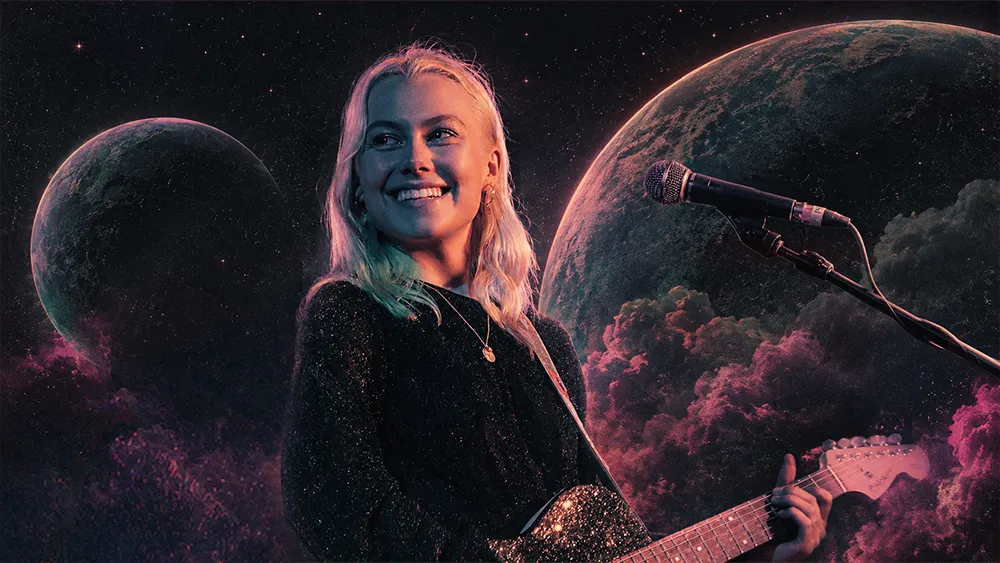
"Phoebe Bridgers" by David Lee (Redmond, WA, USA), via Wikimedia Commons. Image cropped from the original. Licensed under CC BY-SA 2.0 — https://creativecommons.org/licenses/by-sa/2.0/

If this caught your attention, that’s not accidental.

The best editorial systems don’t happen by accident. Outlever builds them.
If this caught your attention, that’s not accidental.

The best editorial systems don’t happen by accident. Outlever builds them.
Come back for the reason it lands.
Subscribe for the kind of thinking that makes people stop, read and come back.