We truly want to partner with customers, with tech players, with anyone in the ecosystem who's got energy around ideating and planning how retail will move forward here.
 Neil ReynoldsGlobal Chief Customer Officer, Mars Snacking
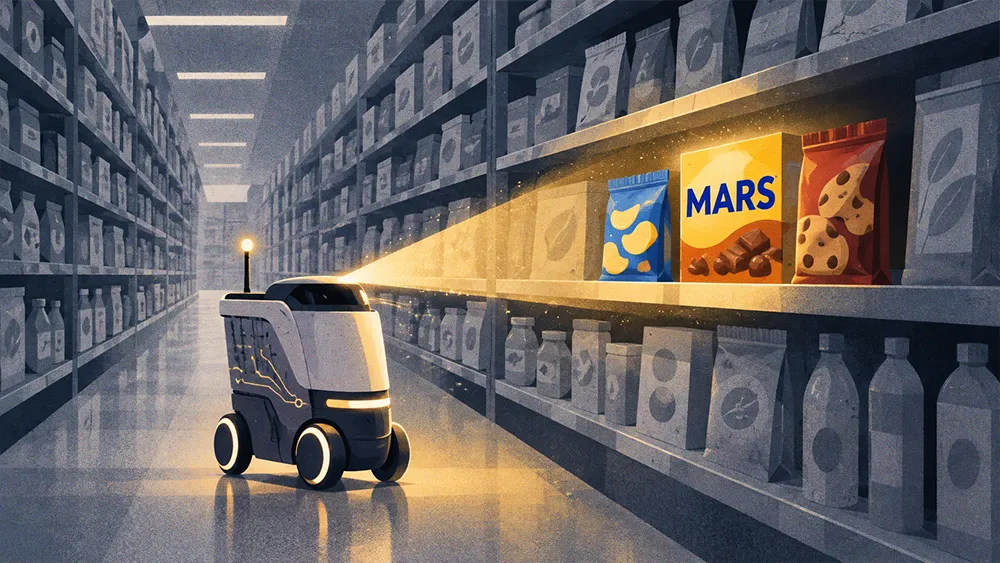
E-commerce brands saw referrals from AI tools jump 752% year over year during the 2025 holiday season. New research from Mars argues that more of a routine grocery run will be automated within a decade. The assistants it describes build the list, restock it, and swap out whatever's unavailable. Snack brands now have to work out which trips they can still reach a shopper on, and what they need to know about them to be chosen.
Neil Reynolds is Global Chief Customer Officer for Mars Snacking, where he owns sales and customer development and sits on the Global Growth Leadership Team. Mars has employed him for nearly all of a 25-year career in consumer packaged goods. Reynolds spent his Mars Chocolate UK years in grocery trading, then category and shopper marketing, and later held the UK Sales Director post at Mars Food. Reynolds also advises both Writer and Shoptalk.
"The way that we compete for share of attention is going to shift. We need to think differently about winning share of the large language model through agentic shopping, to make sure that snacking blips, M&M’s blips, and the retailer blips in that situation," says Reynolds. Reynolds ranks getting picked inside an automated order as job number one, and he wants personalization working behind it so a shopper gets offered something they would actually buy.
The errand and the outing
Reynolds expects technology to take the chore end of shopping first. Ten minutes saved hunting for milk at Walmart is ten minutes a shopper can spend in a store they actually like, and he splits retail along that line.The distinction sits at the heart of Mars' future-of-retail outlook. The company envisions a "two-pronged" shopping landscape, where routine replenishment purchases become increasingly automated through AI-powered assistants, while physical and digital retail environments evolve into destinations for discovery, inspiration, entertainment and human connection. "If I think about the duality of retail, let's all be honest, as consumers, there are some retail outings and visits that we all love and there are some where you fight at home with your better half to see who's actually going to go out and do it," he notes.
People buy the same things on those trips, on roughly the same schedule. Technology handles repetition well, and Reynolds expects more of those trips to move over to it. The job that remains is delivery. "The trick there is really to match together your preferences with inventory and fulfill that as quickly and as easily and as effortlessly as possible," he advises.
The research looks ten years out. Reynolds treats that as a reason to start now, and he's pushing the rest of the industry to do the same. "Every time I log into my Amazon app on my phone, I get a slightly different experience to the one I got yesterday, so we know the pace of change is accelerating," he says.
Data for the occasion
Thirty-nine percent of consumers now say they want personalized online experiences, and every retailer and brand in the category holds the shopper data to build it on. Mars adds what it knows about why people snack. "How can we take the multi-million, multi-billion data points that we all have around how shoppers shop, what their preferences are, what their baskets are, what their audience type or social demographic indicator is, and put that together with the trends and the drivers that we know drive the snacking category?" asks Reynolds.
Mars builds its own category around four moments: connections, indulgence, refueling and healthier intentions. The company matches a shopper's signals to those, picks which of its own brands to put forward, and leaves the rest out of sight. "It means you get a short list. You don't get a long list of 97 things you might be interested in. You get three things which you're very likely to buy into," says Reynolds.
Protein, fiber, and wearables
Health is also now changing what a shopper wants out of a snack. High protein, high fiber, and GLP-1 medications are all reshaping the category, and Reynolds expects shoppers to make their own calls about all of it. "People may well choose to snack on different things, snack at different times, and will take control of their own snacking moments," he says. "We believe that enabling consumers to make informed decisions is critical."
Mobile health and wellness apps are growing 15% a year through 2030, and a shopper can now read their own health off their phone. Reynolds has been running the experiment on himself. "I've just invested in an Oura ring myself, and I'm learning things about my own health and wellness journey that I didn't know even four weeks ago," he notes.
Making those calls takes ingredient and nutrition information. Mars already prints it on every pack, and Reynolds wants it reaching a shopper at the point they choose. "What better way to do that than through agentic engagement, where the great product details and what actually makes up our products can shine through to you as a consumer? You can make an informed decision about what you consume, when you consume it and how you consume it," he says.
Trends that travel
A snacking trend that starts in one market tends to reach the next one as well. Mars built its ten-year view on more than 180,000 data signals across four continents, and it operates in enough markets to watch a trend move between them. "The way we think of it is that trends that emerge from one region or one market will probably transcend throughout different markets in the globe. We want to take advantage of our global footprint through seeing a trend in one market and being able to foresee that and plan for that in our other markets around the world," says Reynolds.
Mars could have kept the research to itself. Reynolds sees a shopper journey running across apps, retailers, and stores as too large for any one company to design. He would sooner have the whole industry working on it. "We truly want to partner with customers, with tech players, with anyone in the ecosystem who's got energy around ideating and planning how retail will move forward here," he concludes. "Our belief is no one player can do it by themselves. We've published the research because it's in the benefit of the whole industry."