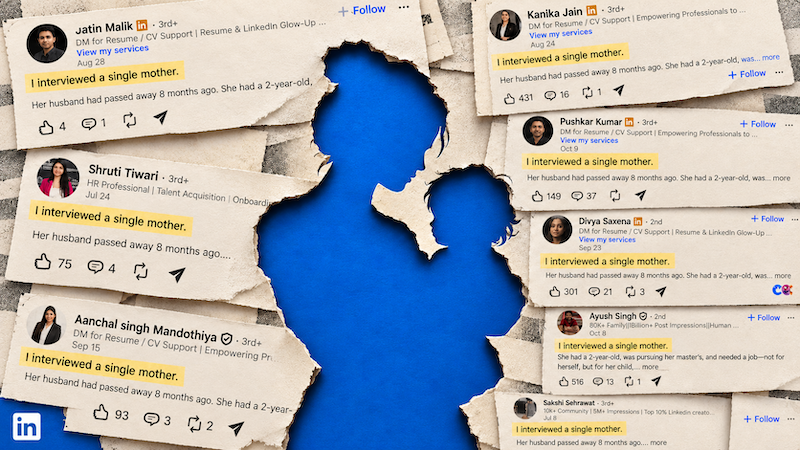
On October 9, a LinkedIn user who advertises resume services posted a story that began, "I interviewed a single mother." Her husband had died eight months earlier. She had a 2-year-old, was working on a master's degree, and needed a job for her child's sake more than her own.
The day before, a different account had posted the same story. So had at least six others going back to July 8, nearly word for word, and each poster described themselves as the person who conducted the interview. Joe Meier collected several of them in a post that has spread widely in the past few days. The profile photos and headlines change from post to post, while the widow, the toddler, the master's degree and the eight months stay the same.
It is possible that one woman was interviewed by eight different people who each chose to write about her in the same words. It is far more likely that none of them interviewed her.
The timing helps explain why the story keeps getting posted. The Skillsyncer tracker counted more tech layoffs between January and late September than in all of 2025, and the median job search now runs 4.7 months, State of Brand reported this month. People in that position spend a lot of time on LinkedIn, some building audiences they can take with them and others posting their wins often enough that the people deciding who stays can't miss them, a habit State of Brand compared to last-click attribution for your career. They are the readers this story is written for.
LinkedIn has spent the year trying to clean up its feed. It added a button in July for members to flag AI slop, and flagged posts now lose reach. It has gone after engagement pods, and in September it started testing a Network tab that shows only posts from people a member chose to follow. None of that has slowed this story down, probably because it reads as a personal anecdote rather than machine writing.
Most of the posters sell resume help
Several of the accounts carry nearly identical headlines, such as "DM for Resume / CV Support" and "Resume & LinkedIn Glow-Up," with a "View my services" link under the name. Most of the people sharing the story sell career help to job seekers, who are also the readers most likely to be moved by it.
A story about a struggling mother looking for work is useful to someone in that business. It suggests the poster understands what job seekers are going through, and the profile headline directs readers to a paid service in the DMs.
Posts that do well on LinkedIn tend to get copied. Some are passed around in creator groups or sold in collections of "viral post" templates, and others are lifted by people who watched them perform. Some of the accounts posting the single mother may have no idea where the story started.
Same words, different reach
The reaction counts vary widely even though the text is the same. One copy got 4 reactions and a single comment. Others got 75, 93, 149, 301 and 431, and the best-performing copy reached 516, about 129 times the lowest.
Because the wording never changed, the gap has to come from somewhere else, such as the size of each account's following, when the post went up, how much early engagement it got and whether a pod was involved. How far the story traveled depended much more on the account posting it than on the story itself.
Much of the feed is machine-written
The recycled story fits a wider pattern on the platform, where a large share of long posts are no longer written by the people who publish them.
In July, AI detection company Pangram published an analysis of roughly a million posts that users scrolled past between April and June 2026 on LinkedIn, X, Reddit, Medium and Substack. LinkedIn had the highest rate, with about 41% of its long-form posts (250+ words) flagged as fully AI-generated. It made up about a third of the posts scanned and nearly two-thirds of the AI content detected, The Decoder reported.
An earlier study by Originality.ai put the share of likely AI-written long-form LinkedIn posts at 54% as of October 2024, after a 189% jump following ChatGPT's launch, according to eWeek.
LinkedIn also offers its own AI writing help through an "Enhance post" button in the post composer, Fast Company noted, so some of that content is produced with the platform's own tools.
A dead internet with people in it
Dead internet theory started in 2021 as a forum post by a user called IlluminatiPirate, who argued that most of what we see online is bots talking to bots. The Atlantic covered it that year and called it wrong, but true-feeling. For several years most people treated it as a conspiracy theory.
More prominent people have taken it seriously since. In September 2025, Sam Altman wrote on X that he had never taken the theory seriously but was now seeing a lot of LLM-run accounts. A few weeks later, Reddit co-founder Alexis Ohanian said much of the internet was now dead and named "LinkedIn slop" as part of the reason. Imperva estimated that bots generated 51% of all web traffic in 2024.
The single mother posts don't fit the theory neatly. Each account has a face, a name and a job title, and at least some of them are run by real people. The theory described bots pretending to be people. On LinkedIn, people are posting the same script at volume, as a bot operation would, and for the same reason, because it brings in business.
Why a copied story does more damage than AI slop
A post written with AI misleads readers about who wrote it. The ideas may be generic, but the person posting usually agrees with them.
The single mother story misleads readers about what happened. "I interviewed" is a claim of firsthand experience, and the post uses that claim, along with the grief of a woman who may not exist, to sell resume services.
Fabricated testimony also costs people who never posted it. Each time an invented first-person story spreads, recruiters, founders and hiring managers with true stories have a harder time being believed.
State of Brand made a version of this argument about companies in August. The Great Convergence traced how firms that bought the same capabilities from the same vendors ended up with the same frameworks and then the same messaging, and noted that "nobody decides to sound like everyone else." The single mother is a smaller version of the same process, a story that worked once and was then copied by people who each made a decision that seemed reasonable at the time.
Dead internet theory imagined feeds full of bots. On LinkedIn, much of the feed is people reading from the same script.
Who pays for a copied story
Most of the cost of a counterfeit story falls on people who didn't post it. Founders, recruiters and marketers telling true stories now face readers who have learned to discount any post that opens with "I interviewed."
Specific details are harder to copy, such as a customer who agreed to be named, a date, a number or an account of what went wrong. State of Brand has reported that the writing that builds a reputation tends to be specific to the person's work, including what went wrong. Readers are also getting better at spotting stories that could have come from anyone.
The posts raise a question about how marketing teams read their own LinkedIn numbers. The same words got 516 reactions on one account and 4 on another, so the engagement measured distribution rather than whether anyone believed the story. Marketers have run into this before with platform-reported ROAS, where the channel reporting the result is also being judged on it.
Each time pods and slop have filled LinkedIn's feed, the company has responded by leaning on members' own networks, which suggests which kind of reach the platform trusts. A copied story can travel a long way through the algorithm, but it does much less well among people who actually know the poster.
The story economy
LinkedIn still has plenty of people on it. What has changed is that many of them have learned a borrowed story can outperform a true one, and that almost nobody checks.
There may once have been a real single mother, and a recruiter who was moved by meeting her. After eight retellings in three months, the story says nothing reliable about her or about anyone who posted it.
The longer that goes on, the harder it will be for anyone on the platform to be believed when the story they tell is true.