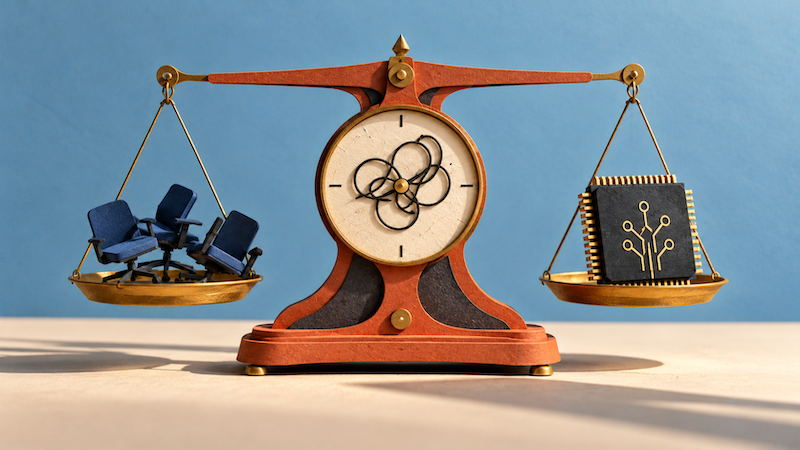
B2B marketers used to have years to enjoy a product or content advantage before competitors caught up. A brand voice can now be imitated with a single prompt, which changes where next year's budget should go.
For most of the last decade, B2B companies had a familiar sequence for staying ahead. They competed on product until rivals matched the features, then on content volume until every competitor had a content team, and then on brand voice, which they documented in style guides and defended in every campaign.
That sequence has stopped working. Competitors can match a feature within a quarter, and a passable ebook costs almost nothing to produce. A brand voice that took years to refine can be reproduced by anyone who pastes a company's last fifty LinkedIn posts into a chatbot, and many competitors have already done it.
Buyers notice. We reported earlier this year that 54% of Americans describe AI fatigue and 52% pull back once they suspect a machine wrote what they're reading.
The buying process has also moved somewhere most brand teams can't see. G2's March 2026 survey of 1,076 software buyers found that 51% now start research in an AI chatbot, and 69% bought from a different vendor than they originally planned because of what the chatbot told them. Those chatbots mostly don't rely on company websites. AirOps' 2026 State of AI Search report found 85% of brand mentions in AI answers come from third-party pages, which we wrote about in September.
At State of Brand, we think marketing teams that keep producing more assets in a voice anyone can copy will spend more each year and get less attention for it. Below are the ten areas where we'd put 2027 budget instead.
Smaller events are getting more of the budget than big booths
In-person events are one part of marketing AI can't produce, and event budgets reflect that. Forrester's Q1 2026 State of B2B Events Survey of more than 400 event decision-makers found that most teams plan more networking events with fewer than 200 people, while only 18% plan more large hosted events. Two-thirds plan to add workshops and roundtables. In Bizzabo's 2026 benchmark, 78% of organizers called in-person events their most effective channel, according to NZ Marketing.
For many B2B companies, a dinner for twelve buyers in a key account's home city will do more next year than another booth at a conference where most vendors are showing similar AI demos. The teams getting the most from these events also record the conversations and publish what attendees said, so a room of twelve people produces stories that reach thousands.
Customers are a more credible source than company copy
Most B2B companies have hundreds of customers, and very few of them are ever heard from beyond a logo on a sales slide. A named practitioner describing how they solved a specific problem is hard for generic AI content to imitate, which makes those customers more valuable to marketing than they've been in years.
They matter to AI engines too. Models give less weight to what a company says about itself and more to independent sources, so a customer quoted in a trade story or speaking on a panel helps a vendor in ways its product pages can't. G2's research found that 85% of buyers think more highly of a vendor when a chatbot recommends it.
The customer programs we see working treat customers as experts on their own field. Marketing teams interview them about the problems they're dealing with, publish those conversations, invite them to speak at events and make it easy for them to share the results. The PDF case study, with its stock photo and three-line quote, does very little by comparison.
The trade press is shrinking, and companies are filling the gap
The reporters who explained B2B categories to buyers are being laid off one beat at a time. As we reported this week, some McClatchy newsrooms lost upwards of 40% of their staff, Future plc told investors its audience fell roughly 20% in each of its last two halves, and one analysis now counts about six PR people for every working journalist. Niche trade beats are usually cut first because they never drew much traffic.
A few companies have started covering their own industries. Ford hired a former AP bureau chief as editor-in-chief, Autodesk advertised for an editor-in-chief, and Robinhood built Sherwood as a standalone media brand.
The efforts that work cover the whole category. That includes news that never mentions the company, moves by competitors and the problems buyers are trying to solve. Over time, a company that does this well becomes a regular source for buyers, journalists and AI engines trying to understand the market. Coverage limited to a company's own roadmap rarely gets there.
Newsjacking works better than evergreen content now
Any AI model can write an ultimate guide to a software category. It can't tell buyers what this week's acquisition, regulation or earnings call means for their budget, in the words of someone who has done the job. That gap is the case for newsjacking in 2027.
In B2B, newsjacking should mean publishing a reported take within a day of a news event and connecting it to decisions your buyers are making. It needs a source, a number or an informed opinion. A rewritten headline adds nothing a buyer couldn't get elsewhere.
Speed is usually the hardest part. Many marketing teams still send a 600-word article through four weeks of approvals. Teams that do this well agree on guardrails with legal and comms ahead of time, keep a short list of internal and customer experts willing to comment quickly, and assign someone to read the industry news every morning and flag what matters to their buyers.
Marketing teams should run more like media companies
The campaign model still shapes most B2B marketing calendars. A team briefs an agency, produces a major asset, puts it behind a form, promotes it for about six weeks and then starts over. In 2027, that asset will be competing with a large volume of similar AI-generated material that cost very little to produce.
A team run like a media company publishes every week or every day and builds an audience that returns. Its archive keeps getting picked up by search engines and AI models long after a campaign would have ended. A research report that a campaign team would gate can become ten stories, and a customer event can become twenty interviews.
The difference also shows up in staffing. These teams usually have a masthead, a defined beat and at least one editor with newsroom experience. They're measured on audience size, citations and influence on pipeline more than on downloads per launch, and they treat the company's remaining campaigns as material for coverage.
Employees and executives reach more people than company pages
Company pages are losing reach. Metricool's 2026 LinkedIn study found personal profiles averaged a 2.60% engagement rate, compared with 1.60% for Company Pages, and LinkedIn is testing a Network tab that shows members only posts from people they follow, as we covered last week. In September, Satya Nadella told Microsoft's engineers, sellers and partners he wants them to play a bigger role in how the company explains itself.
Most employee advocacy programs work against themselves. They give employees a pre-written post about the company and ask them to share it, and the result reads like an ad. LinkedIn's crackdown on engagement pods also makes coordinated talking points riskier.
Our publisher, Outlever, takes a different approach. Its view is that people become a company's social engines when the company features them as experts. Executives, employees and customers are interviewed by an editorial team and published in an industry publication. Each person gets a story about their own work, plus a shareable link and quote card, and most post it because it reflects well on them.
Across dozens of executives, customers and partners, the publication reaches networks a company page never would. Each new story also adds to the coverage AI engines draw on.
AI search visibility depends on what others publish about you
When a buyer asks ChatGPT or Perplexity about a category, the answer is built mostly from what other people have published. A Muck Rack study of 25 million links cited by ChatGPT, Claude and Gemini found 84% came from earned media, as we noted this week. Meltwater found that an identical piece of content was cited 8% of the time on a brand's own site and 34% of the time on a third-party outlet. A Search Engine Land study found 52.2% of AI-cited passages contained original or owned data.
That makes AI visibility behave more like brand equity than like traditional SEO. It accumulates over time as reported stories, named experts and original data keep appearing in sources the models trust. Few companies are measuring it yet. A McKinsey survey of Fortune 500 consumer-brand CMOs found only 16% systematically track how they show up in AI search.
This is the other half of Outlever's argument. An industry publication produces the kind of sourced, dated material with named people that AI engines tend to cite, and the people featured in it share it on social media. A company website still matters, mostly as the page buyers visit after an AI tool has already introduced them to the company.
Cover the news your buyers follow
Most buyers don't read general industry news. They follow the stories that affect their budget, their team or a decision coming up soon. A company that reliably covers those stories can become part of a buyer's weekly reading, and that habit is hard for competitors to replicate with generated content.
The beat should be chosen around the buyer rather than the product. A security vendor's buyers care about breaches, regulation and questions from their board. A martech vendor's buyers care about budgets, AI adoption and what peers are doing with headcount. Neither group is looking for feature announcements.
One way to judge the coverage is to imagine a buyer reading it every week for six months before a first sales call. If that buyer would understand the market better as a result, the program is working. Returning readers are worth tracking with the same attention as pipeline.
A brand voice that fits in a style guide can be copied
Anything written down in a voice guide can be fed into a model. What can't be copied is a particular person's judgment, such as a CFO who has managed through three downturns or an engineer who knows why a migration failed. A customer who switched vendors and will explain why on the record falls in the same category.
AI is useful for research, transcription, first drafts and distribution. The substance still has to come from people, and buyers are starting to reward companies that make that clear. We've written about brands that position themselves against AI-generated content entirely, and Clay and Vanta have both put formal AI writing policies in place.
Companies that want to be distinct in 2027 will also need to take positions. A company that never disagrees with anything in public ends up sounding much like the average answer a model would give.
Measure presence before pipeline
A publishing program judged only on MQLs per quarter rarely survives its second budget review. Its early results show up elsewhere, in AI answers, in buyers' feeds, at events and in what prospects already know when they reach sales.
Pipeline is still the number that matters most to the business, but it lags. Earlier signals include how often AI engines mention the company for the prompts that define its category, how many third-party sources cite it, how many people it has featured and how often they share their stories, and how many readers return each week. Asking every new customer how they first heard about the company catches a lot that tracking pixels miss.
Teams that agree on these measures with finance at the start are more likely to keep their programs running long enough to see results. Teams that skip that step often drift back to campaign planning within a year.
We run this model ourselves
We should be upfront that this is the business our publisher is in. State of Brand and its sister publication, State of AI, are both run by Outlever as its own media properties, using the same model it builds for clients.
State of Brand covers brand strategy and category positioning for CMOs and marketing leaders. State of AI covers AI inside large companies for the engineering, security, data and brand leaders who make AI decisions. In the past week, State of AI has published stories on Accenture capping workplace AI spending, Bank of America's warnings about the AI boom and AI labs bidding for bankrupt companies' data. We covered Microsoft's communications reorganization within weeks of the internal memos.
Most stories on both sites start as a roughly 20-minute interview with an operator or executive. Contributors pay nothing, review their story for accuracy before publication and receive a link and quote card to share. Many of them do share it, which is how the publications reach new readers, and the archive gives AI engines sourced, dated material to cite. Running our own publications also lets Outlever test editorial and distribution decisions in public before using them for clients.
We think the model works. We're also obviously not neutral, so weigh the argument with that in mind.
Our take
As AI makes content and copy cheaper to produce, we expect the B2B brands that stand out in 2027 to be the ones built visibly around people. That means buyers meeting in small groups, customers speaking on the record, and executives and experts covering their industry as the trade press shrinks.
This work takes longer to start than a campaign, and it's harder to attribute. Its value also tends to grow over time, while most AI-produced marketing loses value as more of it appears. Buyers are still asking questions about every B2B market, and we think the companies that answer them through their own people will be the ones AI engines recommend.
Disclosure: State of Brand is published by Outlever, which builds owned media programs and brand newsrooms for companies and is mentioned in this article.