Shopify's CEO Says Employees Are Throwing 'AI Slop Grenades' at Each Other
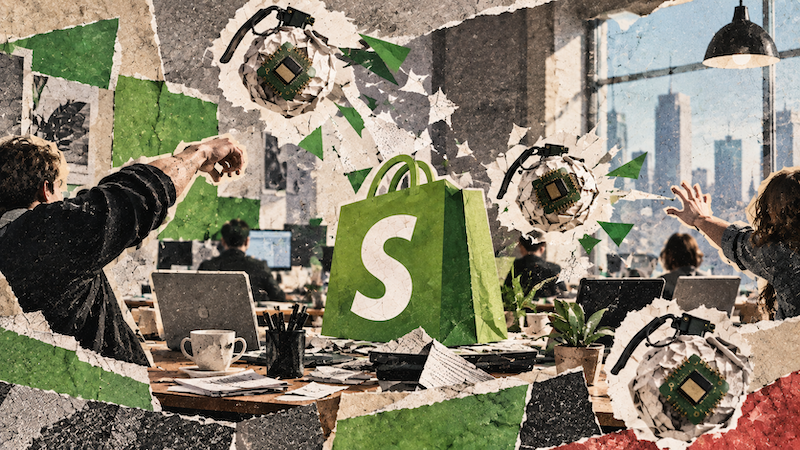
Shopify CEO Tobias Lütke says employees are lobbing "AI slop grenades," and the real casualty is your brand.
Make State of Brand one of your go-to sources on Google

You know the move. You dump a half-formed thought into Claude, tell it to make the thing sound professional, read the first paragraph, and send it. For about an hour you feel like a genius, because you produced something long and confident and neatly formatted.
Then one lands in your own inbox. A 30-page report your manager clearly hasn't read, closing with the words "would love your thoughts." So you paste it back into an AI and ask what it's actually saying. At that point a machine is decoding a message another machine wrote for a person who never looked at either one, and somewhere inside that loop, a brand is quietly taking damage.
Shopify's Tobias Lütke has given the thing a name. As Fortune reported on September 17, 2026, the CEO who told his company AI use was a "baseline expectation," and that people should prove they couldn't get something done with AI before asking for more resources, is now dealing with what everyone actually did with that instruction. Speaking on The Knowledge Project podcast, he described employees shipping unreviewed emails and code and calling it finished. He labels the output "slop grenades," and the phrase is well chosen. A grenade never hurts the person who throws it. It hurts whoever happens to be standing nearby when it goes off.
Why this lands on the brand desk
Most of the coverage is filing this under productivity, and that framing holds up. In a study from the Stanford Social Media Lab and BetterUp, researchers found that about 40% of desk workers had received AI "workslop" from a coworker, with each instance costing close to two hours to untangle and adding up to a real financial drag across a large company. Those are real hours and a real number.
We spend our time on brand, though, so let us add the part that number leaves out.
People tend to picture a brand as a logo, a color palette, or the mission statement hanging in reception. What a brand really comes down to is the accumulated experience of what it's like to deal with a company, and the first place that experience gets built is inside the walls. It shows up in the recaps, the shared docs, the Slack threads, the quick note someone fires off before a meeting. Every one of those messages is a company practicing its voice in a low-stakes room before that voice ever reaches a customer.
Slop grenades wreck that practice room. They trade voice for volume and swap a point of view for the flattened average of everything a model has already absorbed. Worse, they teach your own people to distrust anything that shows up in a company document, so the signal you spent years building starts reading as noise to the very people who are supposed to carry it outward.
Trust that the thing in front of you is worth reading is the one resource a brand cannot manufacture more of on demand. Slop spends it as if it were free.
The tell is "would love your thoughts"
Look at how the grenades tend to end. Would love your thoughts. Curious what you think. Open to any feedback.
That language used to signal collaboration. A lot of the time now it signals something colder, closer to an admission that the sender never formed a judgment and is quietly hoping the reader will supply one. The AI produced the content, and the sender handed off the single task it can't do for them, which is deciding whether any of it is good.
For a brand, that decision is the whole job. The reason a company can charge more, attract better people, and earn trust faster is that somewhere in the chain a human being looked at the work and took responsibility for saying this is good and this is us. Lütke's quietest point is his strongest one. He put it plainly on the podcast: machines don't take responsibility, and a person always ends up owning the result. When that person never read what went out under their name, the line of accountability breaks, and the brand is what slips through the crack.
So what actually helps
The answer here has nothing to do with backing away from AI. Shopify isn't reversing course, and Lütke has been explicit that the mandate stands. What separates useful output from a slop grenade is whether a human actually reviewed it and put their judgment behind it before it left their hands.
In practice that means sending less and standing behind more of it. A three-line recap you can defend does more for you than a ten-page one you're hoping nobody scrutinizes, because your brand gets judged on that ratio whether you like it or not. It means treating your name on a document as a promise that you read the thing and you vouch for it, since the moment "I sent it" and "I stand by it" come apart, the trust underneath your brand comes apart with them. And it means retiring "would love your thoughts" as an automatic closer. Form the thought yourself first. Tell people what you think the material means and what you'd do about it, then let AI help you draft it rather than help you skip the part where you decide.
Underneath all of it is one habit worth protecting. The voice a company uses on itself is the voice it eventually uses on everyone else, so whatever quality goes into your internal writing is roughly the quality that comes back out in front of customers.
The CEO celebrating soaring AI adoption while the building fills with smoke isn't wrong about the adoption. He's counting the wrong thing. Usage climbed and careful judgment slipped, and careful judgment was carrying the brand the entire time.
Throw fewer grenades.

If this caught your attention, that’s not accidental.

The best editorial systems don’t happen by accident. Outlever builds them.

If this caught your attention, that’s not accidental.

The best editorial systems don’t happen by accident. Outlever builds them.


Come back for the reason it lands.
Subscribe for the kind of thinking that makes people stop, read and come back.