Alphabet missed estimates for search, YouTube ads and operating income on Wednesday, and its stock fell more than 7% after hours. Searches on Google are growing faster than they have in five years, and search revenue is growing more slowly than it has all year.
If your company puts a meaningful share of its demand-gen budget into Google search ads, Alphabet's third-quarter report deserves a closer look than the stock chart.
Alphabet reported shortly after the market closed. Revenue rose 25% to $127.6 billion, just under the roughly $128.2 billion analysts expected, according to Reuters' consensus. Search and other revenue came in at $63.35 billion, about $1.5 billion below estimates. YouTube ads brought in $11.2 billion, about $200 million short, and operating income of $40.6 billion missed by roughly $2.6 billion. The stock fell more than 7% in after-hours trading.
The cloud side had a very different night. Google Cloud revenue rose 103% to $30.7 billion, about $2 billion ahead of what analysts expected. Microsoft, which reported at the same time, beat on revenue as Azure grew 48% to $33.2 billion, and its shares rose about 4%.
More people are searching, and Google is making less from it
Google's search revenue grew 12% this quarter. It grew 19% in the first quarter and 17% in the second.
In the same release, Google said search query growth is at its highest in five years, commercial queries included, and CEO Sundar Pichai said Google's AI investments are behind it.
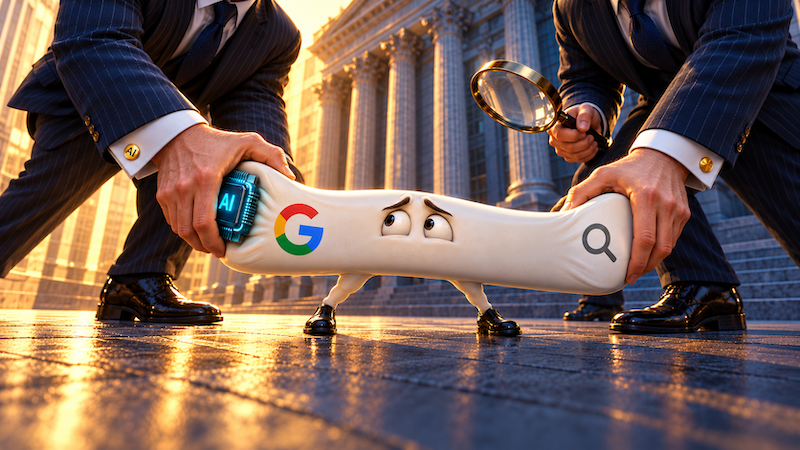
That's a search business with more traffic and slower revenue growth. Alphabet's release doesn't explain the gap. We think AI Overviews and AI Mode are the likeliest reason. When Google answers the question at the top of the page, the searcher has fewer reasons to click on anything below it, ads included. Google hasn't said this, and one quarter doesn't prove it. But it's the most straightforward way to read more searches and less money, and investors read it the same way tonight.
Search is still paying for Google's AI build-out
Alphabet spent $51.4 billion on capital expenditures in the quarter and reported negative free cash flow of $9.1 billion, only the second negative quarter in its history as a public company. Cloud is growing fast enough to justify some of that. Search still generates most of the cash, which is why investors punished a $1.5 billion search miss harder than they rewarded a $2 billion cloud beat.
Some early posts tonight pointed out that Alphabet and Microsoft both spent less than analysts expected, by about $4 billion at Alphabet and roughly $6 billion at Microsoft. Don't read that as a retreat from AI. Microsoft recently changed how it accounts for some data center leases, which lowers its reported capex without changing its plans, and analysts expect Alphabet's spending to top $300 billion in 2027.
Our take
Don't pull money out of Google search over one quarter. Search is still growing, and Google says commercial queries are growing with it. But B2B marketers should plan for paid clicks to get scarcer and more expensive. If AI handles more of the early research questions on the results page, advertisers end up bidding for the clicks that remain, and those come mostly from buyers who already know what they want. Watch cost per click and impression share on your core terms through the first quarter of next year.
The bigger shift is where buyers get their answers. When a Google summary or a chatbot answers a buyer's question before an ad loads, the companies named in that answer get the attention, and nobody paid for the placement. Those answers are assembled from what's published about your category: reporting, expert commentary, customer stories, press coverage. Paid search is attention you rent one click at a time. Being the source those answers draw from is attention you own, and it keeps working after the campaign budget runs out. We made that case in our 2027 B2B marketing playbook, and tonight's numbers make it harder to put off.
Then fix your reporting before budget season. If more of the work happens on the results page, last-click attribution will make search look weaker than it is. Track branded search volume, direct traffic to the pages AI tends to cite, and pipeline from accounts you've never marketed to, as we suggested after ChatGPT's tracking bug earlier this month.
Alphabet reports again early next year. If search growth picks up over the holidays, tonight will look like an overreaction. If it slows again while searches keep climbing, the squeeze is real, and the marketers who spent this winter building an audience of their own will be glad they did.