Sam Altman Has Solved the Problem of Talking to Your Children
Altman pitched an AI podcast for the drive to school. An eight-word reply beat him 13 to 1, and it exposed a positioning problem the whole industry shares.
Make State of Brand one of your go-to sources on Google

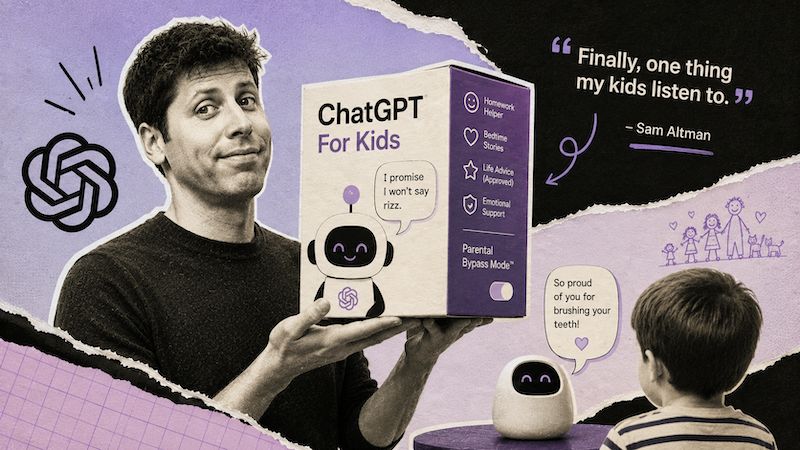
Sam Altman spent Friday recommending what he called a cool use case for ChatGPT Work. Per TechCrunch, the idea was for parents to "connect your family calendars and explain your kids' interests," then get a podcast every morning for the drive to school, covering one kid's soccer game that afternoon, another kid's upcoming birthday, a bit of news.
Alex Hirsch, who made Gravity Falls, replied: "What if you just talked to your children?"
Then he beat the CEO of the most valuable AI company in the world with it. AI Weekly counted 122,000 likes and 9,000 reposts on Hirsch's reply, against roughly 9,600 likes and 300 reposts for the post it was mocking. Thirteen times the likes. Thirty times the reposts. Eight words, presumably typed with one thumb.
If you work in AI positioning, you should probably look at that number for a while.
The feature was fine
The capability itself is dull, which is the frustrating part. Family logistics really are a mess. explainX laid this out in its piece on the backlash: one parent gets the school notices, another keeps the sports calendar, birthdays sit in a shared calendar nobody opens, and what the kid is actually into this month lives in no system whatsoever. Software that gathers all that up and tells you what today looks like is a perfectly good product. People would buy it.
But explainX also put a finger on why the pitch landed so badly. The thing Altman described sits in a slot human behavior already occupies. On the way to school you can just ask your kid how they're feeling about the game. They might tell you. They might not. They might complain about their teacher for 11 minutes instead. The unpredictability isn't a flaw in the drop-off. It's most of the point of it.
He pitched a product into a space that was full, and the thing filling it was the relationship.
Category error
Every product lands inside some category of human activity, and each of those categories comes with an unwritten rule about what's allowed in. Automate something people file under admin and you look helpful. Automate something they file under intimacy and you look like you've missed something obvious about being a person, however well the software works.
Nobody's ever been offended by a calendar reminder for a birthday. Everyone understands the reminder as scaffolding around the relationship. But put a synthetic host in the car doing a segment about your daughter's birthday while your daughter is sitting in the back, and the same information has changed category. The scaffolding has become a stand-in.
Identical technology, both times. What differs is the framing, and Altman's framing sat a machine in the passenger seat during one of the few unstructured conversations a working parent gets in a week.
Bad week for it, too
One ratio isn't market research, and OpenAI could reasonably write this off as a rough day on a hostile platform. I'd argue against that, because families aren't a side project for them.
TechCrunch points out that the company recently posted a job listing for a product manager with experience building trust-sensitive consumer experiences for parents and families, and that Meta is off testing an AI app that tells bedtime stories. Altman has been laying this groundwork for a while. He told The Tonight Show he couldn't imagine having figured out how to raise a newborn without ChatGPT, then conceded in more or less the same breath that people had been doing exactly that for a very long time without any trouble.
Underneath all of it, according to the same TechCrunch report, sit multiple lawsuits from parents and families alleging that ChatGPT played a role in relatives' delusions and suicides.
Every family-facing message OpenAI sends now arrives into that. Consumer marketing gets read uncharitably when the company behind it is in court over harm to vulnerable users, and a pitch that sounds like automating time with your children lands on a stack of associations nobody in that marketing meeting intended. The expensive part of Friday wasn't Hirsch's reply. It was that his reply handed a lot of people a tidy way to say something they were already uneasy about.
The version that would have worked
The fix is small enough to be annoying.
Sell it as household admin. A briefing for the parent instead of a broadcast for the family. Tell me before I leave the house that the soccer cleats are in the trunk, that a birthday is 11 days out and I've bought nothing, that the school moved pickup to 3:15. That version helps a tired adult show up with the right question in mind. It sets up the conversation rather than performing it.
Same calendars, same interests, same underlying model. One of them prepares the parent and the other one replaces the parent, and only one gets ratioed.
Satya Nadella wandered into a mild version of this last year, saying he'd given up listening to his favorite podcasts on the commute and now asks a chatbot about them instead. Smaller stakes, so a smaller reaction, but the same basic move: a tech leader demonstrating how excited he is by showing AI taking over something people were enjoying.
The instinct, not the pitch
What should worry OpenAI isn't this one post. It's the reflex underneath it.
AI leadership has developed a habit of proving how powerful a product is by finding somewhere surprising to put it, on the assumption that the more personal the setting, the more impressive the demo. Everyone outside the industry reads that in reverse. It comes across as an inability to name a single thing a person might want to hang on to.
People's wariness about AI usually gets described as fear of the technology, and mostly it isn't. Nobody's marching in the streets about meeting summaries. What sets people off is the growing suspicion that the men building these systems can't tell a chore from a relationship, and are cheerfully offering to take both off your hands.
So if you're shipping AI features this year, the skill worth having is knowing which parts of your customer's life to leave completely alone, and making sure they can tell you know it. Restraint sells now. There's a lot of credibility waiting for whichever AI company says first, out loud, that some things are better done by hand.

If this caught your attention, that’s not accidental.

The best editorial systems don’t happen by accident. Outlever builds them.

If this caught your attention, that’s not accidental.

The best editorial systems don’t happen by accident. Outlever builds them.


Come back for the reason it lands.
Subscribe for the kind of thinking that makes people stop, read and come back.