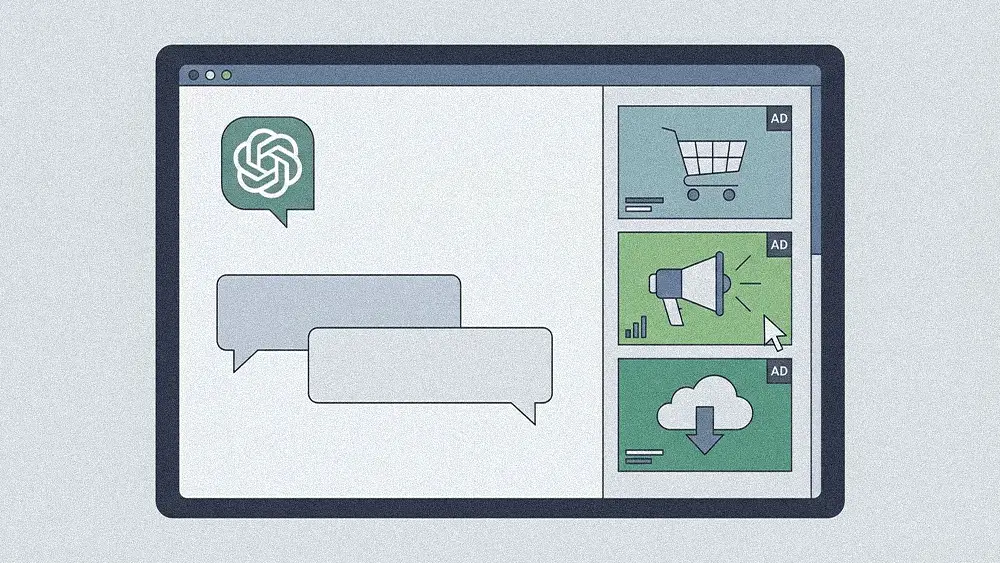
Ask ChatGPT which CRM to buy and you'll get a sensible answer naming three or four vendors. On a free account, there's a good chance you'll also get a sponsored card underneath it for a fifth.
Seer Interactive flagged this in its early read on ChatGPT ads, and it's the change that matters most for anyone who spent the last two years building toward AI citations. Search never quite produced this arrangement. A blue link and a text ad were different objects in different parts of the page, and users had twenty years of training in telling them apart. In a conversational answer they're inches from each other, in the same frame, and the sponsored one is the only one anybody can buy.
That's the trade the whole answer engine optimization category now has to explain. You can't purchase the recommendation. You can purchase the space beside it. Since the end of August, so can advertisers in about forty more countries.
The number, and what OpenAI wants it to mean
On August 31 OpenAI said ChatGPT Ads had reached a $1 billion annualized revenue run rate, roughly 200 days after launch. Axios, CNBC and SiliconANGLE all ran it the same day. Alongside the announcement, OpenAI opened its self-serve Ads Manager to buyers in India, Europe, the Middle East and North Africa, having run it in the US since May.
Two bits of context change how that number reads. OpenAI pitched the milestone as evidence of a diversified business, and it did so under pressure to justify an $852 billion valuation ahead of an IPO. And per Quartz, the company booked $6.7 billion in the second quarter alone. A billion a year, annualized, is a rounding error against that.
So the milestone isn't really a milestone. It's a proof of concept expensive enough to justify building more inventory.
The dissenting read is useful too. eMarketer's Nate Elliott told Reuters the announcement was "incredibly impressive and terribly disappointing," since a $1 billion run rate leaves OpenAI well short of a $2.5 billion advertising target for the year. Fast growth and a missed number at the same time. Companies behind plan on ad revenue don't respond by showing fewer ads.
How fast this actually moved
Most marketing teams haven't tracked the rollout closely, and it's been quicker and messier than the coverage suggests.
OpenAI announced the test in January and switched it on for US free-tier users in February. Canada, Australia and New Zealand came in April. The self-serve Ads Manager opened to US businesses in May with CPC bidding. The UK went live in June, Japan not long after. By July the platform had picked up conversion-based bidding, bulk campaign tools and mobile measurement integrations with AppsFlyer and Adjust. Pricing started at a $60 CPM with a six-figure minimum and has since moved to open auction.
Eight months from closed pilot to self-serve buying in forty-plus markets. For comparison, Google took about two years to get ads into AI Overviews at similar breadth.
Only free and Go users see ads. Plus, Pro, Business, Enterprise and Edu accounts remain ad-free, which means the ad layer is currently pointed at consumers and small businesses rather than the enterprise buyers most B2B brands are chasing. Early advertisers skewed accordingly, with HubSpot, Fiverr and Top10.com among the heaviest spenders in the spring. The format has stayed the same throughout: one labeled sponsored card per response, rendered with the answer. OpenAI's line is that ads are clearly marked, kept separate from how the model generates its answer, and that buyers can't see what users talk about.
Be careful with the penetration numbers
You'll see a figure quoted a lot right now: ads in 51% of US replies. It comes from Cloro's tracking panel for the week ending July 3. A later study from LLM Pulse, built on 137,038 answers across 70,760 distinct questions collected between late July and early August, put the US number at 72%.
Both are scraper panels. OpenAI publishes nothing, and the trend these trackers have captured is erratic enough that any single snapshot is close to meaningless. Penetration sat near zero through early spring, jumped hard in late May, fell to 0.05% by mid-June, then climbed back past the earlier peak within a fortnight. Nobody outside OpenAI has explained the June pause, and nobody has ruled out another one.
The swings tell you more than the levels do. This isn't an ad product settling into a stable fill rate. It reads like a company finding out, in production, how much of its answer surface it can sell before users start complaining. Build a 2027 plan around 51% and you'll be wrong in one direction or the other. Build it around the direction of travel and you probably won't be.
Google is doing the same thing, with more formats
Scoping this as an OpenAI story misses the larger half of it.
At Google Marketing Live in May the company introduced ad formats built specifically for AI Mode, including conversational discovery ads and a placement called Highlighted Answers. Serving in AI Mode and AI Overviews runs through Performance Max, AI Max, Shopping and broad match, which quietly turns eligibility into a question of campaign architecture rather than a separate media buy. Google has confirmed that Dynamic Search Ads, automatically created assets and campaign-level broad match all migrate onto AI Max starting this month.
Google has also been testing ads in AI Mode against healthcare queries, limited to US advertisers on English-language searches. Regulated categories normally go last in any ad rollout. Starting there suggests the remaining question is scheduling, not whether.
What this does to the case for AEO
The pitch for answer engine optimization always rested on an unstated assumption, which was that the AI answer is an unbought surface and that earning a place inside it buys you something durable. Budgets moved on that. So did a couple of hundred million dollars of venture funding into visibility tooling.
That assumption is now half wrong. Roughly half of US ChatGPT replies carry a commercial placement on the most conservative panel available, and whatever attention that placement takes comes off the same screen your earned mention is sitting on.
The awkward part is the asymmetry. An ad next to a category query is something you can buy on a Tuesday and see running by Wednesday. A citation is neither purchasable nor stable, and the trackers that watch it report heavy month-to-month turnover in which domains get cited. CFOs work that comparison out quickly, and they don't usually land on the side of the thing you can't buy or guarantee.
Meanwhile both platforms have committed themselves financially to expanding the paid layer. OpenAI needs the line to grow before an IPO. Google is moving its entire search ads stack onto AI surfaces on a published schedule. Neither has any reason to leave the answer box looking the way it did last year.
That doesn't make the AEO work worthless. Being named inside the recommendation is still a different and better thing than being an ad beside it, and no amount of spend gets you there. But you're running two programs on one screen now, and only one of them answers to you.
Four things to do before Q4
Run your top twenty commercial prompts on a free ChatGPT account and write down which sponsored card appears with each. If a competitor is buying adjacency to answers that recommend you, that's a commercial problem this quarter, not a research project for next year.
Settle your position on defensive brand buying inside AI answers before someone forces it. The industry hasn't decided whether it's table stakes or an extortion tax. It had the identical argument about branded paid search around 2010 and came down on the side of buying.
Split earned and paid AI presence in your reporting. If they arrive on the same slide, nobody in the room will be able to say which one is working. Google's generative AI performance reports in Search Console went out to every site worldwide on August 31 and give you a free impressions baseline for AI Overviews, AI Mode and Discover, though no click data yet. There's no equivalent for ChatGPT and there probably won't be.
And stop briefing the answer box as a channel you can win outright. It's acquiring an organic layer and a paid layer, on the same trajectory as every surface before it, and the planning assumptions should match.