Last week A24 reached for the standard studio tool, a copyright takedown notice, and learned within about seventy-two hours that the tool no longer fits the job.
The sequence, as reported by The Wrap, went like this. A Reddit user, u/GnarlyNet, posted in r/backrooms that Redbubble had pulled their Backrooms-inspired artwork after a complaint filed on behalf of A24 Films LLC. Kane Parsons, the director whose YouTube series became the studio's highest-grossing film ever at more than $370 million, saw the thread and commented that he was looking into it and that it should not be happening. By Friday, A24 had issued a public statement, shared on the official Backrooms X account, affirming that online creators "have every right to tell their own version of the story." The studio clarified that it claims no ownership over the yellow wallpaper, the original post that started it all, or the community works built around it since.
A three-day news cycle, on its surface. Underneath it sits a preview of the next decade for every brand that touches culture.
An IP with no author
To understand why A24's retreat matters, you have to understand what Backrooms actually is, and what it is not.
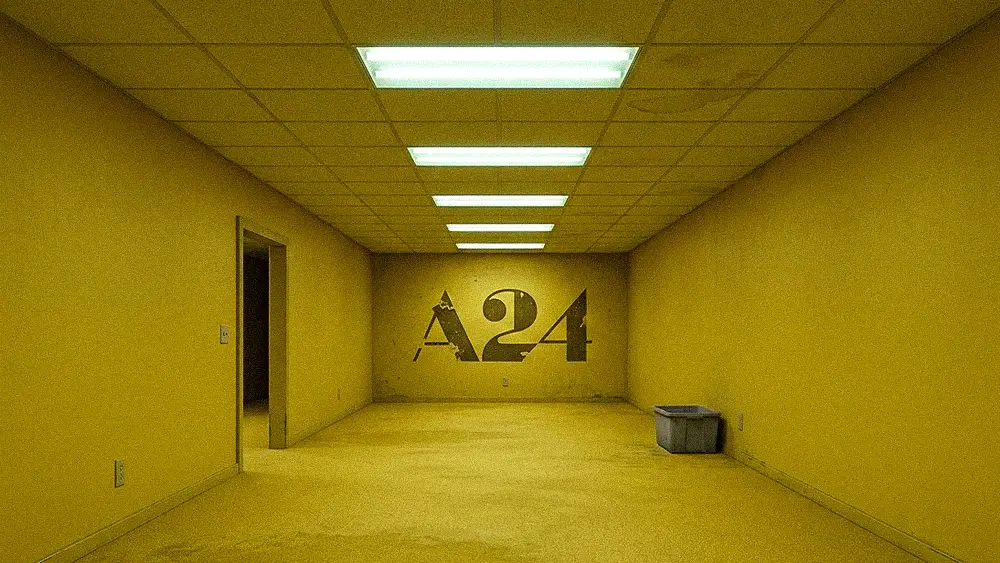
It is not a screenplay. It is not a novel with an author's name on the spine. It began in 2019 as an anonymous 4chan thread inviting people to post images that felt subtly wrong. Someone shared a photograph of an empty, yellow-lit interior, later identified as an old furniture store. Another anonymous user replied with a short piece of lore about slipping out of reality into an endless maze of damp carpet and buzzing fluorescent light, stalked by something that has already heard you.
Two anonymous posts. That is the founding document of a nine-figure film franchise, authored by no one and owned by no one.
Everything that followed was built by a distributed, unpaid community of collaborators: the entity taxonomies, the numbered levels, the found-footage aesthetic, the wikis, the fan games, the thousands of YouTube interpretations. Parsons was one of those collaborators. He was a teenager making VHS-styled shorts in the same sandbox as everyone else. His version was strong enough that A24 came calling, but it was a version, never the version. The community understood this from the start, and the box office proves they showed up anyway. They came because they had co-authored the world, not in spite of it.
So when a takedown notice landed on a fan artist's storefront, the studio was not protecting its property. It was claiming property that had never been transferred to it, from a commons that never had an owner in the first place. As u/GnarlyNet put it in the original thread, rights to a specific film adaptation should not be treated as ownership of the entire concept, its visual language, or the surrounding community lore. The fans did not experience the takedown as enforcement. They experienced it as theft of something they built.
Why the old playbook was always going to fail here
Hollywood's IP machinery was engineered for a clean chain of title. A writer creates a thing. A studio buys the thing. The studio puts a fence around the thing and charges for access. Copyright is the fence, and for a century the fence held because creation was expensive, distribution was scarce, and audiences stood outside looking in.
Backrooms breaks every assumption in that model. Creation was free. Distribution was ambient. And the audience was never outside the fence, because the audience built the property before the studio arrived. A24 did not acquire a finished story. It acquired a beachhead in a story that tens of thousands of people were still writing, in public, in real time.
This is what should worry brand strategists most: the thing that made Backrooms valuable enough to acquire, its enormous and generative fandom, is exactly what makes it impossible to enforce like traditional IP. The moat and the liability are the same asset. Send takedowns and you are not defending the franchise, you are draining it. Every fan artist you shut down is a marketing department you fired.
Parsons appears to understand this better than the institution distributing his film. His intervention was loyalty to the community that raised him, but it was also sound strategy. The property's value lives in its momentum, and the momentum belongs to the crowd.
Then AI walks into the room
If Backrooms were a one-off internet anomaly, studios could file it under edge cases and move on. It is not, and the reason is sitting in every creator's browser tab.
Generative tools are collapsing the production gap between a studio and a teenager at a pace that makes the YouTube era look slow. Parsons made his original shorts with consumer software and unusual talent. The next Parsons will not need the unusual part. Fan communities that once produced wiki entries and Redbubble prints will soon produce full trailers, episodes, and eventually features, rendered in the visual language of the official film, iterating faster than any studio pipeline, and answerable to no development executive.
Which raises the question already circulating in industry commentary, including a widely shared Open Gardens post on LinkedIn responding to the A24 story: how long before an AI-generated spinoff starts pulling audience attention away from an official sequel? A bootleg copies. A spinoff extends. It gives the fandom more of the world they love, sooner, made by people inside the fandom. A studio may hold legal claims against some of that output, but enforcement at that scale and speed is a fantasy, and enforcement against your own superfans is self-harm. The Backrooms episode just demonstrated, in miniature, exactly how that plays out.
We are entering a period where the official version of a story is simply the best-funded version, one voice in a chorus it does not conduct. The chorus enhances the film. The chorus also, inevitably, competes with it. Both things are true at once, and copyright law, written for a world of discrete authored works, has no comfortable answer for a property whose defining trait is continuous co-authorship. It is worth noting that A24 is navigating this while defending its own AI partnerships against fan backlash, which tells you how many directions the pressure is coming from at once.
The new playbook: stewardship over ownership
So what does a studio, or any brand, actually do in this landscape? The Backrooms saga sketches the outline, and it looks less like property management and more like community governance.
Start by owning your version rather than the world. A24's corrected position is the right one. The studio holds rights to its specific adaptation, its footage, its designs. The concept, the aesthetic, and the lore stay in the commons, because trying to enclose the commons does not consolidate value. It evaporates the goodwill the value depends on.
Then treat the fandom as a co-production engine. Every remix is a signal about what the audience wants next, a free marketing impression, and a talent pipeline. Parsons himself is the proof of concept, a franchise director sourced directly from the franchise's fandom. A studio that watches its community the way a venture firm watches deal flow will find its next filmmakers, its next storylines, and its next franchises already validated before a dollar is spent.
Compete on quality and canon rather than scarcity. When anyone can make a version, the official version has to earn its status by being better, and by serving as the trusted keeper of the story's spine. Canon becomes a service the studio provides, not a wall it builds. Audiences will pay for the definitive experience. Backrooms' $370 million says so. But only if the definitive experience respects the world they made.
Finally, put a creator-diplomat at the center. The most consequential actor in this entire story was not a lawyer or an executive. It was Parsons, moving between studio and community, translating each side to the other, and overruling the institution when it broke the social contract. Every internet-native property is going to need this role. The brands that formalize it will thrive. The brands that improvise it will keep stepping on rakes in public.
Who owns a story a million people told?
For a hundred years, brand and ownership were near synonyms. A brand was the thing you controlled: the mark, the character, the story, and the fence around all of it. What Backrooms suggests, and what the broader trajectory of participatory, AI-amplified culture suggests, is that the strongest brands of the next era may be the ones held loosely. Their value will not come from exclusion. It will come from being the gravitational center of a world that other people are actively building.
That is a destabilizing idea for an industry whose balance sheets are made of exclusivity. It is also one of the oldest ideas in storytelling. Myths never had owners. Folk tales were remixed for centuries before anyone thought to copyright a single telling. Hollywood's century of enclosed IP may prove to be the anomaly, a brief window when stories could be fenced because the tools of telling were scarce.
The tools are not scarce anymore. The audience no longer just consumes the story. It inhabits it, extends it, and, when an institution overreaches, defends it. A24's takedown lasted a matter of days against that reality. Credit to the studio for reversing quickly, and credit to Parsons for forcing the reversal. But be clear about what happened: a major studio tested whether the old fence still holds, and the internet answered no.
The studios that internalize that answer will build the next generation of billion-dollar worlds alongside their audiences. The ones that refuse will keep filing takedowns against the very people writing their sequels for free, wondering why the walls keep shifting under their feet.
The walls were always shifting. That was the whole point of the story.