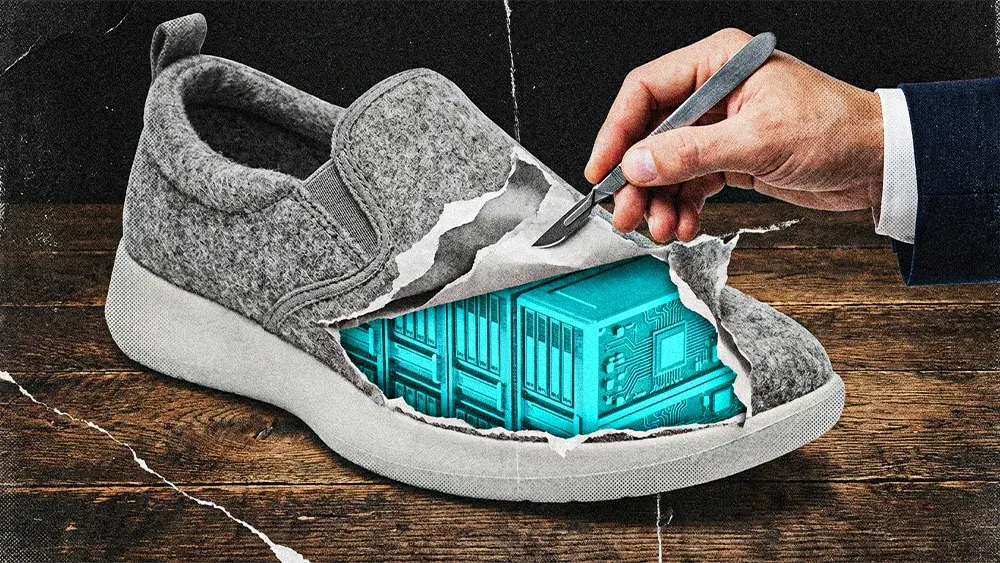
Allbirds, the company that made those cozy wool sneakers every product manager in San Francisco owned in 2021, announced today that it is pivoting to become a "fully integrated GPU-as-a-Service and AI-native cloud solutions provider." The stock went up more than 300%. The company that once sold sustainable merino wool slip-ons is now going to lease graphics processing units, under a new name: NewBird AI. If you're a brand leader watching this, the comedy writes itself. But the implications underneath it are worth taking seriously.
The Sustainability Icon That Burned Out
Allbirds IPO'd in 2021 at a valuation of roughly $4 billion. Tim Cook wore the shoes. Barack Obama wore the shoes. They were the unofficial uniform of the sustainability-conscious tech worker. Then the market turned. Revenue declined every quarter of 2025, net losses hit $77 million, and a going-concern risk appeared in the annual filing. In January, Allbirds closed all remaining full-price US stores. In March, it sold the entire brand and footwear assets to American Exchange Group for $39 million. Four billion to 39 million in five years. And then, today, the company that just sold its shoes announced it would pivot its remaining public shell into an AI compute infrastructure provider. NewBird AI. GPU-as-a-Service.
We’ve Seen This Exact Movie Before
TechCrunch drew the comparison immediately, and it holds up. In 2017, Long Island Iced Tea, a small beverage company with a roughly $24 million market cap, renamed itself Long Blockchain Corp. The stock jumped nearly 300%. There was no blockchain business, no team, and no real plan. The company was eventually delisted. The structure of the Allbirds story looks familiar. A sudden pivot announcement, a sharp market reaction, and a wide gap between narrative and operational reality.
The difference is the backdrop. AI has real commercial force in ways blockchain never did, and companies like Anthropic generating tens of billions in revenue signal a legitimate shift. That's what makes the Allbirds pivot more revealing, not less. When a technology has genuine traction, it becomes easier for struggling companies to borrow its credibility. The signal gets stronger, but so does the noise.
The underlying pattern is consistent. A company attaches itself to a cultural moment, raises capital and attention on the strength of that story, and the business fails to keep up. Allbirds rode sustainability until it stopped working financially. WeWork sold a vision of the future of work before collapsing under its own losses. Juicero raised over $100 million to build a machine that turned out to be unnecessary. In each case, the story outlasted the business. When the gap becomes too wide, what follows is either collapse or reinvention into whatever sector the market is currently rewarding. Blockchain in 2017. The metaverse in 2021. AI now. Attaching a depleted company to the hottest sector gets attention and moves a stock price, but it doesn't build anything lasting.
Brand Is the Only Durable Asset
The Allbirds story is the purest possible demonstration of something I've been arguing all year. Brand is the only thing that determines whether a company builds durable value or becomes an empty vessel that gets repurposed for the next hype cycle.
Allbirds had a genuinely strong brand, strong enough that when the company was falling apart, the name and IP were still worth $39 million to a buyer who wanted to keep making shoes under that name. But the company behind it couldn't build a sustainable business on it. When the brand got sold off, what remained was a publicly traded company with no product, no revenue, and no identity. A strong brand without a viable business model depreciates, and a business model without brand is just a vessel waiting for the next trend. The brand creates the value. The business model captures it. When they come apart, you get a wool sneaker company pivoting to GPU leasing.
The Uncomfortable Question for B2B
A shoe company becoming an AI infrastructure provider is the kind of thing that makes you check whether the article was published on April 1st. But there's a quieter version of this story playing out across B2B that deserves the same scrutiny.
I've lost count of how many B2B companies have added "AI-powered" to their positioning without meaningfully changing their product, updated their homepage to mention AI without rebuilding any underlying capability, or announced an "AI strategy" that amounts to wrapping an API call in a press release. The Allbirds pivot is the cartoonish extreme of something happening at a subtler scale across the entire landscape. Companies are attaching their brands to AI because that's where the attention, the funding, and the market premium currently live. And because AI actually works, the consequences of faking it are more severe than they were with blockchain or the metaverse. When buyers are sophisticated, technical, and allergic to marketing hype, the credibility loss from an empty AI claim is permanent.
Identity Outlasts Every Hype Cycle
The companies that survive across hype cycles know what they are. They have a clear identity that doesn't need to be reinvented when the market shifts, and they adopt new technologies without pretending to become a different company. Anthropic wasn't built on a pivot. It was built as an AI company from day one, with a specific thesis about safety and trust that differentiates it from every competitor. The best B2B companies operate the same way. They use AI to make their existing positioning more powerful, not to replace a positioning that wasn't working.
Allbirds made great shoes. It had a brand people loved. It lost the business model, sold the brand, and now what's left is called NewBird AI. Somewhere in a startup accelerator, a founder is looking at this stock chart and thinking about what they could do by adding AI to the name. Build something real instead. Build it on a brand foundation that doesn't need reinventing every cycle, and let the NewBirds chase the trend while you compound the value.
The fuzzy shoes deserved better. Your brand does too.