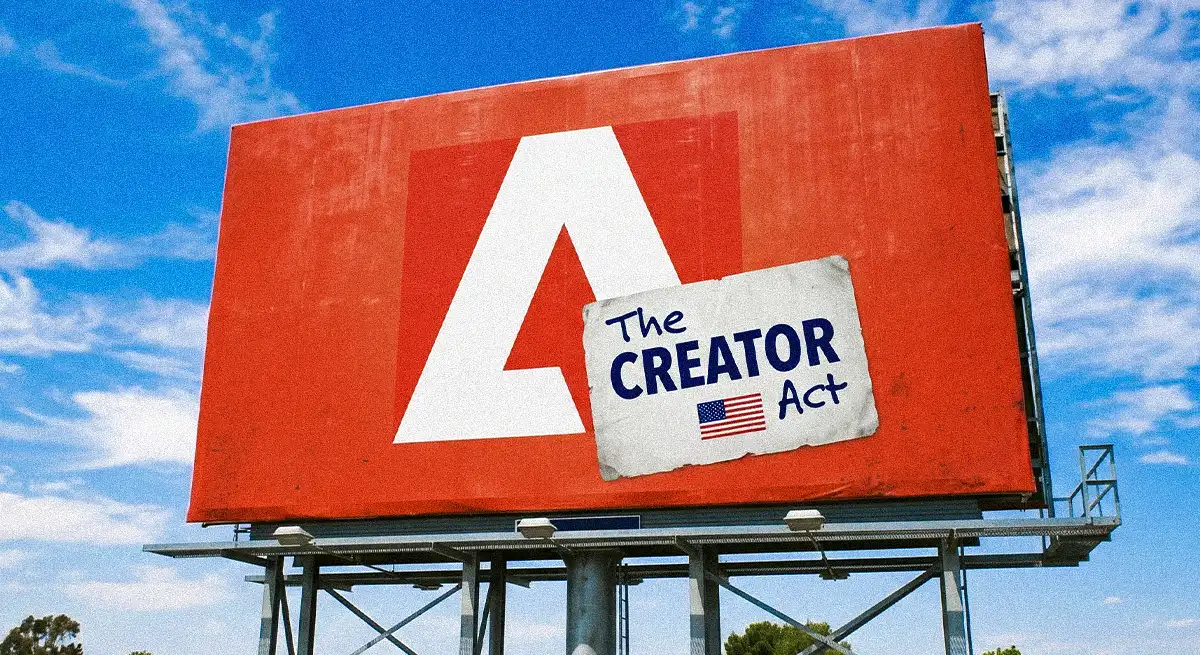
On Tuesday, a piece of legislation landed in Washington with a clunky acronym and a large ambition. The CREATOR Act, short for Creative Rights for Artists' Technique and Originality Are Reserved, would do something U.S. law has never done. It would protect a visual artist's distinctive style from being copied by AI for commercial gain. Copyright protects the specific thing you made. The CREATOR Act would protect the recognizable way you make things.
Behind the bill is a familiar name. Adobe is championing the measure, and the company has built its public case around a single distinction it wants written into federal law: the difference between inspiration and impersonation.
"We want creators to be able to use tools that have AI without fear," Adobe Chief Legal Officer Louise Pentland told Axios, which first reported the bill, framing the measure as a way to draw that line cleanly. In a post on Adobe's blog published alongside the bill's introduction, Pentland argued that artists can now have their signature look replicated at zero cost and in seconds, without consent, and that existing IP frameworks built long before generative AI have no answer for it.
For The State of Brand, the artist angle is only half the story. The other half is that a brand is a style, and Adobe just proposed making style legally defensible.
Why this is a brand story, not just an artist story
Strip away the illustration-community framing and the CREATOR Act is about something every brand manager already understands. A recognizable visual identity is an asset with commercial value. Adobe's own pitch leans on this. The company points to illustrator Fabiola Lara, who says an AI platform generated imitations of her work to demo its technology without asking. The threat Adobe describes is a signature look flooded into the market at scale by anyone with a prompt, and it is precisely the risk that brands have quietly been absorbing for two years.
Consider what brands buy when they commission a distinctive illustrator, hire a photographer with an unmistakable eye, or build a house style with an agency. They are buying differentiation. If that look can be regenerated on demand for free, the value of commissioning the real thing erodes, and so does the moat around a brand's visual identity. A federal right against deliberate, commercial style impersonation is, in practice, a new tool for protecting brand equity that lives in aesthetics rather than logos.
That is the part marketers should focus on. The industry has spent decades treating brand as the trademark, the wordmark, and the color in the swatch book. The CREATOR Act points toward a future where the feel of a brand's creative output carries protectable weight too.
What the bill actually does, and pointedly does not
Adobe is careful to keep the scope narrow, and the limits matter as much as the rights. By the company's account, the bill creates a federal right for visual artists to seek damages and demand that impersonation stop. It targets the actor who knowingly uses AI to fake an identifiable artist's identity for commercial gain. It does not, Adobe stresses, touch artistic influence, parody, fan work, or general AI research and development.
There is a meaningful gap, though, and the bill's own sponsors acknowledge it. The legislation does not build any infrastructure for artists to register a style. There is no database and no reference point for proving who owned a look first. Rep. Yvette Clarke, a co-sponsor, suggested to Axios that enforcement may eventually need an independent arbitrator to judge the validity of claims rather than leaving that policing to platforms. Co-sponsor Beth Van Duyne argued creators should not have to register their style the way musicians register songs. The bill establishes a right without yet answering the operational question every brand lawyer will ask first. How do you prove the style was yours, and where is the line between inspired by and ripped off?
The bill is bipartisan, introduced by Reps. Van Duyne (R-TX), Clarke (D-NY), Burgess Owens (R-UT), and Valerie Foushee (D-NC). Van Duyne told Axios that tech platforms have been broadly receptive, largely because a single federal standard beats a patchwork of state laws.
The Adobe brand play underneath it all
It would be naive to read this purely as advocacy. Adobe sells the AI tools, Firefly among them, that make style replication trivial in the first place, and it is simultaneously positioning itself as the industry's loudest defender of the creators that technology threatens. That is a deliberate brand posture, and a shrewd one. Adobe describes the CREATOR Act as a new arrow in the quiver alongside its Content Authenticity Initiative, the provenance-labeling coalition it co-founded that now claims more than 6,000 members.
The logic of Adobe's brand strategy is becoming clear. Own the position that AI and human creativity can coexist, and make Adobe the company that wrote the rules for how. For a business whose customers are the exact creators most exposed to AI disruption, creator-first is not only a values statement. It is retention.
The stakes for the rest of us
Adobe cites a figure worth keeping in view. The U.S. creative economy contributes roughly $1.2 trillion a year, about 4.2 percent of GDP. Brands, agencies, and platforms all draw from that well. If AI-enabled imitation hollows out the economics of building a distinctive look, the loss does not stop at individual illustrators. It reaches every brand that depends on original human creativity to stand apart.
The CREATOR Act is early, narrow, and untested. Whether it passes, and whether it can actually distinguish homage from theft, remains open. But the premise it puts on the table is the one this industry will be arguing about for years. In the age of AI, is a style something you can own?
For brands, the answer is that they have always behaved as if it were. The law is only starting to catch up.