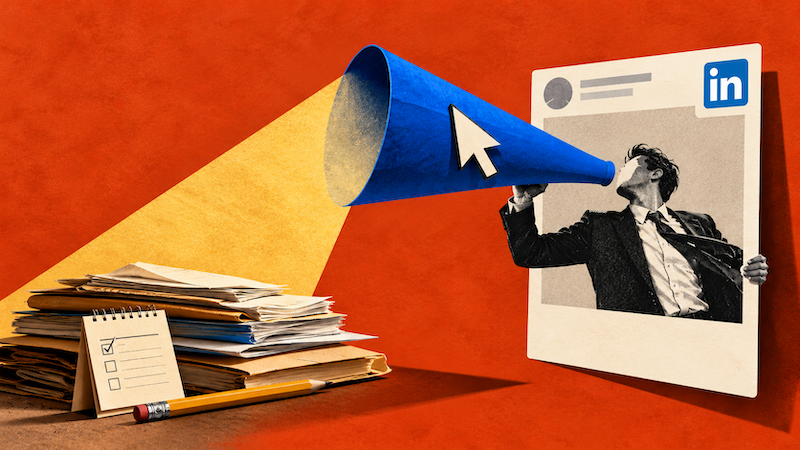
A LinkedIn member wrote recently that he lost his job because his manager had no idea what he had contributed. His comment sat under a LinkedIn News roundup of a Business Insider report on "loud working," the habit of announcing your accomplishments often enough that the people deciding who stays can't miss them.
The fear behind it is well founded. The Skillsyncer tracker counted more tech layoffs between January and late September than in all of 2025, and the median job search has stretched to 4.7 months, State of Brand reported last week. That piece looked at professionals building audiences outside the company, on newsletters and posts they keep after their login stops working. Loud working is aimed inward, at a manager and a skip-level.
Anyone who has defended a marketing budget will recognize the premise. Marketing teams have spent a decade arguing about measurement systems that credit whoever was standing closest to the sale, and loud working asks employees to make sure that person is them.
Attribution has always favored the last touch
Siraj Dawar, Head of Marketing at Bee Enterprises, described a campaign to State of Brand that returned about 30 times its ad spend. When he looked closer, most of the buyers it claimed had been planning to purchase anyway, and the campaign had collected demand that earlier channels created. Attribution, in Dawar's words, rewards "the last room the customer stood in."
He also described what usually happens next in the budget meeting. The retargeting line with the impressive ROAS keeps its money, and the prospecting work that filled the retargeting pool gets trimmed. A few months later the pool has shrunk and nobody can say why.
Layoff decisions often run on the same kind of information. A manager weighing two people will usually remember who presented the launch results. The person who rebuilt the data pipeline three months earlier, so the launch had numbers to present, left much less of a trace.
Marketing's own work is the hardest to see
Brand programs take a long time to pay back, and the return is hard to tie to any single campaign. That has made marketing an easy target when budgets tighten. When profits fall short, marketing is cut 45.4% of the time, more often than any other function, according to the CMO Survey figures State of Brand reported in August. Salesforce's February layoffs this year included marketing roles.
That August piece also cited a Bain survey in which a consumer-goods CFO said he would throw money at marketing if he believed its data. The finance leaders in that research understood the awareness metrics marketers brought them. They weren't persuaded by them, and a CMO who expects the work to speak for itself is in roughly the position of the employee who was let go.
CMOs end up having to work loud for the department. Platform-reported ROAS is the obvious material, and it has the same weakness as an employee's self-written list of wins, since in both cases whoever reports the result is also being judged on it.
Managers will be grading their teams' press releases
Marketing leaders also manage people, and if loud working spreads they will be on the receiving end of it. Status updates and Slack recaps will be written partly as a case for keeping the author's job.
Marketers learned long ago to discount the conversions an ad platform reports about its own campaigns, and self-reported wins from a team call for a similar discount. Dawar made a related point about automated bidding, which he said scales bad distribution faster instead of fixing it. A team rewarded for announcing results will announce more of them. Work that leaves nothing to announce, like cleaning a dataset or killing a weak idea early, will get less of everyone's attention.
Some of the announcing will happen on LinkedIn, where it may not go as planned. LinkedIn added a button in July for members to flag posts as AI slop, and flagged posts now lose reach, State of Brand reported in August. The author gets only a private notice in their analytics.
What this asks of marketing leaders
Incrementality testing asks what would have happened if a campaign had never run. Just over half of US brand and agency marketers now use it, according to the eMarketer figures cited in the Dawar piece. A manager can put a version of that question to any contribution and ask what would have shipped late, or broken, if this person hadn't been on the team.
Dawar traces high-ticket sales from the first newsfeed impression through WhatsApp chats and phone calls to the signed deal, then stitches the steps together by hand in the CRM. Projects can be traced the same way, back past whoever presented the result to whoever scoped it and kept it moving. He also uses marketing mix modeling so that no single platform defines success, and performance reviews benefit from the same habit of checking peers and downstream teams before settling on a verdict.
For the department, the August piece argued that CMOs win budget by pitching brand the way an investor would, with a payback window and a review date on the calendar. Nikolay Tsonev, Head of Marketing at Businessmap, told State of Brand he now tracks branded search instead of website traffic, and that his marketing and sales teams report the same metric. Both approaches give the CFO evidence that doesn't depend on marketing's own account of itself.
Loud working makes sense for any employee whose manager can only see the last room. Marketing leaders have spent years learning how misleading that view can be, which puts them in a better position than most to stop managing by it.