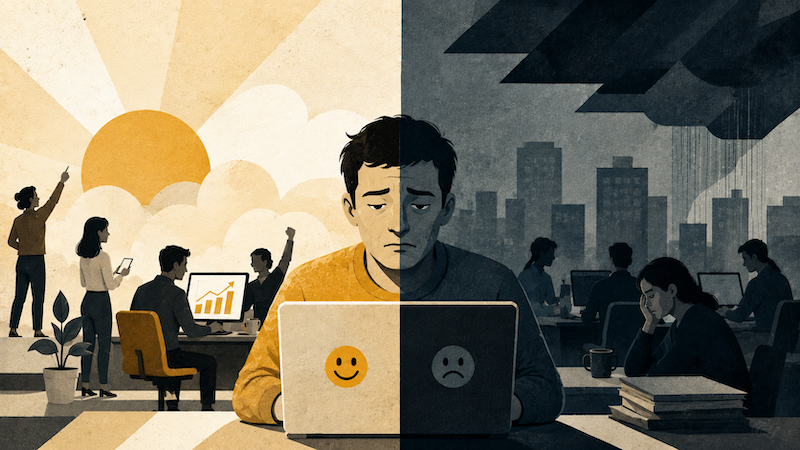
Tech Spent Two Years Telling Everyone Work Was About to Get Better. It's the Only Industry Where Employees Got Unhappier.
Tech now trails construction on employee happiness by fourteen points. The number underneath the recovery is worse for employer brand than the headline is good.
Make State of Brand one of your go-to sources on Google

Employee happiness went up this year, and that is the sentence that will get quoted.
BambooHR's 2026 Employee Happiness Index puts eNPS at 40 for the first half of the year, up 4.4% year over year and the strongest first half since 2023. It follows four consecutive years of decline and an all-time low of 37 in late 2024. The finding is drawn from more than 2.5 million self-reported scores across 1,400 companies, so the recovery is real.
Then you get to the industry table, and the recovery stops being a single story.
Seven of the eight sectors BambooHR tracks are holding steady or climbing. Healthcare is up 19.4% year over year, the largest percentage gain in the set. Finance is up 10.5% to 47. Nonprofits bottomed at 30 in September 2024 and have climbed back to 38. Construction, an industry that spends approximately nothing on employer brand, has led the entire index three years running and sits at 51.
Technology is the only sector in sustained decline. It scored 42 in 2023 and it scores 37 today, below the overall average, and it has yet to find a bottom while everyone else already has.
The industry writing everyone's workplace copy is losing its own argument
BambooHR attributes the slide to the last six months of tech layoffs, which is almost certainly part of it. But every sector on that table has absorbed a bad stretch inside this window. Nonprofits went through a funding contraction, healthcare went through a staffing collapse, and restaurants went through the whole thing twice. All of them turned. Technology hasn't.
That asymmetry matters more than the raw number, because of what tech is to everyone else on the table.
This is the category that produces the workplace narrative the rest of the economy consumes. It sells the engagement platforms and publishes the future-of-work research, and it runs the employer brand campaigns about mission and velocity and doing the best work of your life. It spent two years telling every other industry that AI would make work better, then ran the largest layoff cycle in its history while saying so.
The industries buying that software now report higher morale than the industry selling it. Construction is fourteen points ahead of technology. Call that a talent problem if you like, but it looks a lot more like a credibility gap turning up on a scoreboard, and it lands in the same place as the 29% of employees quietly sabotaging AI rollouts and the CEOs Jensen Huang told to stop hiding behind AI as a layoff excuse. Employees are grading the story their employer told them, and in tech the story is losing.
The number the recovery is hiding
The finding that should concern anyone who owns a brand, in any industry, sits further down the report.
Employee happiness follows a U-curve by tenure. New hires score 51, employees at the two-to-three-year mark score 33, and twenty-five-year veterans score 57. New-hire eNPS has been essentially flat at 51 for eighteen months, and BambooHR's own read is that new hires appear insulated from the sentiment swings moving through the rest of the workplace.
Read that stability as a sign of a healthy workplace and you will draw the wrong conclusion. What it shows is that the recruiting pitch still works.
The new-hire number grades your marketing and the year-three number grades your product. The eighteen-point drop between them is the distance between what you promised and what you delivered, and every brand person reading this already knows what to call that. It is a positioning problem that shows up in the attrition line rather than the engagement report.
The people falling through that trough are also your loudest reviewers. They write the Glassdoor entries, run the group chats, and populate the answer a candidate gets when they ask an AI assistant whether your company is a decent place to work. Your careers page is no longer competing with a competitor's careers page. It is competing with the pooled account of everyone who left you in year three.
The retention math, with the caveat the report includes and the coverage will drop
Companies with the highest happiness scores lose 46% fewer employees than the lowest, roughly 18 additional exits per 100 employees a year at the unhappy end. The gap is brutal at small scale: under 150 employees, negative-eNPS companies lose 18 to 19 percentage points more of their workforce annually. At 301 to 500 employees it compresses to 4.5 points.
BambooHR is explicit that this is correlation. Unhappiness may drive turnover, the churn and instability of high turnover may equally drive unhappiness, and both may be downstream of something neither metric captures. That caveat will be stripped out of every LinkedIn post about this report by Thursday. Hold onto it anyway, because the directional finding survives without the causal claim.
What makes it urgent is the market context. Applicants per posting doubled between 2021 and 2025 while the hiring rate fell from 4.5% to 2.8%. Every employer currently feels like it holds the cards. The turnover data says the people who don't want to be there leave anyway, and in a low-hire market you replace them out of a pool you now have to sort through at twice the volume.
One message, no audience
The recovery isn't reaching people evenly. The 26-to-30 cohort sits at 31, nine points under average, while the 51-to-60 group sits eight points above it. Workers over 50 have posted strong gains and workers under 30 have barely moved. The gender gap narrowed to 6.6 points from a three-year average of about 8, which counts as progress and is still a gap.
BambooHR's Nicole Csiszar argues that the fix is never one-size-fits-all, and that companies keep designing for an "average employee" who doesn't really exist.
Marketers have run this exact failure before: one message, built for a composite persona, performing respectably on the aggregate metric and poorly with every actual segment inside it. The aggregate went up 4.4% this year, which tells you very little about whether it went up for anyone you are trying to keep.
eNPS is, in the end, a promoter score. It measures whether people will recommend you. Read at that level, the report says the promise is intact while the delivery isn't, and the sector with the widest gap between the two is the one drafting everybody else's workplace copy.
BambooHR's full 2026 Employee Happiness Index, including the industry breakdowns and methodology, is available here.

If this caught your attention, that’s not accidental.

The best editorial systems don’t happen by accident. Outlever builds them.

If this caught your attention, that’s not accidental.

The best editorial systems don’t happen by accident. Outlever builds them.


Come back for the reason it lands.
Subscribe for the kind of thinking that makes people stop, read and come back.