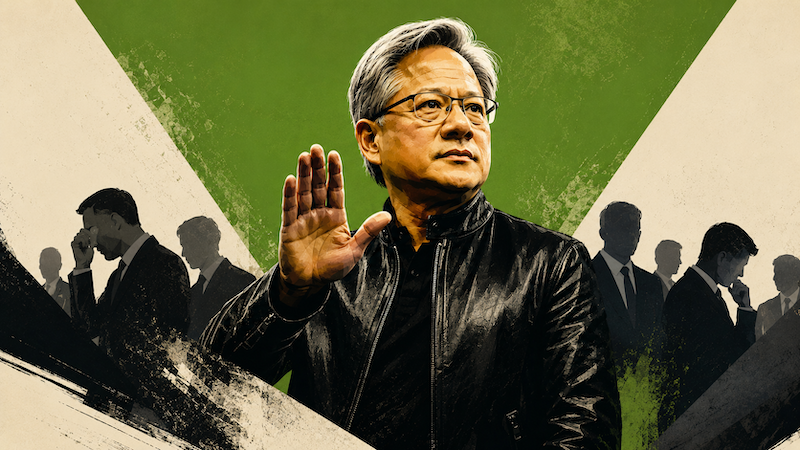
We have spent months pulling apart what is actually going on behind the AI layoff narrative. We wrote about it when 150,000 tech workers lost their jobs and the real reason was GPU budgets. We wrote about it when 80% of companies that cut jobs for AI saw zero improvement in returns. We wrote about it when Klarna fired 700 people for AI, then quietly hired them back.
Now Jensen Huang is saying it on camera in Singapore, and the words he picked tell you everything about where the consensus is shifting.
What He Actually Said
Speaking to Channel NewsAsia, NVIDIA's CEO was asked about the wave of AI-attributed layoffs sweeping tech. He did not hedge. CEOs who blame layoffs on AI are "scaring people, and that's irresponsible." The whole explanation is "lazy."
Then he asked the question that should have been obvious to every executive who signed one of those memos: "AI has just arrived. How is it possible they're already losing jobs?"
Sit with that for a second because the timeline falls apart the moment you look at it. Generative AI became commercially viable roughly two and a half years ago. Enterprise deployment is still early innings for most companies. Most organizations are running pilots, building governance frameworks, still sorting out which use cases are real and which are demos that look good in a board deck.
But the layoff memos read as though the transformation already happened. As though AI walked in the door and made tens of thousands of roles redundant overnight, but It did not. Huang knows it did not. The CEOs writing those memos know it did not.
Two Weeks, Two CEOs, Same Message
Huang's comments dropped one week after Demis Hassabis, CEO of Google DeepMind, said something remarkably similar. Hassabis called AI-driven developer layoffs a reflection of "a lack of imagination" from employers. Not a technology problem. A leadership problem.
Two of the most powerful people in AI, running two of the companies that build the actual infrastructure, are now publicly saying the same thing: companies are slapping the AI label on decisions that have nothing to do with what AI can actually do today.
This is not a minor disagreement about messaging. This is the people selling the shovels telling the miners to stop blaming the shovels for the cave-in.
The Framing Persists Because It Is Useful
The AI layoff narrative survives because it serves everyone in the room when the decision gets made. It plays well on earnings calls, where "AI-driven efficiency" signals forward-thinking leadership to analysts. It holds up in board meetings, where restructuring sounds better attached to a technology thesis. It writes cleaner press releases, where "investing in AI" pulls better headlines than "cutting costs because we overhired in 2021."
We have covered this math before. The $725 billion that Amazon, Microsoft, Alphabet, and Meta are spending on AI infrastructure in 2026 has to come from somewhere. For many companies, the somewhere is headcount. Not because AI replaced the work. Because the budget line got moved to a different row on a spreadsheet.
That is a capital allocation decision. It is a legitimate business decision. But dressing it up as an AI-driven workforce transformation is dishonest, and the dishonesty is starting to cost real money.
The Damage Is Measurable
When companies frame layoffs as AI displacement, three things happen at the same time.
They terrify their remaining workforce. Employees who survive a round of AI-attributed cuts do not become more productive. They become more defensive. They hoard information. They resist the very tools they are told to adopt because those tools just became synonymous with getting fired. We covered the data: 29% of employees at companies that rolled out AI with a layoff threat attached are now actively sabotaging adoption.
They poison the public narrative around a technology that could expand what organizations do. Every memo that says "we are replacing these roles with AI" makes it harder for the next company to roll out AI as a capability multiplier instead of a headcount reducer. The fear stacks. It compounds. And it creates political and regulatory blowback that lands on the entire industry, including the companies doing it well.
They create a credibility gap they cannot close. When the same roles show up on job boards six months later, repackaged at lower salaries or offshore, the original story collapses. Bloomberg data suggests roughly half of AI-attributed layoffs result in the same work being done by different people for less money. That is not transformation. That is arbitrage with a press release.
What Huang and Hassabis Are Actually Telling You
Strip away the diplomatic language and both executives are delivering the same verdict: if you are a CEO and the best use you can find for AI is cutting headcount, you are telling the market you have run out of ideas.
The companies pulling the strongest returns from AI right now are not using it to do less with less. They are using it to do more with more. More customer interactions resolved. More code shipped. More products launched. More markets entered. The productivity gains are real, but they show up as expanded output, not reduced input.
Marek Kosmowski, a marketing and strategy executive at Veda Praxis who has been running these implementations across Southeast Asia, made the point cleanly in response to Huang's interview: "The organisations with vision are using AI to do more with more. Improving service, increasing productivity, accelerating delivery and unlocking new capability across the business." He added a line that belongs on every AI strategy deck in every boardroom: "That is the difference between cutting and building, between fear and ambition, between being out of ideas and being full of them."
Brand leaders should care about this more than anyone, because every one of those audiences is watching: employees, customers, investors, the public. They all read the same memo.
Every AI Layoff Announcement Is a Brand Event
It tells employees what the company values. It tells customers how the company thinks about the humans who serve them. It tells the market whether leadership is building something or liquidating something.
The companies that will truly own the next decade of enterprise trust are the ones that figure out how to tell an AI story about expansion, not extraction. About what became possible, not who became expendable.
Jensen Huang just handed every CEO in the world a mirror. The ones who look into it and see a builder will be fine. The ones who see a cost-cutter with a convenient excuse have a problem that no GPU budget on earth will fix.