80% of Companies Cut Jobs for AI. It Didn't Improve Their Returns. Not Even a Little.
Gartner just dropped the most important data point in the AI-and-jobs debate. The finding: cutting people doesn't correlate with better financial performance.
Make State of Brand one of your go-to sources on Google

On Monday, Gartner released findings from a survey of 350 global business executives at companies with at least $1 billion in annual revenue. All of them were already piloting or deploying autonomous business capabilities, including AI agents, intelligent automation, robotic process automation, and digital twins. These are not companies kicking the tires. These are large enterprises well into deployment.
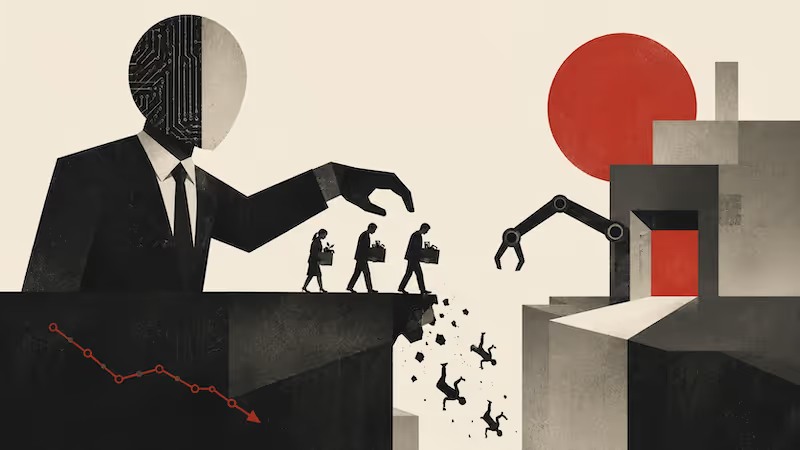
80% of those organizations reported workforce reductions tied to their AI initiatives. Some cut headcount by as much as 20%. And the companies that cut the most showed nearly identical financial returns to the companies that cut the least. In several cases, the ones that cut less performed better.
No correlation between AI-driven layoffs and improved ROI. At all.
Helen Poitevin, Distinguished VP Analyst at Gartner, was direct: "Many CEOs turn to layoffs to demonstrate quick AI returns; however, this disposition is misplaced. Workforce reductions may create budget room, but they do not create return."
That distinction matters. Cutting people frees up cash. It does not generate value. Most leadership teams are conflating those two things, and the data says they shouldn't be.
A caveat worth taking seriously
We should be honest about the limitations. We are still very early in the AI deployment cycle. The companies in this survey are piloting and deploying, not running mature, fully integrated AI operations that have had years to compound. It is entirely possible that some of these workforce reductions will prove prescient in hindsight, that the roles eliminated were genuinely redundant, and that the financial returns just haven't shown up yet.
AI agent software spending is projected to reach $206.5 billion in 2026 and $376.3 billion in 2027, up from $86.4 billion in 2025. The capabilities are improving fast. What doesn't work today might work in 18 months.
But that's precisely the problem. Companies are making permanent workforce decisions based on where AI is right now, while the technology is still shifting underneath them. They're locking in cuts before they know whether the systems replacing those people can actually carry the load. And as Gartner's analysts noted, some organizations that moved too fast were forced to quickly rehire employees soon after cutting them.
The early timeline doesn't argue for patience on AI investment. It argues for patience on headcount reduction. Those are very different things.
The business case everyone is building, and what it gets wrong
We talk to a lot of B2B leaders at The State of Brand. The story we hear repeatedly goes like this. Someone on the executive team, usually aligned with the CFO, builds a business case for AI that runs: here's what we spend on people in this function, here's how much of that work AI can absorb, here's the headcount reduction, here's the savings.
Clean slide. Compelling narrative. And according to the data from 350 enterprises that actually tried it, incomplete at best.
The companies achieving real returns from AI are not the ones eliminating people. They're the ones redirecting them. They upskill staff to work alongside AI. They redesign roles around what people do well and what AI does well. They build operating models where humans guide autonomous systems rather than getting replaced by them.
Poitevin was pointed about this: "Those who only look to the workforce tend to be the 'laggards,' because they're not going after the broader set of value that they can get to." The companies fixated on headcount are optimizing for the smallest possible version of what AI can deliver. The ones going after revenue growth, time to market, and operational transformation are the ones seeing returns.
The difference is between using AI to do the same work with fewer people and using AI to unlock work that was previously impossible. The first approach saves money on paper. The second compounds over time. And it is the second group that Gartner's data associates with stronger ROI.
The brand dimension that Gartner doesn't measure
At The State of Brand, we've been following a pattern all year. Klarna replaced 700 customer service roles with AI, watched quality decline, and started rehiring. IBM automated large parts of its HR function and reversed course when the systems couldn't handle anything requiring judgment. The Commonwealth Bank of Australia reversed 45 AI-driven layoffs after concluding the roles were never redundant. In February, Gartner predicted that half of companies that attributed headcount cuts to AI would rehire under new titles by 2027.
Now we have data confirming at scale what those individual stories suggested. Cutting people for AI is not improving financial performance. The companies doing it are performing no better than the ones that kept their teams and invested in transformation.
But the Gartner survey only captures what shows up on a balance sheet. It doesn't capture what happens to the brand in the space between the layoffs and the eventual rehiring.
When a company cuts its customer success team and replaces it with automation, the financial outcome may be neutral. The brand outcome is a different calculation entirely. Customers experience lower quality. The market watches you cut and then quietly rebuild. Potential hires see a company that treated its people as a variable cost. Buying committees that are weeks away from a seven-figure decision start to wonder whether your company will still have the team to support them a year from now.
When a company eliminates its mid-career talent pipeline to save money and then pays a 15% premium to recruit that same talent two years later, which is exactly what Gartner predicts will happen in supply chain organizations by 2030, the cost eventually hits the P&L. But the institutional knowledge that walked out the door, the customer relationships that frayed, the employer brand damage among the people you'll need to hire next, none of that ever shows up in a quarterly report. It just makes everything incrementally harder, quarter after quarter.
The Gartner data says the financial ROI is equivalent whether you cut or not. Our view is that the brand ROI is worse if you cut, because you absorb reputation risk, service quality risk, and talent market risk in exchange for savings that don't translate into returns.
What the opportunity actually looks like
Poitevin said something in the Computerworld interview that got less attention than it deserved: "AI is not leading to a jobs apocalypse, but it's unleashing job chaos, changing the shape of what people do."
Changing the shape, not shrinking the headcount. That reframe is important, especially this early in the cycle when nobody fully knows what AI will be capable of in two or three years.
The companies we're watching that seem to be getting this right are not treating AI as a replacement layer. They're treating it as a redistribution layer. Support teams handling fewer tickets, but each interaction carrying more weight because the easy ones are already handled. Marketing teams spending less time on production and more time on positioning, narrative, and the kind of original thinking no model can replicate. Sales teams prospecting with sharper signals and closing with better materials because AI handles the research and people handle the relationships.
Some of those teams will be smaller. Some will be larger. The composition changes. What matters is whether the change was driven by a cost target on a spreadsheet or by a genuine assessment of where human presence creates value that AI cannot.
The organizations that get this wrong will feel like it. Not broken, necessarily. Just thinner. Less responsive. Less differentiated. Less memorable to interact with. The ones that get it right will feel noticeably different from their competitors, because their people are doing higher-value work and the AI is making them better at it rather than replacing them.
The conversation that should be happening this week
If you're sitting in a room where someone is building an AI business case around headcount reduction, the Gartner report is worth circulating. The data is early, but it is clear: companies that cut are not outperforming companies that invest. That assumption, the one that says fewer people equals better margins equals better returns, is not supported by the evidence available today.
We recognize the timeline could change. AI capabilities are advancing fast. Roles that seem essential now might genuinely become redundant as the technology matures. We are not arguing that companies should never restructure around AI. We are arguing that doing it now, at this stage, based on current capabilities, carries more risk than most business cases acknowledge.
And the risk we keep coming back to at The State of Brand is the one nobody puts on the slide: what happens to your brand?
Gartner forecasts that autonomous business will be a net-positive job creator by 2028 to 2029. The demand for people who can guide, govern, and scale AI systems is building. Companies that gutted their teams in 2025 and 2026 to hit a quarterly number will be rebuilding from scratch in a tighter talent market. The companies that invested through this period will have the teams, the knowledge, the customer relationships, and the brand equity that comes from treating people as an asset through a period of uncertainty rather than a line item to cut.
The data says cutting doesn't improve the bottom line. Our argument is that it damages the brand on top of that. And both of those things are true while we're still early enough in this cycle to make a different choice.

If this caught your attention, that’s not accidental.

The best editorial systems don’t happen by accident. Outlever builds them.

If this caught your attention, that’s not accidental.

The best editorial systems don’t happen by accident. Outlever builds them.


Come back for the reason it lands.
Subscribe for the kind of thinking that makes people stop, read and come back.