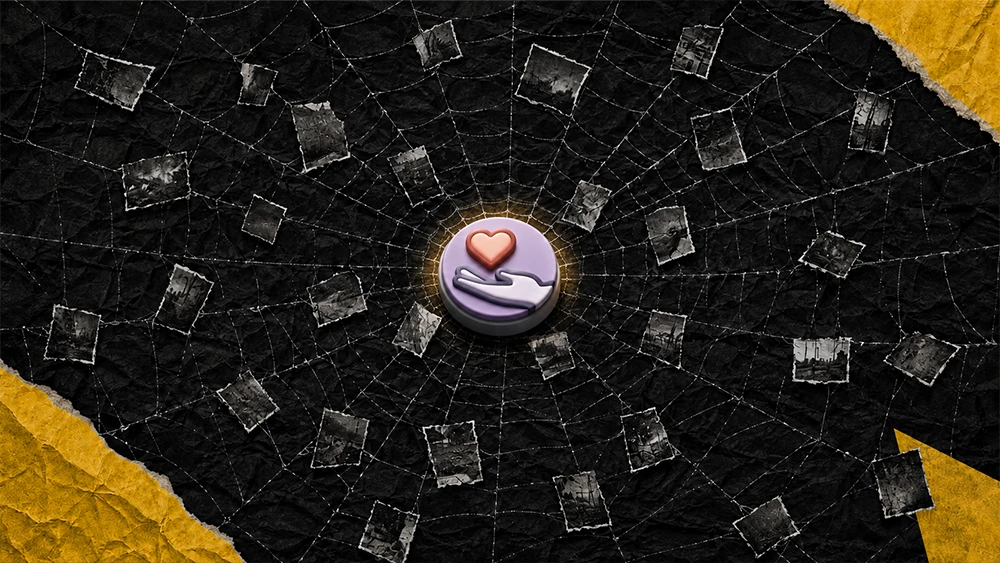
There's an unwritten rule circulating among LinkedIn users, passed along like a survival tip: whatever you do, don't touch the sympathy reaction.
You know the one. Someone in your network posts that their father passed away after a long illness. It's a moving post, the kind of raw human moment that occasionally breaks through the platform's usual wall of "thrilled to announce" and "5 lessons I learned from getting laid off." Your instinct is to acknowledge it. So you tap the little purple heart-in-hands. Support. Condolences. It costs you nothing and it means something.
Except it doesn't cost you nothing. What you've actually done is cast a vote, and the algorithm, which does not understand grief, only signals, hears that vote loud and clear: this user engages with death content.
What happens next is what people have started calling the death spiral. Your feed, previously a manageable stream of hiring announcements and thought leadership, turns into an obituary column. Someone's co-founder died. Someone's wife is in hospice. A second-degree connection you've never met is posting through chemotherapy. React to any of these (and you probably will, because you're not a monster) and the spiral tightens.
The algorithm can't tell sad from good
The uncomfortable part is that the system is working as designed.
Recommendation algorithms don't have a category for "content the user found meaningful but does not want more of." They have engagement, and its absence. Death posts pull enormous reaction counts and comment threads, because the social cost of scrolling past someone's dead parent is much higher than scrolling past someone's product launch. The algorithm reads all that interaction as a quality signal and distributes accordingly. Grief is high-performing content.
The sympathy reaction makes things worse because it's so specific. A generic like is ambiguous. The support reaction gets used almost exclusively on posts about loss, illness, and hardship, so one or two taps hand the recommendation system an unusually clean data point about a "preference" you never expressed and definitely don't hold. Nobody wants more death in their feed. They wanted to be kind, once, to one person.
What this means for the rest of us
For a platform whose entire premise is professional identity, this creates a strange set of incentives.
It helps explain the rise of what one writer called "deathbragging," the steady migration of deeply personal tragedy onto a networking site. If loss posts reliably outperform everything else, the platform is quietly training its users to disclose. Not cynically, in most cases. But the feedback loop is real: vulnerability gets reach, reach feels like community, and the feed fills up with content a work platform was never built to hold.
It's also a reminder that reaction data is not preference data. Any brand treating engagement metrics as a proxy for what audiences want is making the same mistake LinkedIn's algorithm makes. People engage with car crashes. That doesn't mean they want to see more of them. A lot of modern feed misery lives in the gap between what people respond to and what people would choose to see, and engagement-optimized systems have no way to perceive that gap.
Most practically, users are adapting, and their adaptations should worry the platform. When people learn that expressing condolences pollutes their feed for weeks, they stop expressing condolences. The rational move becomes withholding the exact kind of human response that makes a network feel like one. An algorithm that punishes sympathy will, over time, get less of it. Not because people care less, but because they've learned what the button actually does.
That lesson is the real cost of the death spiral, more than the two weeks of bleak scrolling. On an engagement-optimized platform, kindness has a price, and the price is your feed. A social network that makes people afraid to be sociable in the most basic human way has optimized itself into a corner.
So the folk wisdom stands. If someone in your network loses a loved one, send them a message, or write a comment if you must. Just be careful with the purple heart. The algorithm is watching, and it does not know the difference between what moved you and what you want more of.