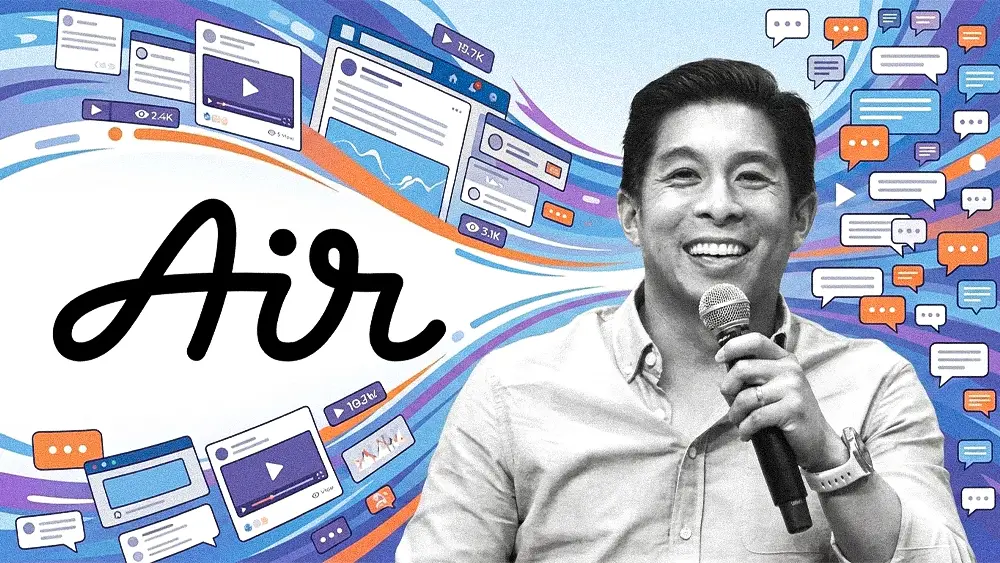
On Monday, Eric Toda announced he'd taken the CMO job at Air. By dinner time, he'd quit.
Six hours (maybe seven). Both posts went up on his real profile, the one attached to twenty years of actual career: Facebook's early ad business, Snapchat's first monetization products, Hill City at Gap, Airbnb, Nike, the brand work through Facebook's rebrand into Meta. Everything about the setup was true except the job.
It turned out to be act one of a five-part improvised mockumentary, with Toda playing a composite of every executive he's ever had to sit across from, opposite Jaeki Cho, Timm Chiusano, and Charles Hsu playing themselves. A bad first day. A campaign meeting that goes nowhere. An HR sit-down. A farewell speech landing Friday. Inc. had the exclusive.
My favorite detail is the one nobody planned. An HR trade publication ran a straight news story announcing the appointment. No wink, no hedge. A reporter saw a plausible executive move and filed it, which is the whole reason the joke worked in the first place.
The notification was the campaign
Most branded video is a film that someone then posts. This was a post that happened to come with a film.
The load-bearing element of the entire campaign is LinkedIn's new-job notification. That notification might be the last piece of high-trust, high-reach, zero-cost inventory left anywhere online. It goes out to people who muted your company page, who scroll past your ads, who have never once opened your newsletter. It carries an implicit endorsement from the platform. And it fires a reflex, congratulations, that people perform without reading much of anything.
So Air walked straight through a piece of LinkedIn's own plumbing that people still trust, and the reach came free.
Then they ran the same trick on the exit. Resignation posts have their own format and their own tempo, and a CMO leaving after six hours breaks a timeline that every professional carries around in their head without ever having been taught it. Nobody needs the joke explained.
Confusion was the deliverable
Days later, people are still arguing in the comments about which parts were staged. Toda has said the team expected exactly that and planned for it.
This is the part most brands would have ruined. The instinct in any marketing org is to resolve ambiguity fast, because ambiguity feels like a failure of clarity and clarity is what everyone gets paid for. But once your audience knows precisely what a thing is, they file it and move on. An unresolved question is a loop that stays open, and people close loops in public, at length, for free. Every argument about whether the resignation was real is distribution the brand didn't buy and couldn't have written.
The serialization does the rest. Five parts across a week turns one spike into an appointment. Most stunts have no second day. This one has a Friday finale and an audience that already agreed to show up for it.
Why breaking the pattern is the only lever left
The case for pattern interruption comes down to supply and demand.
For about thirty years you could substitute money for surprise. Buy the spot, buy the billboard, buy the search position, buy the list. Every one of those has since been either arbitraged flat or buried under volume. B2B outbound is the cleanest example: the second it became free to send a million personalized emails, it became worthless to receive one.
At the same time, the cost of making competent content fell through the floor. Anyone with a laptop can produce a clean landing page, a tidy explainer, a well-structured launch deck, in an afternoon, and it will be fine. Infinite supply pushes price to zero. Polished and on-brand is now the cheapest commodity in the business, which is precisely why it buys you nothing.
What's left is prediction. Scrolling is a prediction machine. You read four words, finish the post in your head, and move on, and you're nearly always right. On-pattern content gets completed by the reader before it's even consumed. The only thing that stops a thumb is a sentence that ends somewhere other than where it was headed.
Which makes "pattern interruption" a narrower idea than the phrase suggests. Being weird is easy and mostly ignored. What you need is a script the audience already has memorized, a context where they fully expect it to be followed, and then a deliberate break. No rigid script, nothing to break. The new-job announcement is one of the most rigidly formatted rituals in professional life, right down to the font of the little briefcase icon. Perfect target.
Your approval chain is where this dies
Every marketing department in America has somebody who could pitch this. Almost none of them will ever ship it, for reasons that have nothing to do with creativity.
Air's head of content, Ariel Rubin, reports directly to CEO Shane Hegde with nobody in between. That reporting line is the mechanism behind everything Air ships, because interruption dies by a thousand reasonable edits. One stakeholder wants the product mentioned sooner. One wants the ambiguity cleared up. One worries the executive looks bad. One asks for a disclaimer at the top. Every note is individually defensible and easy to justify in the review. Together they strip out the exact element that made the thing work, and what ships is wallpaper with a bigger line item.
Rubin has been blunt about the alternative. Asked about spending months building stakeholder trust through small safe experiments, he said he'd quit instead. He's also said, of the reaction to Air's campaigns, "I love when people hate it."
Notice what actually got spent here. Toda put his own name on a false job announcement and then absorbed several days of people sincerely believing he'd flamed out of a role before lunch. Air borrowed a real reputation as collateral, and that's a currency most companies can't access, because only a person can spend it. A brand has nothing to put up.
Toda's own framing is the most useful thing in the campaign: every CMO, brand lead, and recruiter says they want breakthrough work, and this is what it looks like when it actually shows up. The question is whether your organization can survive the four days where nobody can tell yet if it worked.
Where this thesis falls apart
Anyone selling pattern interruption as a permanent operating system is selling you something.
Start with the obvious problem. Interruption is a tax on a pattern, and taxes get priced in. This play works once. The second fake CMO hire is a copy, the fifth is the new bland, and by then the thing you interrupted has quietly become the thing you're doing. The durable skill is reading which script is currently rigid enough to be worth breaking and getting there before the crowd, which is a much harder job than producing a stunt.
Then there's the question of what attention actually converts into. Air ships real product to real customers including Google, JPMorgan, and Mars. When they ran a full-page handwritten letter in the New York Times in March, CEO Shane Hegde's personal cell number printed at the bottom, it landed the same week as the largest product update in the company's history. The interruption pointed at something. Skip that step and you've built a memorable joke about a forgettable company, and guess which half people remember.
Last, you need a plan for the people who feel had. Deception without a fast resolution is a trust withdrawal you don't get to make twice. The version that works discloses quickly, casts the deceiver as the idiot rather than the hero, and lands in a category where the audience is already primed to play along. Miss on any of those and the campaign becomes a crisis you'll spend a quarter cleaning up.
The bar is on the floor
What's genuinely uncomfortable about this execution is how little it required. Nobody got outspent. Air noticed that the feed is full of people who've been processed by committee until they all sound identical, found a ritual everyone performs on autopilot, and broke it on purpose using people willing to look ridiculous on camera.
That's it. Available to everyone, used by almost nobody, because failing loudly gets noticed and failing blandly never does.
Toda's closing line is the right test to hold your next campaign against. If it unsettles nobody and intrigues nobody, your marketing does nothing at all.