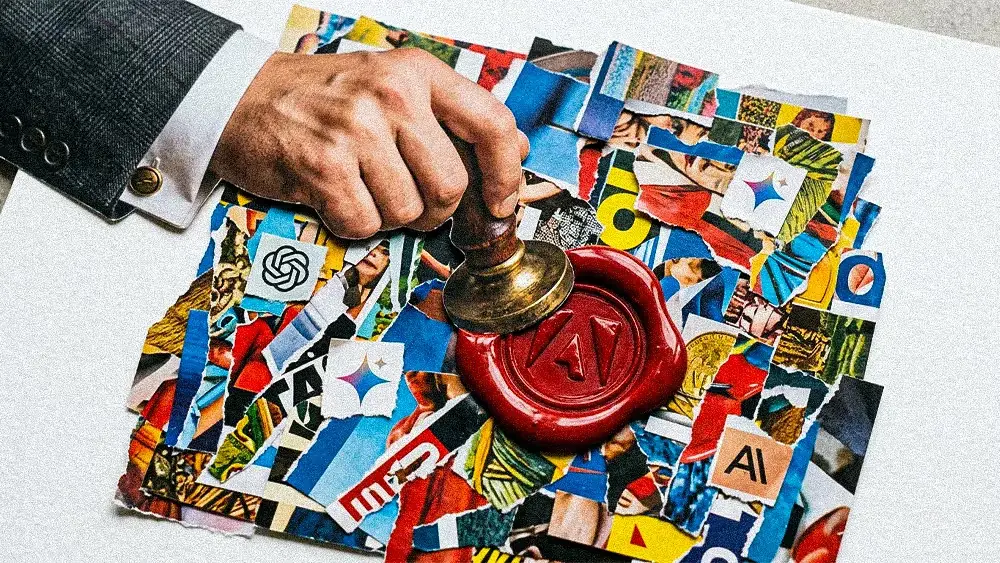
I have a confession that Adobe's CMO probably doesn't want to hear. Last week, I needed a hero image for a presentation. I opened ChatGPT, typed a sentence describing what I wanted, and had a polished, usable image in about eight seconds. The week before that, I used Gemini to generate a set of social media graphics for a campaign concept. They were good. Not perfect. But good enough to share with stakeholders, get alignment, and move forward.
I didn't open Photoshop. I didn't open Illustrator. I didn't open Firefly. I didn't need to.
Here's the part that should bother anyone who has spent a career thinking about brand. The image I used was fine. Fine was the ceiling. It wasn't crafted. It wasn't considered. It wasn't distinctive in any way that would register with a buyer six months from now. But it moved the meeting forward, which in the current calculus is all that mattered.
That calculus is what Adobe is fighting. And the fight is more interesting than most of the coverage suggests.
The B2B marketing leaders I talk to every week are running the same playbook. They're generating pitch deck visuals in ChatGPT. Building landing page mockups in Claude Design. Creating social graphics in Canva's AI tools. Producing video concepts in Runway. The creative workflow that used to require a designer starts and finishes inside a chat window.
The numbers tell one version of that story. Adobe's stock is down 37% over the past year. Figma dropped 7% the day Claude Design shipped. Canva is approaching IPO with $3.5 billion in ARR and 260 million users. The SaaS software ETF has lost $2 trillion in value since early 2026.
The other version is happening this week in Las Vegas. Adobe Summit 2026 pulled 14,000 attendees from 60 countries. The company just launched Adobe CX Enterprise, Adobe Creative Agent, and Adobe Brand Intelligence. Over 20,000 global brands have built their businesses on the platform.
So which story is true? Is Adobe a legacy giant being disrupted, or the company that matters more than ever now that AI is flooding every content pipeline with fine?
Adobe's CMO Is Reading This Moment Better Than Most
Lara Balazs Hood joined Adobe as CMO after a career running brand and marketing at Intuit, and since taking the seat, she has been telling anyone who will listen that "we're entering a golden age of creativity." On The CMO Podcast in March, she described leading "one of the most ambitious AI-enabled marketing transformations in the industry," and spoke about Adobe's refreshed mission to "empower everyone to create."
Hearing that in a market where ChatGPT, Gemini, Claude Design, and Canva can already produce a usable asset in seconds, the easy read is corporate positioning. Empower everyone to create feels like a slogan written for a world that no longer exists. Everyone already can.
Spend more time with what Balazs Hood is actually arguing, though, and the framing holds up. Her claim is more specific than the slogan suggests. Creation is the beginning of the enterprise marketing job, and everything hard about brand happens after it. Anyone can generate an image, a prototype, a slide deck, or a video concept. The tools are free or nearly free. The quality is fine for most use cases. That part is settled.
The golden age lives in what happens after the image gets made. Brand control at scale. The work of ensuring the thousands of assets being generated across an enterprise actually look, sound, and feel like they belong to the same company. That's the gap between "I can make an image" and "I can make an image that is on-brand, legally safe, properly formatted for seven channels, approved by the right stakeholders, and consistent with the 50,000 other assets the company produced this quarter."
That gap is where Adobe lives. And Balazs Hood is one of the few marketing leaders naming it out loud, while most of her peers are still debating whether AI belongs in the creative stack at all.
Five Times the Content, None of the Coherence
Adobe's own research says marketers expect content demand to rise five times over the next two years. That number reflects business expectations more than AI capability. The moment a CMO realizes AI can generate personalized content for every segment, every channel, every market, and every stage of the buyer journey, the expectation calcifies into a mandate. Do all of it.
Most companies are. Badly. A Barron's investigation found that AI-generated corporate language has homogenized to the point where earnings calls, press releases, and shareholder letters from different companies now read like variations on the same draft. 74% of new web pages contain AI-generated content. Output has exploded. Coherence has collapsed. The enterprises producing the most content are, by almost every measure that matters to a brand leader, saying the least.
Adobe read that gap earlier than most of its category. At Summit this week, the company launched Adobe Brand Intelligence, described as "a continuously learning reasoning engine that captures evolving brand signals" and ensures "every piece of content is on-brand." It sits inside GenStudio, Adobe's content supply chain platform, as an intelligence layer that any AI agent in the workflow can call.
Alongside it, Adobe launched Creative Agent, which can autonomously execute creative workflows, and CX Enterprise, an agentic system connecting brand visibility, customer engagement, and content supply chain under a single architecture. The system supports MCP integrations with Anthropic's Claude, Google's Gemini, Microsoft's Copilot, and OpenAI's ChatGPT. Adobe has no interest in replacing those tools. The company is building the governance layer that sits on top of them.
That is the strategic pivot that most of the coverage is missing. Adobe stopped competing with ChatGPT on image generation and started competing on what happens after the image exists. Who approves it. Whether it holds up against the brand guidelines. Whether the legal team can sign off. Whether it ships to seven channels in the right format. Whether it belongs in the same creative universe as everything else the enterprise has shipped this year.
Every one of those questions is a brand question. Adobe is betting that the company answering them at scale is the company enterprises cannot afford to rip out.
The Legal Footnote That's Actually a Moat
Adobe trains its Firefly models on licensed or public domain data and backs enterprise customers with legal indemnification. Every Firefly asset ships with a guarantee that it won't infringe on someone's copyright. Most of the consumer-facing AI image generators offer no such thing.
For a marketing leader producing at scale, that guarantee matters more than any quality gap between Firefly and ChatGPT. A company generating 10,000 AI-created assets per quarter needs only 1% to contain a copyright-triggering element before the legal exposure turns into a boardroom conversation. Adobe's commercial safety guarantee moves that risk off the marketing team's ledger entirely.
That is a trust moat. Anthropic has one in safety-first AI. Ramp has one in "we want you to spend less." Adobe's is "everything we generate is commercially safe for enterprise use." When foundation model providers are racing on capability, the company racing on trust and governance is running a different, and arguably more durable, playbook.
On the Summit keynote stage, Adobe CEO Shantanu Narayen delivered the line that crystallized the entire strategy. "Tools don't create, people do." Five words, and the cleanest articulation of Adobe's bet I've heard from anyone this year. The company is claiming a specific spot in the stack, the layer that ensures what gets created is controlled, consistent, and commercially safe. Creation can happen anywhere now. Governance happens in Adobe.
Adobe Lost the Chat Window. It May Have Won the Stack.
Adobe's vulnerability at the individual creator level is real. When a marketer needs a quick image, ChatGPT is faster, cheaper, and good enough. When a product manager needs a prototype, Claude Design is more intuitive than learning Figma or Adobe XD. The "I just need something decent in 10 seconds" use case has already migrated to foundation model providers and the application layers built on top of them. No keynote is going to reverse that, and a generation of creators is coming up without ever opening Photoshop. Adobe's stock reflects the shift. The shift is structural, and Adobe cannot undo it.
The governance layer is a different market, and most of the companies absorbing Adobe's creator base aren't set up to compete in it. No foundation model provider is building the system that keeps tens of thousands of quarterly assets on-brand. No AI startup is building the content supply chain that runs from creative production through review, approval, distribution, and analytics. No chat-based design tool is taking on the legal indemnification that lets Fortune 500 companies generate at scale without copyright exposure. That work takes years to build and decades of enterprise relationships to sell. Adobe has spent 40 years assembling both. Most of its disruptors are four years old.
None of that makes Adobe safe. It means the company is playing a different game than its stock price suggests. Losing the creator and winning the enterprise are not mutually exclusive, and the next two years will decide whether Adobe can give up the first without the second unraveling.
The Lesson Adobe Is Handing Every B2B Brand
Adobe's position in 2026 is the position most B2B brands are about to find themselves in. The core capability you sell is getting easier for AI to replicate. The creation layer of your value proposition is being commoditized faster than any strategic plan assumed.
What survives is everything that sits above the making. The workflow depth. The institutional knowledge. The regulatory relationships. The brand consistency. The trust your enterprise customers have spent years extending to you, and will not hand over to a faster competitor without a fight.
Balazs Hood's golden age of creativity framing holds, with one adjustment worth making. The real test of the age is the ability to create at scale while holding the consistency, quality, and integrity that make the output worth paying for. The companies that solve that problem, in any category, are the ones whose work will still be building something in five years.
Anyone can make an image in ChatGPT. The brands that win the next decade will be the ones that make sure every image, every asset, every piece of content across every channel tells the same story to the same buyer in the same voice. That is brand work. And it has never been more valuable than it is right now.