The math underneath B2B marketing has changed, and most brands haven't caught up yet.
Google search traffic to publishers dropped 33% globally in the year to November 2025, according to Chartbeat data published in the Reuters Institute's Journalism and Technology Trends 2026 report. For smaller publishers, the damage has been worse. Referral traffic from traditional search engines declined 60% over two years. Some well-known tech publications have reported search referral drops exceeding 85%.
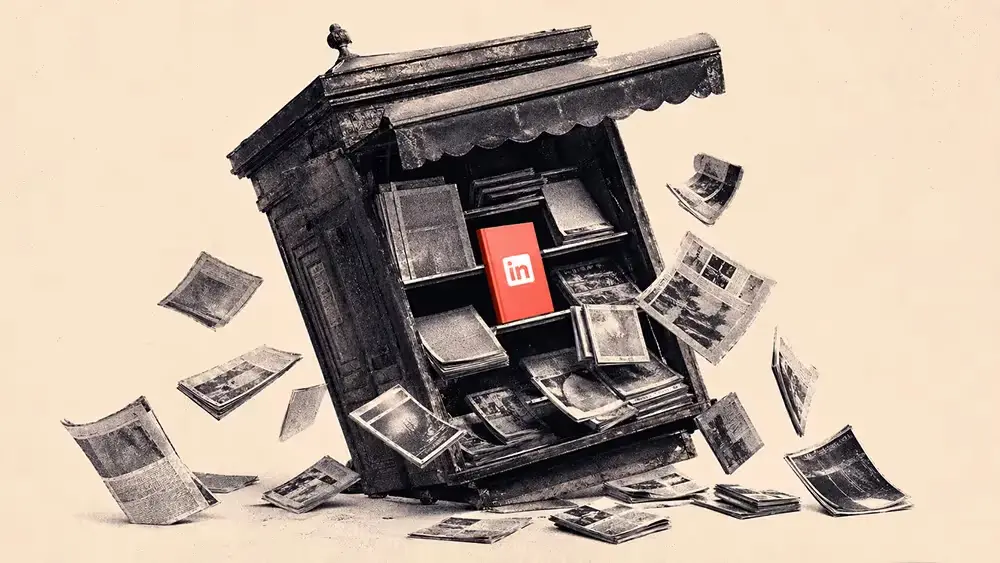
At the same time, trade publications that B2B companies have relied on for decades to reach their buyers are shuttering, consolidating, or cutting staff at historic rates. Publishers have been candid about losing 20%, 30%, and in some cases 90% of their traffic and revenue over the past year. The Reuters Institute projects more closures in 2026.
The result is a vacuum. And a growing number of companies are choosing to fill it, not by spending more on ads or pitching the remaining publications harder, but by building their own newsrooms.
The Rise of Owned Media Infrastructure
The concept of a brand newsroom is not new. Red Bull, American Express, and Apple have operated media arms for years. But what's happening now is different in kind. Companies are staffing journalists, building editorial operations, and publishing third-person industry news at a pace and quality level that competes with, and in some cases outranks, traditional media.
Rippling is one of the more striking examples. When the HR and IT platform faced a high-profile corporate espionage case involving competitor Deel, it didn't issue a standard press release. It published the story on its own domain, written in third-person journalistic style. The piece outranked every publication that covered the story. Months later, when Rippling announced a $450 million funding round, it used the same playbook, and again, its own coverage sat at the top of search results.
A recent survey of 367 editors by recruiter Chandra Turner found that 66% have left traditional media for roles in content, communications, and marketing. The Wall Street Journal reported that LinkedIn job listings mentioning the term "storyteller" doubled over the past year. OpenAI, Google, and Anthropic are all paying premiums to hire experienced journalists and editors. The talent migration is real and picking up speed.
The Edelman Trust Barometer found that 80% of people trust the brands they use more than they trust government, media, or NGOs. A 2025 Gallup poll put American trust in mass media at just 28%, a record low. The distance between those two numbers is, more and more, the business case for brand-owned journalism.
Why Distribution Has Gone LinkedIn-First
For companies building these editorial operations, the distribution question has a clear answer: LinkedIn.
The platform has crossed 1.3 billion total members and generated 1.4 billion monthly visits as of February 2026. But what matters more for B2B brands is the composition. Four out of five LinkedIn members drive business decisions at their organization. The platform generates 80% of all B2B leads from social media, outpacing every other channel by a wide margin.
The Edelman-LinkedIn 2025 B2B Thought Leadership Impact Report found that 95% of decision-makers say thought leadership directly influences their purchasing decisions. Nearly two-thirds prefer content that is less formal and more human in tone.
And here is the number that should reshape how every B2B company thinks about its LinkedIn investment: posts from individual profiles receive 8x the engagement of identical content from company pages. That gap is widening, not closing. LinkedIn's algorithm has made this shift official, rewarding authentic, expert-driven content from real people over polished corporate messaging. For B2B brands, the takeaway is simple: employees are the distribution now.
This is the model that Outlever, a San Diego-based company co-founded by former BuzzFeed VP and Cheddar CRO Melissa Rosenthal, has built its entire business around. Outlever operates what it calls the first LinkedIn-first native newsroom, building owned media ecosystems for B2B companies that function like trade publications but live across a brand's own domain and social channels. The company deploys journalist teams, proprietary media listening tools, and a publishing infrastructure that produces industry news at editorial speed and quality, distributed natively through LinkedIn rather than depending on traditional SEO or paid media.
"Trade publications are dying, and that's creating an opening for well-funded companies to become the authoritative news source in their industries," Rosenthal has said. "But this requires real infrastructure. Journalist teams, custom tooling, and a publishing operation that functions like a newsroom, not a content marketing department."
The AI Citation Layer Changes Everything
There is a second shift happening that makes this strategy even more important: AI search engines are now citing LinkedIn content at a rate that would have been hard to predict even a year ago.
A Semrush analysis of 325,000 unique prompts across ChatGPT Search, Google AI Mode, and Perplexity found that LinkedIn is the second most-cited domain across all three platforms, trailing only Reddit. On average, 11% of AI-generated responses reference a LinkedIn URL, ahead of Wikipedia, YouTube, and every major news publisher.
Separately, data from Profound, drawn from 1.4 million citations across six AI models between November 2025 and February 2026, showed that LinkedIn's domain rank on ChatGPT jumped from roughly #11 to #5 over that period. That is more than a twofold increase in citation frequency. Axios reported that for professional queries specifically, LinkedIn is now the #1 most-cited domain across every major AI search platform: ChatGPT, Gemini, Google AI Overviews, Google AI Mode, Microsoft Copilot, and Perplexity.
The type of content getting cited matters, too. Posts, long-form articles, and newsletters together now account for roughly 35% of all LinkedIn citations within ChatGPT responses, up from about 27% at the start of the tracking period. On ChatGPT Search and Google AI Mode, 59% of citations come from individual creators, not company pages. Articles between 500 and 2,000 words receive the most citations, and most cited authors are frequent posters who publish more than five times in a four-week period.
Put plainly: AI search engines are now treating LinkedIn content as a primary source of truth for business and professional queries. Companies and individuals that publish consistently on the platform are not only building an audience. They are building a citation footprint that shapes how AI tools describe their industry.
This is what makes the owned media play more than a content strategy. When a company operates a newsroom that publishes original, third-person journalism on its own domain, and distributes that content natively through LinkedIn via employees, executives, and subject-matter experts, it creates a feedback loop. The content builds brand authority with human readers. It simultaneously builds citation authority with AI systems. And because AI models tend to reinforce the sources they have already cited, the companies that move first build an advantage that gets harder to close over time.
What a LinkedIn-First Newsroom Actually Looks Like
Outlever's model puts specific mechanics behind the idea. The company builds what it describes as "account-based media," a brand newsroom that produces hundreds of stories per week covering market intelligence, industry trade news, partner perspectives, and company developments. The output reads like a trade publication because it is written by former journalists using editorial standards, not like a corporate blog repurposing product messaging.
The distribution layer is native to LinkedIn. Rather than publishing articles on a company blog and waiting for search traffic, the content flows through the profiles of employees, executives, and partners, the voices LinkedIn's algorithm is actively rewarding. This maps directly to the data: individual creators drive the majority of AI citations on ChatGPT and Google AI Mode, and personal profiles generate 8x more engagement than company pages on LinkedIn itself.
Rosenthal's background informs the approach. At BuzzFeed, she helped build one of the most successful digital media operations of the last decade. At Cheddar, she was part of the founding executive team that scaled the company from under $1 million to $50 million in revenue before its $200 million acquisition by Altice USA. At ClickUp, as Chief Creative Officer, she brought that publisher mindset into a SaaS company for the first time, an experiment that became the template for Outlever.
The company also runs State of Brand, its own marketing publication covering owned media, brand strategy, and go-to-market trends, demonstrating the model by practicing it.
The Case for Owned Distribution
The forces behind this shift are not cyclical. They are not going away.
Google referral traffic to publishers has dropped by a third and is expected to keep falling. The Reuters Institute projects a 43% total decline by 2029. Trade publications are closing or consolidating, leaving coverage gaps across dozens of industries. AI search engines are rewarding platforms where credible, expert-authored content lives, and LinkedIn has emerged as the primary beneficiary. Meanwhile, 96% of B2B content marketers already use LinkedIn to distribute content, and 94% of B2B buyers say they use AI tools in the early stages of the buying journey.
The companies that see this are not adding LinkedIn to their marketing mix as an afterthought. They are rebuilding their entire distribution strategy around it, with a newsroom at the center.
It is a bet that the next generation of B2B influence will not be won through banner ads, gated whitepapers, or shrinking trade publication placements. It will be won by the companies that become the publication and own the conversations their customers care about.