
powered by




OpenAI released GPT-5.5 this morning. Greg Brockman called it a step toward "more agentic and intuitive computing". And for brand leaders, the question isn't "should we adopt AI" anymore.
OpenAI released GPT-5.5 this morning. Greg Brockman called it a step toward "more agentic and intuitive computing" (TechCrunch). Sam Altman posted on X that he "personally likes it" (TechRadar). Understatement has become OpenAI's preferred launch posture.
Don't let the casual tone fool you. GPT-5.5 is the first fully retrained base model since GPT-4.5, a ground-up rebuild with a natively omnimodal architecture that unifies text, images, audio, and video in a single system (VentureBeat, Lushbinary). It shipped seven weeks after GPT-5.4. One week after Anthropic released Claude Opus 4.7.
For brand leaders, the question isn't "should we adopt AI" anymore. The question is whether your brand is structured to survive in an environment where AI agents are doing the first 70% of your buyer's journey before a human ever enters the conversation.
OpenAI is positioning GPT-5.5 around a single idea: the model understands what you're trying to accomplish and carries more of the work itself (9to5Mac, OpenAI).
That sounds like standard launch copy until you see what it means in practice. Codex, OpenAI's coding and task-execution product, now uses GPT-5.5 to browse web apps, test user flows, capture screenshots, and iterate on what it observes until the task is complete (9to5Mac). That's not autocomplete. That's an autonomous agent running multi-step workflows with minimal human supervision.
OpenAI VP of Research Mia Glaese was direct about it: GPT-5.5 is their strongest model for coding by both benchmarks and partner feedback (VentureBeat). Brockman went further and connected the release to OpenAI's long-stated vision of a unified "super app," a single service combining ChatGPT, Codex, and an AI browser for enterprise customers (TechCrunch).
Early testers used GPT-5.5 Pro less like a chatbot and more like a working partner. An immunology professor at the Jackson Laboratory ran a gene-expression dataset spanning 62 samples and nearly 28,000 genes through the model and got back a research report that surfaced questions his own team hadn't considered. He said it would have taken months the old way (OpenAI).
The implications for brand operations are direct. A model that can research, draft, check, and iterate isn't a writing assistant. It's a workflow engine. And the teams that plug it into their brand operations are going to be producing at a velocity that teams without it can't match.
Most of the GPT-5.5 coverage is focused on benchmarks and pricing. The part that matters most for brand teams is getting almost no attention.
OpenAI is building toward a super app. A single surface where hundreds of millions of users search, research, compare, build, browse, and buy (TechCrunch). SemiAnalysis analyzed this trajectory after GPT-5 launched and argued that OpenAI's router architecture and tool-use capabilities were built to enable agentic purchasing, where AI agents evaluate options, check out products, and complete transactions on a user's behalf (SemiAnalysis). Instacart already lets AI agents complete checkout. Fidji Simo, who oversaw that feature at Instacart, now runs product at OpenAI.
For brand, this isn't speculative. This is an infrastructure change that rewrites how buyers discover and evaluate you.
Harvard Business Review's March 2026 piece on preparing brands for agentic AI identified three interaction modes that now define the buyer journey: consumers talking to brand agents directly, searching through personalized third-party AI, and letting AI negotiate with other AI on their behalf (HBR). GPT-5.5 makes all three faster and more autonomous.
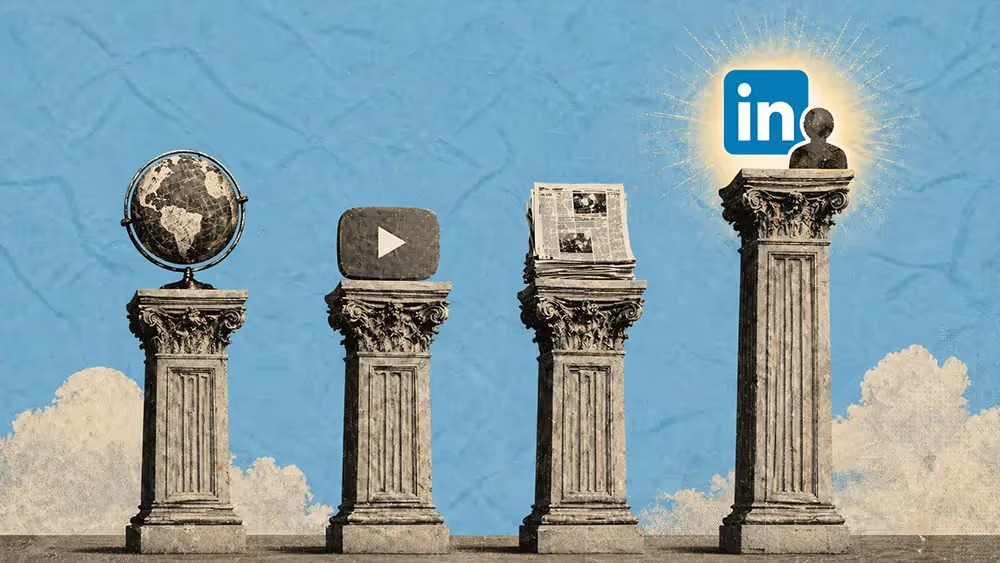
LinkedIn is now the second most-cited domain across ChatGPT Search, Google AI Mode, and Perplexity. Employee content on personal profiles is becoming source material for how AI systems describe industries and shortlist vendors. A brand without coherent, expert-driven content in the places where AI trains is a brand that doesn't show up in the AI discovery layer at all.
When the AI agent is doing the buying research, your brand needs to be the one it recommends. That requires clarity. Not SEO tricks. Not gated PDFs. A brand position distinct enough for a machine to parse and consistent enough for it to trust.
Marketing Week published one of the most important pieces on this dynamic last year. Tom Roach argued that brands need to start thinking of LLMs as a new audience, not just a tool. Campaigns that generate earned media on Reddit, YouTube, and LinkedIn aren't just building salience with people. They're becoming training data. The source material AI systems pull from when a user asks which vendor to choose (Marketing Week).
GPT-5.5 makes that dynamic faster, deeper, and harder to reverse-engineer after the fact.
Claude Opus 4.7 shipped April 16, exactly one week before GPT-5.5. The two models are competitive on benchmarks, trading leads depending on the task. Opus 4.7 leads on SWE-bench Pro at 64.3% versus GPT-5.5's 58.6%. GPT-5.5 leads on Terminal-Bench 2.0 at 82.7% versus 69.4%. On computer use benchmarks like OSWorld-Verified, the gap is negligible: 78.7% versus 78.0% (R&D World, VentureBeat, Digital Applied).
That benchmark parity is exactly why the brand positioning of each company matters more than the model specs.
Anthropic's enterprise trajectory is worth sitting with. Annual recurring revenue jumped from $9 billion to $30 billion, driven by enterprise adoption of Claude for coding and security workloads (Lushbinary). Claude Code became the most-used AI coding tool among professional engineers. Anthropic controlled 54% of the enterprise coding market by early 2026 (Zapier). Claude Code alone became a multi-billion-dollar revenue line.
And then there's Mythos. Anthropic published a 245-page system card for Claude Mythos Preview, a model so capable at discovering and exploiting cybersecurity vulnerabilities that the company chose not to release it publicly. The New York Times reported that the Bank of England's governor warned Anthropic may have found a way to reshape the entire cyber-risk landscape. The European Commission met with Anthropic multiple times without gaining access (R&D World).
Anthropic restricted its most powerful model. OpenAI shipped its most powerful model to every paid subscriber the same morning.
That contrast is a brand strategy story as clear as any in tech right now. OpenAI's brand is velocity and ubiquity. The bet that putting more capability in more hands creates more value. Anthropic's brand is restraint and trust. The bet that safety and selectivity build a different kind of market position. Both are winning. Anthropic is winning enterprise infrastructure. OpenAI is winning consumer surface area. They're building different futures, and the brands that build on each platform need to understand which future they're buying into.
Stanford's AI Index report put the underlying dynamic in plain terms: the capability gap between frontier models is closing while the trust gap is widening (Stanford HAI). When the models are at parity, differentiation shifts to brand. That's true for the AI companies themselves. And it's true for every company that depends on them.
Meta removed manual ad targeting, deprecated legacy campaign types, and started generating creative by default in 2026. LinkedIn's 360Brew algorithm replaced the old engagement-counting system with a 150-billion-parameter model that reads content semantically and rewards expertise over corporate broadcasting (Forbes). Barron's found 73 corporate documents in a single quarter using the identical "not just X, it's Y" construction. AI-generated brand language is already collapsing into sameness .
GPT-5.5 accelerates every one of these trends. When an AI can execute a multi-step campaign from research to draft to review to publish, the execution layer isn't a differentiator anymore. It's table stakes. The teams that still define brand work as "making the thing" are measuring the wrong output.
What's left is the part that was always the most valuable and the hardest to automate. The positioning. The voice. The strategic clarity that tells every system, human and machine, what this company stands for and why it's different.
OpenAI itself gets this. Their GPT-5.4 launch documentation highlighted "strong personality and tone adherence, with less drift over long answers" as a feature (TrueFuture Media). The model is getting better at following brand rules. But it still needs brand rules worth following. A model that adheres perfectly to a vague brief produces perfectly vague output.
Stop treating model releases as IT updates. GPT-5.5 is a market structure shift. So was Claude Opus 4.7. So was Gemini 3.1 Pro. The frontier is being rebuilt every few weeks, and the brands that adapt to each shift are compounding an advantage that the ones still running annual planning cycles can't close.
The 95-5 rule, that 95% of your market isn't in-market today but will remember what you stand for when they are, has always been the core argument for brand in B2B. The arrival of AI agents that autonomously research, shortlist, and recommend vendors makes that rule load-bearing. If your brand isn't readable to the AI doing the research, you won't make the shortlist. Period.
Brand clarity isn't a nice-to-have that justifies a workshop anymore. It's infrastructure. It's the input layer that determines whether your positioning survives translation through an AI agent, a LinkedIn algorithm, a Google AI Overview, and whatever OpenAI's super app looks like by Q4.
GPT-5.5 just made execution cheaper, faster, and more autonomous than it's ever been. The only asset it can't manufacture is a point of view worth executing.
That's brand. And it's the only thing left that's expensive to build, impossible to commoditize, and fatal to neglect.


The best editorial systems don’t happen by accident. Outlever builds them.


The best editorial systems don’t happen by accident. Outlever builds them.