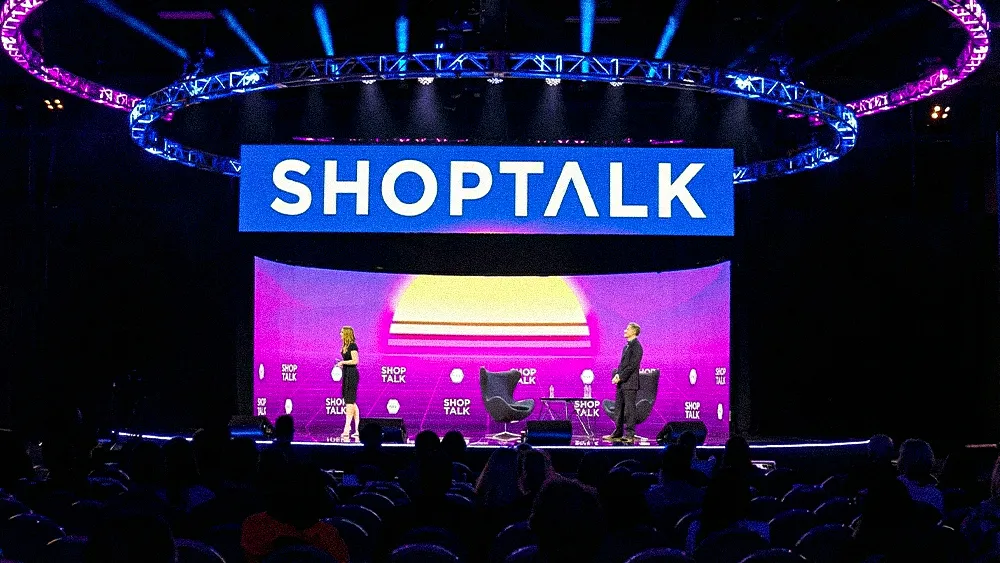
Shoptalk Spring wrapped in Las Vegas last week, and if you only read the headlines, you'd think the entire conference was about agentic shopping and AI-powered checkout. But the hallway conversations, dinner table chats, and honest moments between sessions told a different story. Leaders spoke of the growing distance between what AI can do and what their organizations are actually able to execute, with brand absorbing most of the fallout.
I've attended enough industry conferences to know that stage content and hallway reality always diverge, but lately the gap is feeling wider than ever. On the main stage, the energy was ambitious and future-forward, with reveals like Meta’s AI-powered shopping experiences and Sephora’s dedicated app within ChatGPT. Off stage, CMOs described teams drowning in tool sprawl, brand managers told stories of AI-generated content going live that didn't match their positioning, and marketing ops leaders described data foundations that weren’t ready for automation stacking.
The numbers behind the gap: Stensul's research, discussed widely at the conference, found that 53% of organizations lack comprehensive AI governance for marketing campaigns, while AI adoption is simultaneously the top mandate for 38% of teams. Nearly 90% of organizations without governance reported at least one campaign error in the past year. The most common fix is a heavier review process, which kills the speed advantage AI was supposed to create. McKinsey's State of Marketing 2026 report found that 94% of European marketing organizations haven't advanced their AI maturity, and the 6% that have are seeing 22% efficiency gains. Everyone else is buying tools without a strategy to reap the benefits.
Why brand breaks first: Brand is consistency at scale. When organizations move fast without governance, the brand is always the first thing to fracture. I've witnessed the companies I've advised deploying AI across email, social, content, and ad copy, each team setting its own quality standards. Some review output carefully, but others let it slip, and the result is a brand that comes across differently depending on the tool that generated the content and the team that produced it. No single asset is recognizably off, but the brand starts to feel generic, inconsistent, even hollow. It's subtle enough that buyers often can't articulate why their trust is eroding, but erode it does nonetheless.
The irony is that the brands least prepared for AI are often the ones deploying it the fastest, as the pressure to keep up is overwhelming. AI will produce more content, more campaigns, and more touchpoints than ever, but when all of it is slightly misaligned with the brand it represents, the effect undoes years of trust faster than any single mistake could.
A handful of sessions throughout the Shoptalk agenda made a clear case for something the main stage kept dancing around: brand infrastructure, not AI capability, is what separates the companies that will compound their advantages from the ones that will slowly erode them.
The human layer is the strategy: Lowe's VP of Customer Marketing Amanda Bailey articulated something I've been saying for years: buyers go to creators for ideas, inspiration, and validation, not just product recommendations. Human credibility is the trust layer that automation cannot manufacture. An EMARKETER analyst reinforced this with perhaps the most important observation of the week: most buyers who receive an AI recommendation still go do their own research. AI creates a new entry point to brand evaluation, but the brand still has to hold up when buyers arrive. Employee advocacy, executive thought leadership, and creator partnerships are the credibility infrastructure that makes your AI presence worth trusting.
Governance before scale: The 6% of organizations McKinsey identifies as AI leaders aren't winning because they adopted faster. They prioritized infrastructure first: data foundations, quality standards, workflow governance, and clear ownership of AI output quality. I've always believed brand systems are the operating system for marketing, and AI governance is now an extension of that system. Without it, every AI deployment is a brand risk dressed up as a capability.
Measure readiness, not adoption: Too many brands at Shoptalk were celebrating AI deployment without being able to answer basic questions. Is the output consistent with our positioning? Who reviews it? How do we catch inaccurate claims before they ship? The metric that matters isn't how many tools an organization uses. It's whether the governance, data, and standards are in place to use them without compromising the brand.
Shoptalk 2026 showed an industry at a genuine decision point. One path leads to organizations that build governance and groundwork before scaling automation, compounding AI's advantages on top of a brand that's already clear, consistent, and trusted. The other leads to organizations that chase every capability announcement, deploy without standards, and slowly erode the trust that took years to build.
The stage made it look like everyone already has AI all figured out. As a professional who has spent a career protecting precisely the things that makes brands valuable, I'm here to tell you: they don't.