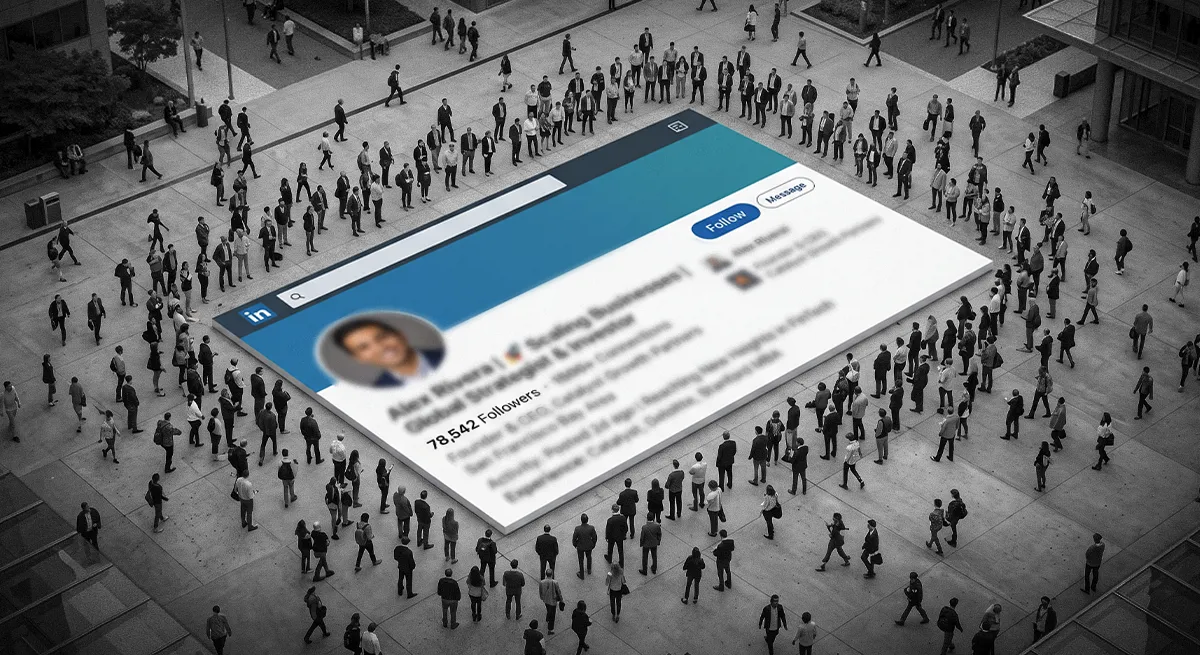
For about ten years, the LinkedIn playbook had one number at the center of it. Followers. Build the audience and the reach would follow. Get to 10,000, then 50,000, then 100,000, and your posts would land in more feeds by default. Every "grow your LinkedIn" course, every agency pitch, every quarterly brand report leaned on the same assumption: more followers, more reach, but now the data tells a completely different story.
Follower count and reach have come apart. The number most have spent years growing is now close to a vanity metric for any given post. And this is the same pattern we keep documenting in this publication: the gap between what LinkedIn implies and what LinkedIn's algorithm actually rewards is where the real story lives. If you are still reporting follower growth to your CMO as a performance number, you are operating on outdated information.
The Numbers Behind the Decoupling
The clearest evidence comes from Richard van der Blom's Algorithm Insights Report, produced by his consultancy Just Connecting. The 2025 edition analyzed 1.8 million posts across 58,000 profiles and 31,000 company pages. A later round added roughly 1.3 million more, and a separate fall pass covered around 400,000 profiles. No single study settles anything on its own, but this is the dataset marketers actually cite.
The headline finding is that follower count and reach are now structurally decoupled. In the current data, an account with 8,000 focused followers can out-distribute one with 80,000 scattered ones, according to analysis of the 2026 report by LinkedIn consultant Melanie Goodman. Relevance now outweighs volume.
The broader collapse it sits inside is one we wrote about in LinkedIn's Algorithm Killed Company Pages. Van der Blom's data shows overall views down 50%, engagement down 25%, and follower growth slowed by 59%. The audience is not gone. The platform is actively routing attention away from sheer audience size and toward something else entirely.
360Brew Stopped Counting Followers
The mechanism behind the shift has a name we have covered before: 360Brew, the AI ranking model that replaced LinkedIn's old content system. The old algorithm was, at its core, a reaction counter. It measured early likes, comments, and shares, and your follower base was the pool it drew that early signal from. A bigger list meant a bigger head start.
360Brew works differently. It reads content semantically, weighs whether the creator has genuine topical authority based on their profile and posting history, and prioritizes dwell time, saves, and comment depth over raw engagement volume. Audience size is no longer the lever. Relevance to a specific professional interest is.
You can see why followers stopped mattering by following a single post through the system. When you publish, LinkedIn does not push the post to your followers. It runs a test first. The post goes to a small sample made up of your most engaged connections, people who recently interacted with similar content, and a slice of random followers. The first 30 to 60 minutes of engagement decide what happens next, as laid out in this breakdown of the four-stage distribution model. Strong early signal widens distribution. Weak signal ends the post inside the test window, no matter how many followers you technically have.
Followers, in other words, get you into the audition, but they do not win it for you.
The Reach Is Concentrating
That change has reshaped who gets seen at all. In van der Blom's data, visibility for top creators climbed from 15% in 2022 to 31% in 2025, while the broad middle fell from 57% to 28%. Consistency and topic authority are pulling reach toward a small group of focused accounts. A large but generic following is being left behind by the same model that used to reward it.
This connects directly to the format story we covered in LinkedIn Is Quietly Killing Video Reach and the citation story in LinkedIn Has Become AI's Favorite Source Material. The platform is rewarding specific, expert, text-forward content from credible individuals, and follower count is not part of that equation.
The Honest Version of the Claim
It would be wrong to say follower count means nothing. Followers still form the initial test audience and set a ceiling on how many people can ever amplify a post. The accurate version of the argument is narrower. Follower count is a weak predictor of how a given post performs, not an irrelevant one. Some practitioners push it further, with one analysis calling follower count close to irrelevant to whether a post lands at all.
The evidence has limits too. Most of it is proprietary research from consultancies and analytics vendors, including van der Blom's reports and large datasets from tools such as AuthoredUp, which analyzed 621,833 posts. It is not peer reviewed, and the providers do not always agree with each other.
The Brand Strategy Takeaway
If you are building a LinkedIn plan for 2026, here is what the data supports.
Take follower count off the performance scorecard. It measures audience accumulation, not whether your content works. Impressions relative to follower count, early engagement rate, and reach among non-followers tell you something real about how a post performed.
Narrow your topic. 360Brew rewards accounts that are clearly about something, so a feed that swings between hiring posts, product news, and industry commentary reads as noise to a system trying to match content with intent. Two or three themes, posted consistently, do more for reach than any amount of audience growth.
Move distribution from the logo to the person. Company pages were already losing the feed, and a large branded following now offers almost no structural advantage. A focused employee with a few thousand relevant connections will routinely out-distribute a company page with hundreds of thousands of followers.
This is the latest entry in a run of pieces we have published on LinkedIn's platform shifts. The throughline keeps repeating. LinkedIn has rebuilt who and what gets distribution, and the brands reading the data instead of the follower count are the ones that will still be visible when the feed reshuffles again.