Owned Media Is Not a Newsletter. It's an Operating Strategy.
A newsletter is not an owned media strategy. Here's what winning companies actually build: an editorial engine that treats audience as an asset.
Make State of Brand one of your go-to sources on Google

There's a version of the owned media conversation happening in marketing meetings right now that goes something like this. The team has read the numbers on collapsing search traffic and cratering social reach. Someone proposes the fix: "We should start a newsletter." Six weeks later, a Beehiiv account exists, a welcome sequence is live, and the company believes it has an owned media strategy.
It doesn't. It has a channel.
The distinction matters, because the gap between the two is where most owned media efforts quietly die. A newsletter is a delivery mechanism. Owned media, as practiced by the companies making it work, is an operating strategy: a deliberate system for deciding what a brand covers, who it reaches, how the content travels, how editorial activity converts into commercial outcomes, and how the whole thing gets measured as an asset rather than a campaign. Outlever, the company that builds these systems for brands and runs one itself with this publication, describes the difference bluntly: a newsroom is not a content format. It's infrastructure.
The newsletter trap
The newsletter shortcut is understandable. Email is the one channel marketers still trust after watching everything else erode. Fewer than one in three Google searches now sends a click to any website, per SparkToro's 2026 analysis of Similarweb data. LinkedIn company pages reach roughly 1.6% of their followers, down from 7% in 2021. Against that backdrop, a subscriber list a brand actually owns looks like salvation.
But a list is only as valuable as the reason people joined it and the reason they stay. And that's precisely what a newsletter, on its own, cannot answer. Most B2B newsletters are a repackaging layer: the same blog posts, product updates, and curated links, delivered to an inbox instead of a feed. The channel changed. The content strategy underneath it didn't. Open rates decay, list growth stalls, and within a year the newsletter joins the blog in the category of things the company publishes that its market doesn't read.
The failure isn't the format. It's the absence of everything around it.
What the strategy actually contains
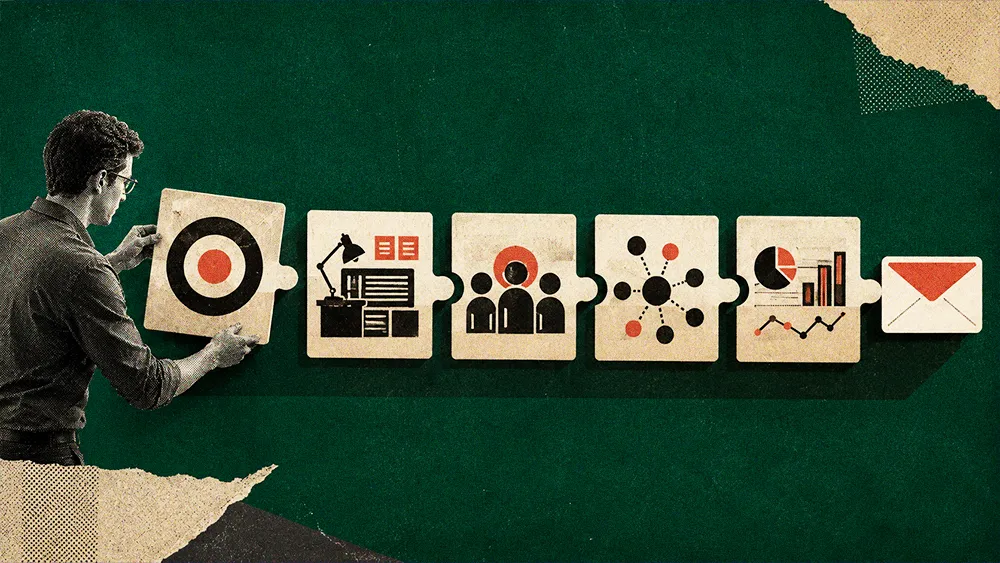
Look at the owned media programs that are compounding rather than stalling, and a consistent architecture shows up underneath them. It has five parts, and the newsletter is at most one-fifth of one of them.
An editorial position. Before anything gets published, the strategy answers a harder question: what is this publication for, and for whom? The working answer sits at the overlap between what a specific industry genuinely cares about and where the brand credibly belongs in that conversation. That's a beat, in the journalistic sense. It's narrow on purpose. A publication that tries to cover everything for everyone competes with the entire internet. A publication that owns one industry's conversation competes with almost no one, because trade media itself is thinning out and leaving the seat empty.
A newsroom operation. The strategy runs on editorial speed, not campaign cadence. That means original reporting, practitioner interviews, and fast commentary on the stories the industry is already talking about, produced continuously rather than batched into quarterly content calendars. This is the part that most resembles actual journalism, and it's the part in-house content teams find hardest to replicate, because it requires a different muscle: news judgment, sourcing, and a publishing pipeline built for tempo. It's also where operators like Outlever have concentrated their investment, deploying journalist teams and media listening tooling so that brand newsrooms can react to industry news the day it breaks, not the quarter after.
Interviews as pipeline architecture. Here's where owned media stops being a marketing program and becomes a go-to-market motion. When the people featured in the coverage are drawn deliberately from a company's ideal customer profile, every editorial conversation is also a relationship with a future buyer. The interview subjects share the coverage, which distributes it person to person through exactly the networks the brand wants to reach. Demand generation and brand building, long separated into different budgets with different metrics, collapse into a single motion. No newsletter does that by itself. It's a function of who the strategy chooses to cover.
A distribution system, plural. The newsletter finally enters here, and it's one surface among several. The full system pairs a home base the brand controls with distribution wherever the audience already is: LinkedIn as the primary engine, employee and executive profiles carrying the content natively, syndication and pickup extending the reach, and increasingly, AI search surfacing the work to people who never saw it in a feed. That last channel is small but moving fast. Similarweb data shows AI referral visits more than tripled year over year, and when ChatGPT began linking directly to brands inside its answers this May, referral traffic jumped over 150% in a week. Answer engines cite recognized sources and original reporting. A newsletter locked in an inbox is invisible to them. A publication is not.
A measurement model built for assets. Campaigns get measured on attribution. Assets get measured on leading indicators: are the right people reading, returning, sharing, and appearing in the coverage? The strategy defines those signals up front and holds the line while they build, because waiting for clean, linear attribution before believing in the asset is how companies kill the thing before it works. This is arguably the most strategic component of all, since it's the one that determines whether the program survives its first budget review.
Where the newsletter actually fits
None of this makes the newsletter irrelevant. In a functioning owned media system, it plays a specific and valuable role: it's the direct line. It converts anonymous readers into a known audience, insulates the relationship from every algorithm, and gives the brand a channel that works even if LinkedIn's reach falls another 60%. That's real.
But it's the last mile, not the strategy. The newsletter distributes the value the rest of the system creates. Strip out the editorial position, the newsroom, the ICP-driven sourcing, and the multi-channel distribution, and what's left is an empty pipe. The companies discovering this the hard way are the ones staring at a twelve-month-old newsletter with flat growth, wondering why owning the channel didn't translate into owning the audience.
The State of Brand runs on the full system, not the shortcut. The publication reached 1.5 million monthly unique visitors within three months of launch, and the majority of that traffic arrives from unpaid, off-platform sources. The newsletter is part of the machine. It has never been the machine.
The strategic takeaway
The shift underway in go-to-market isn't from blogs to newsletters. It's from renting attention to operating media. That's a bigger commitment than a new channel, and it's supposed to be. The commitment is the moat. Any competitor can launch a newsletter in an afternoon. Very few will build an editorial position, staff a newsroom motion, wire their coverage to their ICP, run distribution as a system, and defend asset-based measurement long enough for it to compound. The ones that do, whether in-house or with a partner like Outlever operating the engine, end up owning something no platform can repossess: their industry's attention, arriving directly.
A newsletter is something you send. Owned media is something you become.
Frequently asked questions
Is a newsletter considered owned media? Yes, a newsletter is one form of owned media, because the brand controls the channel and the subscriber relationship. But a newsletter alone is not an owned media strategy. The strategy includes the editorial position, the reporting operation, the distribution system, and the measurement model that make the newsletter worth subscribing to.
What does an owned media strategy include? Five components: an editorial position focused on a specific industry's conversation, a newsroom operation producing original reporting at editorial speed, interview sourcing aligned to the brand's ideal customer profile, a multi-channel distribution system spanning the brand's site, LinkedIn, and AI search, and a measurement model that tracks audience-quality indicators ahead of revenue.
Why do most B2B newsletters fail? Because they repackage existing content rather than sitting on top of a real editorial engine. Without original reporting and a clear beat, there's no durable reason to open the email, so growth stalls and engagement decays within the first year.
How is owned media different from email marketing? Email marketing is a distribution tactic that pushes messages to a list. Owned media is a publishing strategy that builds the audience, the trust, and the content the email carries. In a working system, email is the last mile of distribution, not the strategy itself.
Do you need a full team to run an owned media strategy? No. The on-ramp can be a single content marketer with a narrow beat and a fast publishing rhythm. What's non-negotiable is the system thinking: a defined audience, an editorial position, and distribution beyond the inbox. Companies like Outlever build and operate the full engine for brands that want the infrastructure without the multi-year learning curve.

If this caught your attention, that’s not accidental.

The best editorial systems don’t happen by accident. Outlever builds them.

If this caught your attention, that’s not accidental.

The best editorial systems don’t happen by accident. Outlever builds them.


Come back for the reason it lands.
Subscribe for the kind of thinking that makes people stop, read and come back.