


powered by




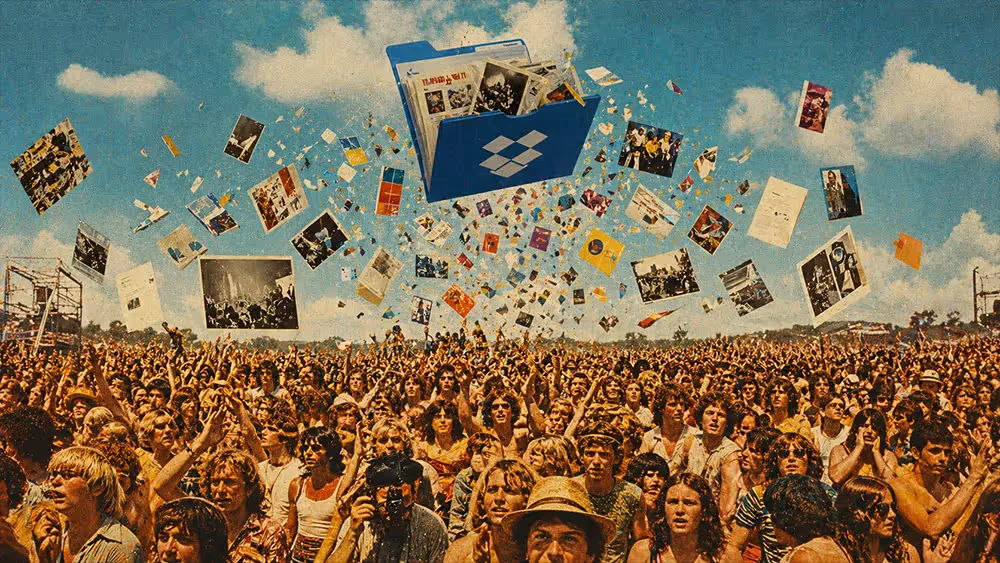
Fred again.. asked fans to cover their phone cameras at every USB002 show. Then he shared photos and videos with them through Dropbox.
There is a version of this story that reads like a standard brand partnership announcement. Global artist teams up with tech company to share exclusive tour content. Fans get access to behind-the-scenes files. Both parties post about it on social media.
That is not what happened here. And what did happen should change the way every brand team thinks about partnerships.
Fred again..'s USB002 tour, which ran across 10 cities over 10 weeks from October 2025 through February 2026, did something almost no major tour does anymore: it asked fans to put their phones away. Not metaphorically. Organizers handed out stickers at the door to cover phone cameras so everyone could stay present. No cameras. No video. No recording the set through a screen you will never watch again.
In exchange, Fred promised something specific. After every show, his team would share the photos and videos from the night directly with fans. Not through an app. Not through a proprietary platform built for the occasion. Through a Dropbox folder.
Nobody at Dropbox was involved. There was no sponsorship agreement. No brand integration deal. Fred and his creative team were already using Dropbox to collaborate on the visual identity of USB002 across time zones and cities, and when they needed a way to share content with fans after each show, they used the tool they were already working in.
Dropbox's Head of Brand Marketing, Liz Armistead, described the origin story in a LinkedIn post that every brand partnerships team should read:
"For his USB002 tour, Fred and his creative team wanted to make sure attendees could be totally present, so he asked people to cover their phone lenses, and he shared photos and videos via Dropbox after each show so they could relive the night. We weren't involved and we didn't sponsor any of it. This was all his doing."
After the tour wrapped, Fred reached out to Dropbox because he wanted to extend the experience. He wanted to keep giving fans access to the creative world behind USB002 through the same tool his team had been using all along. Armistead's response captured what makes this different from every traditional brand partnership: "The dream brand partnership: a real customer, wanting to provide more value to his community with our help. Obviously we said, 'hell yes.'"
The Dropbox folder that went live today is not a curated press kit. Not a highlight reel packaged for social media.
These are the actual working files Fred's creative team used to build USB002. Original flag designs. Show posters from every city. Vinyl artwork and templates, including unseen and unused options. The ambient show creative folder. Unseen images from each stop. Visual stems from the slow-motion visualizers that defined the tour's aesthetic. The large-scale fabric installations by artist Boris Acket, documented in full.
Billboard reported that the files reflect how global creative teams actually work today: collaborating, experimenting, and sharing ideas across fragments and time zones. Fans who access the folder are encouraged to download, edit, and repurpose the content however they want. Make new posters. Cut new videos. Remix the aesthetic of the tour into something entirely different.
The brand and the artist are handing fans the raw materials and saying, do something with this.
USB002 was not a normal tour. It was structured as a rolling creative experiment: 10 weeks, 10 cities, 10 new songs, one released each Friday alongside a show in a different city. The guest collaborators included Four Tet, Skream and Benga, Caribou, Floating Points, Sammy Virji, and Danny Brown, among others. The tour culminated in six nights at New York's East End Studios and four nights at London's Alexandra Palace, where the final show featured a back-to-back set with Daft Punk's Thomas Bangalter, which Fred later called "the greatest show of my life."
But the detail that defined the tour's identity, the thing fans are still talking about months later, was the phone policy. On TikTok, fans are posting about their USB002 camera cover stickers like concert memorabilia. The sticker became the artifact. The absence of phones became the experience.
Fred got something right that most brands still miss: in a culture drowning in content, scarcity creates value. By removing phones from the equation, he did not limit the experience. He elevated it. The shows became something you had to be in the room to understand. And then, by sharing the professional documentation after the fact, he gave fans a way to relive something they had actually lived through, rather than something they had watched through a four-inch screen.
The Dropbox folder is the second half of that equation. Not supplementary content. The fulfillment of a promise that was baked into the experience from night one.
The Fred again.. partnership did not come out of nowhere. It landed in the middle of a pattern that Dropbox has been quietly building for years.
Skrillex dropped his album FUS via a Dropbox link emailed directly to subscribers in April 2025, 14 hours before its official release. The Dropbox comment section turned into an impromptu listening party, with fans reacting to tracks in real time. Ronnie Fieg has used Dropbox folders to preview Kith collections. Maison Margiela shared not just final product, but working creative files through the platform. Nearly 70% of films at the 2026 Sundance Film Festival were made using Dropbox.
The pattern across all of these is the same: the brand did not insert itself into the culture. The culture was already using the product.
That gap is what separates what Dropbox is doing from what most brand partnership programs produce. A typical sponsorship starts with a business development team identifying a cultural property, negotiating placement, and then trying to reverse-engineer authenticity into the activation. The creative is manufactured. The relationship is transactional. The audience can always tell.
Dropbox has something most brands would kill for: organic product usage by the creative community at a scale that turns the traditional partnership model inside out. The brand does not have to convince anyone that creatives use Dropbox. They already do, and they tell each other about it. The partnership layer just amplifies something that was already happening.
Armistead put it simply: Dropbox did not sponsor the USB002 tour. They were not involved. Fred was a real customer who wanted to provide more value to his community. Dropbox said yes.
The Fred again.. partnership launched the same week as Dropbox's broader "The More You Share" brand campaign, created with agency Even/Odd and covered by Ad Age. The campaign profiles three creators to show how sharing is the mechanism through which creative work actually gets better. It positions Dropbox not as storage, but as the moment a creative person hits share and the work goes from private to real.
Fred again..'s USB002 drop is the lived version of that positioning. Not an ad. The campaign's thesis playing out through an artist who independently arrived at the same conclusion: sharing creative files with a community is how you deepen the connection between the work and the people who care about it.
When a brand campaign and a real-world product use case arrive at the same narrative independently, that is not a coincidence. That is brand-market fit, and most companies never get there.
Most B2B companies approach partnerships and sponsorships by asking: where is our target audience, and how do we get our logo in front of them? The question produces stadium signage, conference booths, and podcast ad reads. It occasionally produces something culturally interesting, but usually by accident.
Dropbox is operating from a different question: where is our product already showing up in culture, and how do we support what is already happening?
That question produces Fred again.. sharing working creative files with his entire fanbase through a Dropbox folder, and the brand showing up as the infrastructure that made it possible rather than the sponsor that paid for placement. It produces Skrillex using a Dropbox link as his album release mechanism, not because anyone at Dropbox asked him to, but because that is actually how he distributes files to his audience. It produces Sundance filmmakers name-checking Dropbox in behind-the-scenes content because that is genuinely what they used to make the movie.
The takeaway for B2B brands is not "find your Fred again.." It is simpler than that. If your product is genuinely embedded in how creative, professional, or cultural work gets done, the partnership opportunities are already there. You do not need to manufacture them. You need to listen for them, and then get out of the way enough to let the story be about the creator and the community, not about the brand.
Armistead's LinkedIn post ends with a link to the Dropbox folder and a line that says everything about how Dropbox approached this: "If you're a fan, you might uncover some teasers for what's to come."
Not: if you are a Dropbox user. If you are a fan.
The brand disappeared into the experience. That is why it worked.


The best editorial systems don’t happen by accident. Outlever builds them.

The best editorial systems don’t happen by accident. Outlever builds them.
Subscribe for the kind of thinking that makes people stop, read and come back.