Minjae Ormes Has Built Three Iconic Brands. Her Biggest Lessons All Come From When Things Went Wrong.
Minjae Ormes has built challenger brands inside giants, turned a two-day old company's worst crisis into its strongest brand moment, and reshaped how a billion people think about professional identity.
Make State of Brand one of your go-to sources on Google

Most brand strategies are designed for the moments that go right. Minjae Ormes has built her career in the moments that don't. Across YouTube, Visible, and LinkedIn, she has operated at the intersection of diplomacy and storytelling, building and rebuilding trust from the inside out. The thesis she keeps returning to is that a brand reveals itself under pressure, and the decision made in that moment is the only one that actually counts.
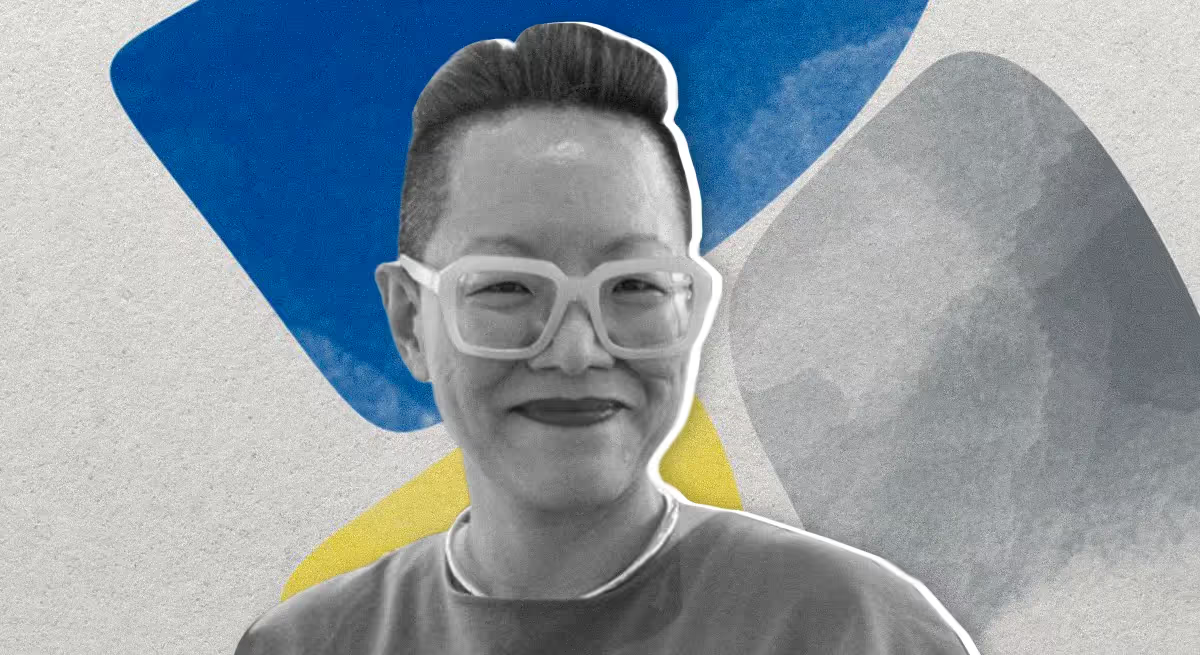
Minjae Ormes is a CMO and strategic advisor who has led brand at three of the most consequential platforms of the last two decades. At YouTube, she launched the first global creator campaign at a moment when the industry was still debating whether creators mattered. At Visible, she built a challenger brand from scratch inside Verizon. At LinkedIn, she oversaw global brand, consumer product marketing, and research during one of the most significant cultural shifts in how people think about work. Her background is as unconventional as her results, a Georgetown School of Foreign Service degree followed by a master's in cinema from NYU Tisch, a combination she describes less as a detour and more as the foundation for everything that followed.
"Diplomacy requires that you discreetly bring parties together and get everybody to think it was their idea in the first place," Ormes said. "Put the egos aside and goals forward, and you can move forward from a place that's closer than where you started."
That instinct runs through every chapter of her career. Reading rooms, understanding motivation, and connecting people across competing contexts are, she argued, the same skills that brand building demands.
The 48 hour test
Visible launched as a direct-to-consumer telecom brand inside Verizon, and 48 hours after going live, the service went down. The company had no brand equity, no contracts locking customers in, and no established relationship with the people who had just signed up in a category defined by low switching costs and even lower brand loyalty.
"When you don't have anything to fall back on, how do you fall forward in that moment to demonstrate who you aspire to be as a business?" Ormes said. "That is ultimately what brand is about."
The team credited customers with one month of service and gave two months in advance. Hundreds of customers wrote back with essay-length responses, part gratitude, part product feedback, and became Visible's first real community. Retention flipped. Customers who had no reason to stay chose to.
"We couldn't have written it ourselves into the best kind of movie twist," she said.
That single decision became the story the team kept returning to as the business grew, a reference point for every subsequent choice about what it meant to be simple and transparent.
Building inside giants
The Visible chapter was one of three times Ormes has built or rebuilt a brand inside a much larger parent organization. YouTube inside Google. Visible inside Verizon. LinkedIn inside Microsoft. Each required the same core skill, moving fluidly between a startup culture she was protecting and a boardroom she was managing, sometimes within the same hour.
"You have to go high and low between different contexts," she said. "One hour, you're having a board-level conversation with stakeholders invested in your business. The next hour, you show up for your team in a startup culture, protected from the existing company mentality, able to run faster."
The throughline across all three, she argued, is that winning internally always precedes winning externally. The brand that shows up on the outside is a direct expression of the culture and decisions happening on the inside. At LinkedIn, that meant shifting how 20,000 employees thought about who LinkedIn was for, before any of that shift could become legible to a billion members on the platform.
When she arrived in 2021, the prevailing perception of LinkedIn was that it was built for people who had already made it. The pandemic had cracked that open. Work was being rethought in real time, and the opportunity was to reflect that back into the brand's own sense of identity. "LinkedIn's mission is to create economic opportunity for every single member of the workforce," she said. "If you're that literal about inclusion, you have to create an aperture that wide. People need to be able to slide in rather than see a wall they don't think they can climb over."
What brand does versus what brand is
Visible and LinkedIn sit at opposite ends of the same lesson. At Visible, brand was forged in a crisis and made visceral for everyone who lived through it. At LinkedIn, the challenge was ensuring that an essence built over twenty years didn't get diluted across tens of thousands of employees and a billion-member platform while also evolving enough to stay relevant. "How do you make sure that essence doesn't get lost when it goes all the way to the 20,000th employee's decision?" she said.
Brand is the hardest currency to earn and the easiest to lose, built in the decisions that happen when nobody planned for them.
AI exposes what's already there
AI is clarifying, and fast. The brands that already know who they are will use it to build, and the ones still figuring that out are about to have the question answered for them. "With any accelerated innovation, it simply exposes what is or isn't already there," Ormes said. "Those who are chasing the tail behind it versus starting from within to apply what this could be, you can already tell the difference."
The examples she finds most compelling come from far outside the frontier model conversation. A pet and livestock health company sitting on decades of patient data, now building toward predictive care. A mineral mining company with hundreds of years of extraction records, using them to locate the next resource. Both were going back to what they had always known and asking what AI made possible on top of it.
Some companies are racing to plant a flag before they have anything worth standing for. "Novelty and attention alone are never enough to create what is enduring," she said. Clarity about who you are turns out to be the only durable AI strategy.
You don't have to fit in to belong
Ormes was recognized by Adweek as one of the most impactful Asian leaders in marketing, and her perspective on representation in the C-suite is shaped by the same instinct that runs through everything else. The edge, she has found, lives in the difference.
"You don't have to fit in in order to belong," she said. "The moments where I felt most me were when I unapologetically owned my difference, and other people acknowledged that."
The distinction she draws between acceptance and acknowledgment is deliberate. Acceptance implies conforming to someone else's standard. Acknowledgment is being seen for what you actually bring, and having that be enough. Ryan Roslansky, who led LinkedIn as CEO during her time there, told her on her first day that her fresh perspective was her superpower and that she should not lose it. "He wasn't saying, you just got here, sit in the back," she said. "He was saying, right now, you're one of the most valuable contributors because you have a fresh perspective."
Her advice to the next generation of marketers, particularly women of color navigating organizations that were not built with them in mind, is the same clarity she has carried her whole career. Own the difference. The room will be better for it.
The views and opinions expressed are those of Minjae Ormes and do not represent the official policy or position of any organization.

If this caught your attention, that’s not accidental.

The best editorial systems don’t happen by accident. Outlever builds them.
If this caught your attention, that’s not accidental.

The best editorial systems don’t happen by accident. Outlever builds them.


Come back for the reason it lands.
Subscribe for the kind of thinking that makes people stop, read and come back.