New Data Proves Your 'AI Employee' Is Destroying Trust Faster Than It's Cutting Costs
Companies are putting AI agents on org charts, giving them names, and calling them teammates. A large-scale experiment shows this is backfiring on accountability, quality, trust, and professional identity.
Make State of Brand one of your go-to sources on Google

The idea sounded clean. Give the AI agent a name. Put it on the org chart. Call it a teammate. Let the rest of the company adjust their mental model from "tool I use" to "colleague I work with."
CEOs loved the framing. It signaled ambition to investors. It made agentic AI feel less foreign to employees. And it gave internal champions a narrative they could sell to skeptical managers: this is not a threat, it is a peer.
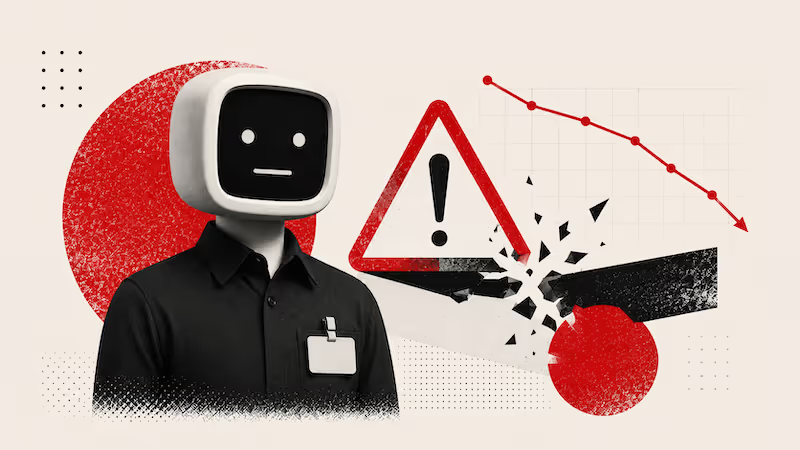
New research from BCG's Matthew Kropp, Julie Bedard, and their collaborators, published this week in Harvard Business Review, tested that assumption with a randomized experiment involving 1,261 managers across the U.S., Canada, and the EU. The findings are not subtle. Anthropomorphizing AI did not increase adoption. What it did was erode accountability, degrade review quality, spike unnecessary escalation, and damage professional identity and organizational trust.
For brand leaders and operators watching this space, the implications go well beyond HR policy. They cut to the core of how companies build trust internally, how they govern output quality at scale, and how they position themselves in a market where AI credibility is rapidly becoming a differentiator.
The Experiment
The researchers gave managers workplace documents that contained deliberate errors and asked them to review the work. The only variable across three groups was who supposedly drafted the document: an AI tool, a human employee named Alex, or an AI employee named ALEX-3.
Among managers whose organizations had already placed AI agents on their org charts, the "AI employee" framing triggered a cascade of problems.
Accountability shifted away from humans. Personal accountability dropped by 9 percentage points when AI was framed as an employee rather than a tool. Accountability attributed to the AI system rose by 8 points. One participant whose company lists an AI agent named "Kevin" on the org chart described the reflex: when something goes wrong, the team says "Kevin made a mistake," redirecting ownership to software that cannot actually bear responsibility for anything.
Error detection collapsed. Managers reviewing documents from an "AI employee" caught 18% fewer errors than those reviewing output from an AI tool. Critical mistakes slipped through. In one case, a budget document claimed a contract would reduce costs while the attached spreadsheet showed expenses going up. In another, an entry-level job description required more than ten years of experience. These are the kinds of errors that, at scale, turn into costly operational failures and reputational damage.
Escalation surged. The AI employee framing increased requests for additional managerial review by 44%. This was not thoughtful oversight. Participants in the AI employee group reported lower confidence in their own judgment and were more likely to pass work upward rather than stand behind their review. The cost to organizations is real: more review cycles, slower throughput, and a workforce that is progressively outsourcing its confidence to a layer of management above it.
Professional identity took a hit. Managers were 13% more likely to report uncertainty about their professional role when leadership framed AI as a teammate. They reported 7% higher concern about job security and 10% lower trust in how AI would be used. One participant put it bluntly: if you want people to feel replaceable, put the AI on the org chart.
Adoption did not increase. This is the finding that should stop every executive mid-announcement. Humanizing AI produced no measurable increase in intent to adopt. Participants exposed to the AI employee framing showed no higher adoption than those who were told it was a tool. What did drive adoption was managerial encouragement and visible role-modeling.
This Is Not an Isolated Finding
The HBR study lands in the middle of a data environment that keeps saying the same thing from different angles.
BCG's own AI at Work report, surveying more than 10,000 employees globally, found that only 13% of organizations have deployed AI agents integrated into workflows. More than half are still running pilots or experiments. And the perception gap between leadership and the workforce remains enormous. BCG and Columbia Business School research found that 76% of executives believe their employees feel enthusiastic about AI. Only 31% of individual contributors said they actually do.
That two-to-one gap is not a communication problem. It is a governance problem. Leaders are making assumptions about workforce readiness that the workforce itself does not validate. And when companies respond to that gap by making AI feel more "human" through naming, org chart placement, and teammate framing, the research now shows they are compounding the problem rather than closing it.
Klarna provided the most public case study of what happens when AI-as-replacement framing meets operational reality. The company announced in 2024 that its AI chatbot was doing the work of 700 customer service agents. The CEO publicly declared that AI could do all human jobs. By mid-2025, Klarna was quietly rehiring. Customer satisfaction had dropped. The quality of automated responses could not handle complexity, nuance, or the kind of problem resolution that builds loyalty. The CEO acknowledged that cost had become too dominant a factor and that investing in human support quality was the way forward.
Klarna's reversal is now cited in boardrooms as a cautionary reference point. More than half of companies that executed AI-driven layoffs reportedly regret the decision. The pattern keeps repeating: volume metrics look strong while quality metrics decay, and by the time leadership notices, the brand damage is already compounding.
The Larridin 2026 State of Enterprise AI Report surveyed over 350 senior leaders and found that while 92% of C-suite executives express confidence in AI's impact, 58% cite unclear or fragmented ownership as their primary barrier to measuring AI performance. Three-quarters lack comprehensive AI governance programs. The enthusiasm is real. The infrastructure to support it is not. The Conference Board's 2026 C-Suite Outlook Survey found that AI investments are now a top-three strategic priority for two-thirds of CEOs, but technology leaders are consistently more bullish on AI deployment than the functional leaders who actually have to manage the output.
The Brand Angle Everyone Is Missing
Most coverage of this research will frame it as an HR or operations story. It is a brand story.
Every output that leaves an organization carries the brand with it. When accountability diffuses, when error detection declines, when professional confidence erodes, the quality of what a company ships degrades. Not overnight. Not in one dramatic failure. It happens gradually, across thousands of documents, decisions, and customer touchpoints, until the gap between what the brand promises and what it delivers becomes visible to everyone except the people inside it.
The companies that framed AI as an employee did not get more adoption. They got less oversight. In a market where trust is the primary differentiator, less oversight is not a competitive advantage. It is a liability.
Consider the downstream effects. A budget document with contradictory numbers gets approved because someone assumed ALEX-3 had it handled. A job posting with absurd requirements goes live because the reviewer caught fewer errors and escalated instead of correcting. A customer-facing report contains flawed logic because the team diffused responsibility across the AI, the manager, and leadership, and nobody owned the output.
Each of these is a brand event. Each one erodes the credibility that took years to build.
BCG's research on AI maturity found that companies leading in AI value creation are 3.5 times more likely to have managers who actively role-model AI use in daily operations. The mechanism is not framing. It is behavior. When a manager uses AI visibly, talks about what it does well and where it falls short, and takes personal ownership of the output, the team follows. When a company instead gives the AI a name and a spot on the org chart, the team takes a step back.
What This Means for Companies Building With AI
The research points to a set of design choices that companies need to make deliberately rather than by default.
Treat AI as what it is. Software that requires human accountability for every output it produces. Not a junior employee. Not a teammate. Not a peer. The framing matters because it shapes behavior downstream, and the behavior the "employee" framing produces is exactly the wrong set of behaviors for maintaining quality at scale.
Redesign roles, not just org charts. As AI handles more execution, human roles shift toward supervision, judgment, and orchestration. BCG projects that 50% to 55% of jobs will be significantly reshaped by AI within two to three years, while only 10% to 15% face full displacement. That shift requires new expectations, new performance standards, and new skill development. Companies that skip this step and simply layer AI onto existing workflows are the ones experiencing the quality degradation and confidence erosion the research describes.
Make oversight a valued skill. The study found that managers reviewing AI-employee output experienced a version of what the researchers call "AI brain fry," a cognitive fatigue from excessive oversight that leads to more errors. When the AI was framed as a tool, managers still bore the cognitive burden of review. When it was framed as an employee, they felt permission to disengage. The implication is clear: organizations need to invest in building oversight capability and rewarding it explicitly, not assume it will happen automatically because someone's job title includes the word "manager."
Close the perception gap before it closes you. The two-to-one gap between executive enthusiasm and employee reality is not benign. BCG's AI Radar report found that 82% of CEOs are more optimistic about AI than they were a year ago, and half believe their job stability depends on successfully integrating AI in 2026. Meanwhile, longitudinal research from Perceptyx shows the biggest shift in employee engagement drivers ever recorded: employees have moved from asking "how can I grow here?" to "do I believe this company will succeed, and will I succeed with it?" This creates an environment where leadership makes decisions based on assumptions the workforce does not share, and where announcements about AI teammates land as threats rather than invitations. Closing that gap requires honest internal communication about which roles are being augmented, which are being restructured, and what success looks like in each case.
Do not confuse framing for strategy. Putting AI on the org chart is a framing choice. Building governance systems, redesigning workflows, and developing human capability are strategy. The research is unambiguous: framing alone does not drive adoption, and when it substitutes for strategy, it makes the underlying problems worse.
The Larger Pattern
We keep seeing the same dynamic play out. Companies race to signal AI ambition through announcements, branding, and symbolic gestures. The market rewards the signal in the short term. Then the operational reality catches up, and the companies that invested in governance, training, and deliberate role design pull ahead while the signalers scramble to fix what they broke.
Klarna announced AI employees and then rehired humans. Companies put agents on org charts and then watched accountability dissolve. CEOs declared that AI could do every job and then discovered that the jobs it could not do well were the ones that mattered most to customers.
The pattern is not about AI being overhyped. The technology is genuinely transformative. The pattern is about companies treating adoption as a narrative exercise rather than an organizational design challenge. The narrative gets the headlines. The design gets the results.
The companies that will build durable competitive advantage with AI are the ones that skip the performative teammate framing and do the harder work: redesigning how humans and AI systems collaborate, building governance that scales with output volume, investing in the human judgment that AI cannot replace, and measuring success by the quality of what ships rather than the ambition of what gets announced.
The data is in. Your AI employee isn't driving adoption. It's pushing accountability out of your org and errors into your output. That's not a workforce strategy. That's a brand risk.

If this caught your attention, that’s not accidental.

The best editorial systems don’t happen by accident. Outlever builds them.

If this caught your attention, that’s not accidental.

The best editorial systems don’t happen by accident. Outlever builds them.


Come back for the reason it lands.
Subscribe for the kind of thinking that makes people stop, read and come back.