



powered by




Klarna's very public reversal on AI-driven workforce replacement is not a customer service story. It's a brand story. And it's the one your company is quietly living through right now.
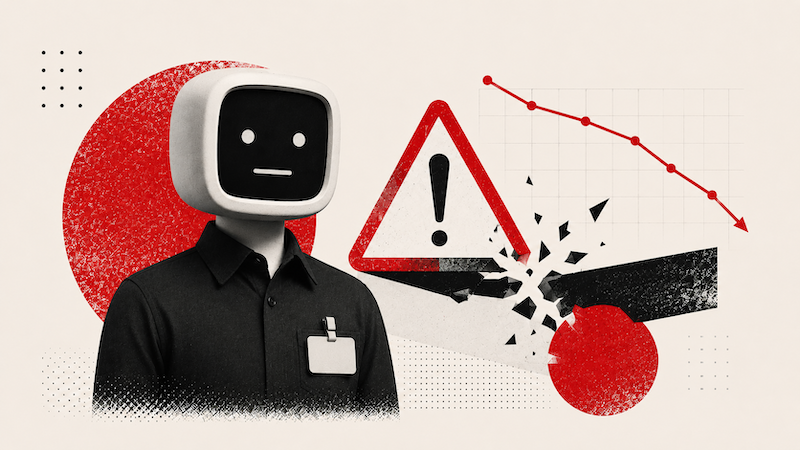
In 2024, Klarna replaced roughly 700 customer service roles with an OpenAI-powered chatbot. The AI handled 2.3 million conversations in its first month. It took over 75% of all customer chats across 23 markets and 35 languages. CEO Sebastian Siemiatkowski called himself Sam Altman's "favorite guinea pig." Klarna froze all hiring for over 12 months. Headcount dropped 22%. The message to the market was loud: AI is cheaper, faster, and infinitely scalable. Humans are a line item to be reduced.
Then the brand started breaking.
Customer satisfaction declined. Complaints increased. Repeat contact rates climbed, which meant customers were reaching out multiple times for the same unresolved issue. The AI could move through volume at speed, but it couldn't tell the difference between a routine refund and a billing dispute that was about to cost the company a relationship. Responses were technically correct and emotionally vacant. The chatbot resolved tickets. It didn't resolve problems.
By mid-2025, Siemiatkowski went on Bloomberg and said two things that should matter to every B2B operator reading this. First: "We focused too much on efficiency and cost. The result was lower quality, and that's not sustainable." Second, and more revealing: "From a brand perspective, a company perspective, I just think it's so critical that you are clear to your customer that there will always be a human if you want."
From a brand perspective. That's the CEO of one of Europe's most prominent fintechs admitting that his AI bet damaged the brand. Not the product. Not the infrastructure. The brand.
Klarna is now rehiring human agents, targeting students, rural workers, and loyal Klarna customers for fully remote roles. The company has shifted to a hybrid model where AI handles routine, high-volume queries and people handle everything that requires judgment. The CEO who once wanted to eliminate 700 positions now calls quality human support "the way of the future."
We've been watching this story closely at The State of Brand, and we think most of the coverage misses the point. The standard take is "AI isn't ready yet." We disagree. AI was ready. It did the job it was designed to do. It handled the volume. It cut costs. It moved faster than any human team could. The technology worked fine. What failed was the brand experience. That distinction matters, because it changes what you do about it.
Every B2B company we talk to is running some version of this experiment right now. The math always looks clean. AI handles 70% of tickets. First-response times drop. Cost per resolution falls. Headcount shrinks. The board sees margin improvement and asks why you aren't going further.
What the board doesn't see is the thing we care about most at The State of Brand: what is happening to the customer's relationship with your company?
Klarna's customers didn't leave because the AI was slow. They left because it was hollow. Interactions were resolved on paper but felt like talking to a wall. The bot could answer a question. It couldn't sense frustration. It couldn't pick up on the context that separates a minor issue from a relationship-ending one. In customer service, the single most frequent touchpoint between a brand and its customers, that gap eats trust from the inside out.
And it happens slowly enough that the metrics don't catch it until the damage is done. Resolution times look great. Ticket volume trends down. CSAT holds flat for a quarter, maybe two. But underneath those numbers, a shift is happening. Customers are deciding, maybe not consciously, that this company doesn't really care. That when something goes wrong, nobody is actually there. And when a competitor shows up with a human who listens, the decision to switch barely feels like a decision at all.
The cost savings Klarna projected didn't fully materialize. The downstream costs of handling quality issues consumed more than was saved. The rehiring costs of recruiting, onboarding, and training new staff exceeded the original savings. The spreadsheet that justified the cuts told a story that turned out to be incomplete.
Klarna is a consumer brand. A missed refund stings but the stakes are low. In B2B, the stakes are a contract renewal. A six-figure expansion deal. A reference call that either opens or closes a pipeline for the next 12 months.
We talk a lot at The State of Brand about where brand actually lives in B2B. It doesn't live in your logo or your tagline or your LinkedIn content strategy. It lives in the interactions between your people and your customers. The support rep who understood the edge case without being walked through it. The CSM who flagged a risk before the customer even noticed. The onboarding lead who adjusted the timeline because they could sense the internal pressure the champion was under. Those are brand moments. They're what determine whether a customer renews, expands, or quietly opens a Slack thread titled "alternatives to [your company]."
Those are also the exact moments AI handles worst. The routine stuff, password resets, status checks, basic how-tos, AI is built for that. But the moments that carry real brand weight require reading context, exercising judgment, and making the customer feel like a person, not a ticket. Automating those moments doesn't save money. It spends brand equity.
There's a particular irony worth noting: many of the B2B companies pushing hardest to automate customer-facing roles are the ones selling AI. They're so committed to the thesis that they've stopped noticing their own customers are judging them on the experience, not the technology.
The temptation is to treat Klarna as one company that moved too fast. That would be comfortable and wrong.
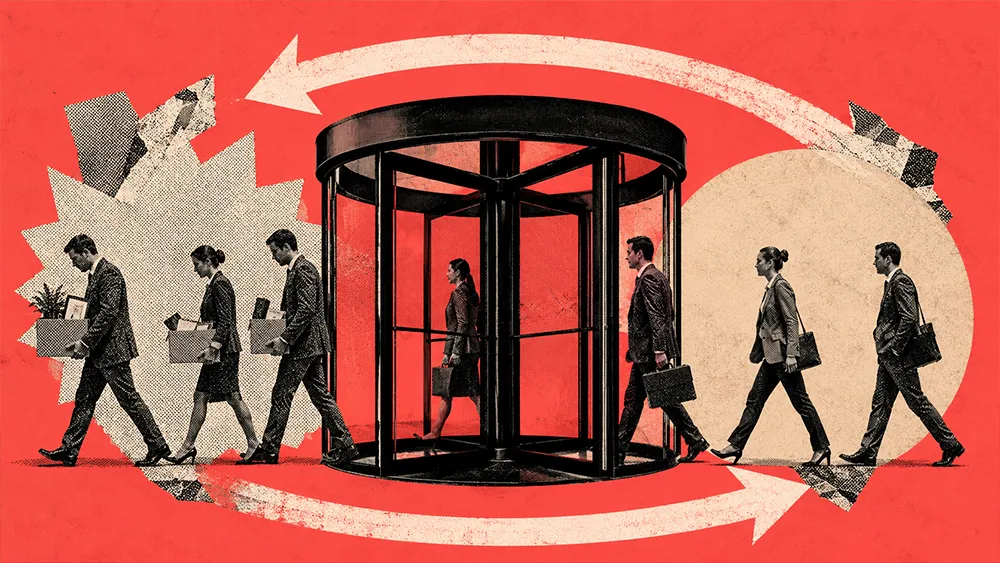
Gartner surveyed 321 customer service leaders and found that only 20% had actually reduced staffing because of AI. Most layoffs blamed on AI during 2024 and 2025 were driven by broader economic pressure. But the prediction that matters is what comes next: Gartner expects that by 2027, half of companies that cut staff for AI will rehire them, often under new job titles.
The cycle repeats. Company automates aggressively. Quality degrades in ways the efficiency metrics don't capture. Customers notice before leadership does. Company rebuilds with a hybrid model that costs nearly as much as the original team but performs better because the AI takes the volume and the humans take the moments that matter. The whole loop takes 12 to 18 months. The brand damage lasts longer.
IBM ran the same experiment with its HR function, replacing large parts of it with AI, then rehiring when the system couldn't handle anything that required empathy or subjective judgment. The Commonwealth Bank of Australia reversed 45 layoffs after determining the roles it eliminated were never actually redundant. Forrester predicts that half of AI-attributed layoffs will be quietly reversed, with jobs returning offshore or at lower wages. Analysts are calling it the "layoff boomerang."
The companies that skip the scorched-earth phase and go straight to a thoughtful hybrid model save themselves 18 months of churn, reputation damage, and organizational whiplash. But that requires leadership teams to accept something uncomfortable: some costs exist to protect the brand. They are not line items to optimize. They are investments in the reason customers stay.
We want to make this concrete because abstract brand arguments don't survive a board meeting. So run the numbers for your own business.
Say your average contract is $150K per year. Average customer tenure is 3.5 years. That puts every relationship at roughly $525K in lifetime revenue. A modest 2-point decline in satisfaction bumps churn by half a point. On a base of 500 customers, that's 2 to 3 extra churned accounts annually, which is $1M to $1.5M in lost revenue every year.
Stack that against the savings from replacing 10 support reps with AI. Fully loaded, that's maybe $800K. The gain is real. But it's smaller than the revenue at risk. And churn compounds in B2B in ways that don't show up on a quarterly report. Lost customers don't just stop paying. They tell the next prospect why they left. In a market where every deal is influenced by peer conversations, community reputation, and G2 reviews, one visible service failure can quietly poison pipeline you'll never even know about.
This is not an anti-AI argument. It's an argument for honest accounting. Put the brand risk on the balance sheet next to the headcount savings and see which number is bigger.
The companies we're watching at The State of Brand that are getting AI deployment right share a few things in common. None of them are avoiding AI. All of them are specific about where they draw the line.
They did the mapping work before they automated. They walked through their customer journey and flagged every interaction that carries disproportionate brand weight. Onboarding a new executive champion. Handling a billing dispute on a major account. Responding to a customer who is frustrated and considering alternatives. Those moments stay human. Everything else is fair game for AI. The distinction is clear and enforced.
They spend more per human, not less. When AI absorbs the routine work, every remaining human interaction carries more weight. The people handling those conversations need to be better trained, better equipped, and better paid than before. Klarna's mistake was automating too much and treating the humans who remained as an afterthought. The best hybrid models flip that. AI handles the volume. Humans handle the value. And the humans get invested in accordingly.
They stopped relying on efficiency metrics to measure brand health. Klarna's AI looked phenomenal on the dashboard. Faster resolution. Fewer escalations. Lower cost per ticket. Those numbers were accurate and completely misleading. They didn't capture the slow erosion of trust happening underneath. The companies doing this well track AI-handled and human-handled interactions separately. They watch repeat contact rates. They read post-interaction sentiment data. They listen to what CSMs are hearing in renewal conversations. The dashboard that matters tells you whether customers feel cared for. Not just whether they were served.
We started The State of Brand on a simple premise: brand is the most undervalued asset in B2B. It's the thing that compounds quietly in the background, making everything else, sales, marketing, retention, expansion, work better. And it's the thing that gets damaged first when companies chase efficiency without thinking about experience.
Klarna is the loudest example of that dynamic, but it won't be the last. Right now, in B2B companies across every category, someone is presenting a business case to automate customer-facing roles with AI. The slide deck shows the headcount savings. It shows the resolution time improvements. It shows the cost per ticket dropping. What it doesn't show is the brand.
And that's the slide that matters most.
The question facing B2B leaders in 2026 is not whether to use AI. Of course you should. The question is whether you've figured out where the human matters enough to your brand that automating it would cost more than keeping it. That line is different for every company. But every company has one. And the ones that find it before their customers do are the ones that will still be here in five years.


The best editorial systems don’t happen by accident. Outlever builds them.


The best editorial systems don’t happen by accident. Outlever builds them.

Subscribe for the kind of thinking that makes people stop, read and come back.