Google Invests $75 Million in A24 to Build AI Filmmaking Tools
A $75 million investment that pointedly leaves A24's film catalog out of the deal shows what an AI company actually wants from Hollywood right now. Not the content. The credibility.
Make State of Brand one of your go-to sources on Google

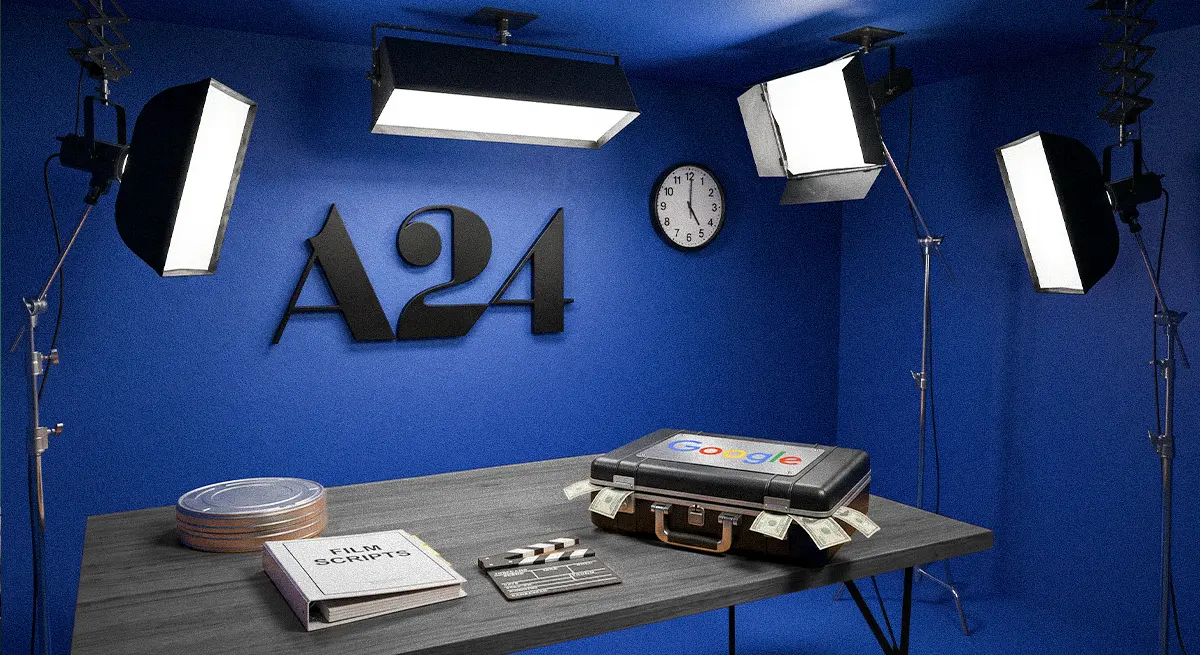
On Monday, Google's DeepMind lab announced a roughly $75 million investment in A24, the independent studio behind Everything Everywhere All at Once, Backrooms, and Marty Supreme. The deal was first reported by The Wall Street Journal and confirmed by Variety, The Hollywood Reporter, TechCrunch, and Google's own DeepMind blog. It is structured as a multiyear, non-exclusive research partnership to build AI filmmaking tools, and it marks the first time Google has taken an equity stake in a film studio.
To most of the technology press, that is the story: a big AI bet on Hollywood. Read it as a brand person, though, and the most revealing part of the deal is what Google agreed not to get.
The thing Google left on the table
Google does not get access to A24's film and television library. It does not get A24's content data. It cannot train models on the catalog it just bought a slice of. Variety reported that the partnership opens DeepMind's research and infrastructure to A24 while walling off the studio's content entirely. The Next Web noted that the agreement is non-exclusive, so A24 is not locked into Google's tools and Google cannot mine the catalog.
This matters because of the moment it happens in. AI labs are currently being sued to pry open exactly these kinds of libraries, and Disney has fought copyright battles with several AI firms. Google walked up to one of the most coveted catalogs in independent film and chose to leave it alone. That omission is not a footnote. It is the point of the deal.
So if Google is not buying the movies, what is it paying for? Proximity to the most trusted brand in independent film, and permission to stand next to it. Google sells video generation tools that much of the public already links to cheap output and lost jobs. A24 carries the opposite association. The studio's reputation does the persuading that Google cannot do for itself.
Why A24 is the only studio that could give Google this
Here is the part that makes the deal worth a brand person's attention, and the part that makes it dangerous.
A24 is not a normal studio brand. It is one of the only entertainment companies where the audience is loyal to the company itself rather than to any single title. As Vulture's Sam Sanders once observed, when people gush over an "A24 film," it is hard to tell whether they care more about the A24 part or the film part. Most moviegoers cannot name the studio behind their favorite movie. A24 fans buy the hoodie and the tote bag before the credits roll.
That loyalty was built on one deliberate promise: A24 is the alternative to corporate Hollywood. The studio grew on its own terms and turned down an approach from NBCUniversal to stay independent. It put the bulk of its marketing budget online rather than on billboards, reportedly around 95 percent, so fans felt like they were discovering the films and handing them to each other. One brand study called it an "anti-brand brand", an identity built on being everything the major studios are not.
That positioning is exactly why this deal hits differently. A company whose entire value rests on feeling handmade, human, and independent just took a check from one of the largest corporations on the planet to help build the machines a lot of its own filmmakers openly distrust. The brand that sold itself as the antidote to slick, mass produced, algorithm driven content is now a development partner for a company building algorithmic content tools.
The Conversation described A24 as a billion dollar, venture backed brand that performs indie authenticity while presenting itself as the scrappy outsider. The Google deal stress tests that performance in front of everyone. Authenticity is the one asset A24 cannot afford to spend, because for A24, authenticity is the whole product.
The brand math runs both ways
For Google, the downside is small. $75 million against A24's roughly $3.5 billion valuation is close to a rounding error, a two percent stake that buys a working research lab full of real directors and a layer of credibility no major studio could supply. If it goes badly, Google absorbs another awkward Hollywood AI headline and walks away.
For A24, the whole identity is in play. The audience skews young and skeptical. Variety reported that roughly 85 percent of the opening weekend crowd for Backrooms was under 35, and pointed to a recent Pew study finding that about half of adults under 30 believe AI will harm society. A24 is monetizing a human craft brand in front of the audience most hostile to AI. If those fans, or the filmmakers A24 relies on, read this as selling out, the credibility Google paid to borrow erodes for both sides at the same time.
A24 clearly knows the risk, because the messaging is locked down. Scott Belsky, who runs the studio's A24 Labs technology arm, told reporters the work is meant to preserve creative control rather than cut corners, and that it will not resemble the prompt and generate AI audiences recoil from. DeepMind CEO Demis Hassabis framed the goal as building tools that empower artists by working with them directly. The first project, AI assisted storyboarding, sits in pre production and supports a director's intent rather than replacing it. That choice is not an accident.
The structure is a brand defense
Look at the deal terms again through a brand lens and they stop reading like legal boilerplate. No library access protects A24 from the charge that it sold its artists' work into a training set. Non-exclusivity keeps the independence story intact. The "research, not production" framing buys time and room to maneuver. Each clause is a guardrail around the one promise that makes A24 worth Google's money in the first place.
The State of Brand take
This is a template, and the rest of the industry will copy it. Google has set a market price for borrowed creative credibility, and it has shown that the durable value in creative AI may not be in generating the art at all. It may be in owning the tools artists use to make it themselves, sold under a brand they already trust. Expect other AI labs to start shopping for their own prestige partners, and other studios to suddenly discover a point of view on responsible AI.
Credibility does not survive being optimized, though. The moment a brand built on human craft becomes the friendly face for the technology that threatens that craft, the friendliness starts to wear thin, and no clause can underwrite trust once it slips. A24 has bought itself a seat at the table where these tools get defined, which is smart and arguably the responsible call. It has also bet the most valuable brand in independent film on its ability to hold an obvious contradiction in public without its audience deciding it has stopped being A24.
Google wagered $75 million that A24's brand is worth borrowing. A24 made the bigger wager: that its brand is strong enough to be lent out and come back unchanged. The answer will not show up in the press release. It will show up in whether the next great independent filmmaker still wants to sign there.

If this caught your attention, that’s not accidental.

The best editorial systems don’t happen by accident. Outlever builds them.

If this caught your attention, that’s not accidental.

The best editorial systems don’t happen by accident. Outlever builds them.


Come back for the reason it lands.
Subscribe for the kind of thinking that makes people stop, read and come back.