HubSpot Bought Media Companies With a Formula That Couldn't Price What Media Is Actually For
HubSpot valued its media acquisitions on CAC math, and now a story it can't control has cut its market cap.
Make State of Brand one of your go-to sources on Google

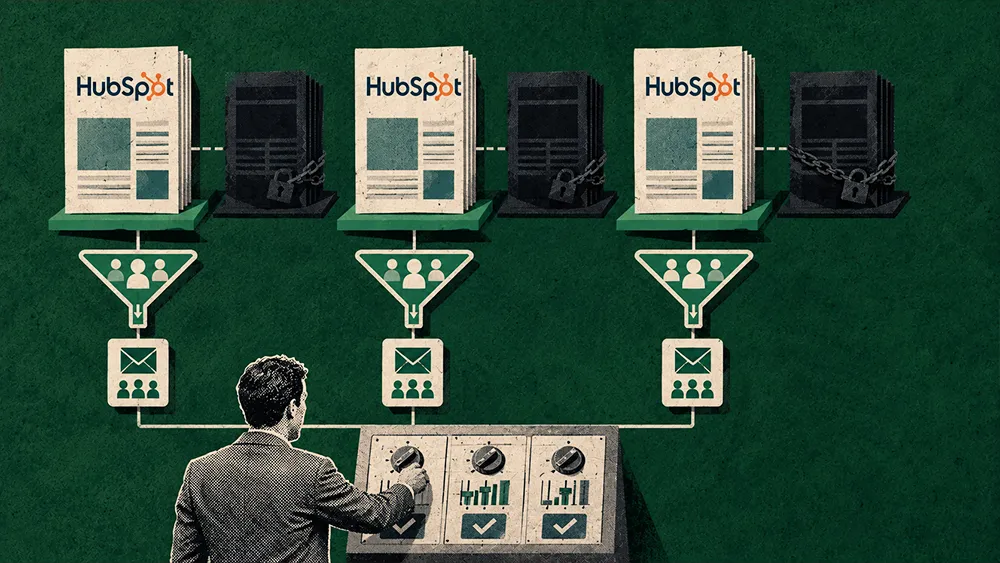
There's a podcast clip floating around where HubSpot's marketing leadership explains, with admirable transparency, how the company decides whether to buy a media company. Kipp Bodnar and Kieran Flanagan have walked through the model on Marketing Against the Grain, and it's clean. Before acquiring The Hustle in 2021, they ran paid campaigns against its audience and measured what it cost to acquire a customer through that channel. Once owning the audience penciled out cheaper than renting it through ads, they wrote the check. Audience as arbitrage. Media as a discounted pipe for leads.
It's the kind of framework that makes CFOs comfortable and gets cited approvingly in every "why brands should buy media companies" thread on LinkedIn. It's also, right now, the most instructive strategic failure in SaaS.
HubSpot is bleeding market cap for a reason no CAC model has a line item for: the story being told about them.
A narrative problem wearing a valuation costume
The numbers don't say what you'd expect. In March, HubSpot reported quarterly revenue up 20%, beating Wall Street expectations, and the stock fell to its lowest level since June 2020 anyway. In May it got worse. Shares dropped 19% in a single day after an AI pricing announcement. As of today the stock trades at $196.00, pricing the company at $10 billion, roughly 70% below its 2021 peak.
The business is fine. The multiple has collapsed. Analysts covering the stock say it plainly: the market is pricing in AI risk. The fear is that customers will use tools like Claude Code to build their own software, that AI agents will vaporize the per-seat SaaS model, that the CRM as a category gets disrupted out from under them. HubSpot trades at all-time low revenue multiples not because of what the business is doing today but because of what investors, customers, and the industry believe is about to happen to it.
That belief is a narrative. Narratives are built from stories, repeated by voices people trust, until they harden into consensus. There is an entire category of company whose only job is manufacturing exactly that.
HubSpot owns several of them.
The assets are sitting right there
The Hustle reaches millions of business readers. Mindstream, which HubSpot acquired in October 2024, is literally an AI newsletter. Earlier this year they added Starter Story to the portfolio using the same logic. Between them, HubSpot's media properties touch the precise audience forming opinions about whether AI kills SaaS: founders, operators, and marketers, the people who both buy HubSpot and shape the conventional wisdom that investors eventually absorb.
At the exact moment the market decided the story of HubSpot is "AI makes this obsolete," HubSpot possessed owned media reaching the people who tell that story. And what are those assets doing? Capturing emails. Warming leads. Hitting their CAC targets, presumably. The Hustle is a funnel. Mindstream is a funnel. They are doing precisely what the acquisition model priced them to do, and that is the problem.
Nobody at The Hustle is prosecuting the case for why the "vibe-code your own CRM" thesis falls apart at the first security review. Mindstream is not the venue where a counter-narrative about AI and SMB software gets built, tested, and seeded into the discourse. HubSpot's most credible answer to the AI question, its own product data showing AI agents resolving around 70% of support tickets across thousands of customers, surfaces in earnings calls and investor decks, two formats that have never changed anyone's mind about anything.
The spreadsheet said the audiences were cheap. The spreadsheet had no cell for "controls the frame people use to think about us."
The company that invented the playbook forgot the playbook
What makes this painful rather than merely ironic is that HubSpot became HubSpot by understanding narrative better than any company in software. Inbound marketing was never a feature. It was a story, a worldview with a villain (interruption), a hero (helpfulness), and a conveniently available product at the end of it. HubSpot didn't win by having a better CRM. It won by authoring the frame through which an entire industry evaluated marketing, then selling the tool the frame demanded.
That is the highest use of media a company can achieve. Not distribution. Definition. Deciding what the category is, what the buying criteria are, what counts as smart.
Then, somewhere along the way, the company that authored a category reduced media to arithmetic. Test the audience. Measure the CAC. Buy if cheap. The model performed on its own terms, and by all accounts the acquisitions did what they were priced to do. The failure sits in what the model excludes. You can buy leads a hundred ways. There is exactly one way to own the narrative infrastructure of your category, and HubSpot bought it, then plumbed it into the demand-gen dashboard.
Meanwhile the old engine seized. HubSpot's blog, the original inbound machine built on ranking for every informational query a marketer could type, lost the overwhelming majority of its organic traffic to AI Overviews and zero-click search. The company deleted more than 30,000 blog posts. The same force rewriting HubSpot's narrative quietly invalidated the CAC math underneath its media strategy. AI didn't just take the story. It took the funnel too.
What the alternative looked like
Picture HubSpot valuing The Hustle and Mindstream the way a media strategist would instead of the way a performance marketer would. The 2025 playbook was obvious: a sustained, editorially credible campaign interrogating the "AI kills SaaS" thesis. Original reporting on what actually happens when SMBs try to run operations on self-built AI tools. The ticket-resolution data turned into stories and case studies carried by voices audiences trust rather than announced from the corporate podium. A drumbeat, over quarters, reframing AI from HubSpot's disruptor into HubSpot's distribution.
Would that have saved the stock? Not by itself. Institutional investors compressing SaaS multiples aren't setting price targets off business newsletters. But investor consensus doesn't form in a vacuum. It forms downstream of customer sentiment, analyst framing, and the ambient conventional wisdom of the industry, and that ambient layer is exactly what owned media shapes. HubSpot needed the customer and category narrative working in its favor months before the market rendered its verdict. Instead its media assets were optimizing open rates.
The counterfactual was never "media fixes the multiple." The counterfactual is a company facing a story problem that owned story infrastructure and used it as a coupon.
The lesson for everyone else
The CAC arbitrage model of buying media was always a category error dressed up as discipline. It values media by the one thing media does least distinctively, delivering reachable audience, and ignores the thing media does exclusively, which is setting the terms of the conversation your company lives or dies inside.
For most of the last decade that error was affordable. Narratives moved slowly, and a strong product could outrun a mediocre story. The AI era ended that. In every category, the market is currently deciding which incumbents get recast as roadkill, and it's making those decisions on vibes, discourse, and repeated stories long before the fundamentals confirm or deny anything. HubSpot is growing 20% and priced at $9.7 billion like it's dying. That gap is the cost of a story you don't control.
If your model for a 2026 media acquisition starts and ends with CAC, you're buying a funnel and calling it a moat. Funnels leak. The editorial frame doesn't, and that frame is the reason a particular kind of person trusts this and not the eleven other things in their feed. Price that or don't bother.

If this caught your attention, that’s not accidental.

The best editorial systems don’t happen by accident. Outlever builds them.

If this caught your attention, that’s not accidental.

The best editorial systems don’t happen by accident. Outlever builds them.


Come back for the reason it lands.
Subscribe for the kind of thinking that makes people stop, read and come back.