The Only Airtable Asset That Held Its Value Was the Name
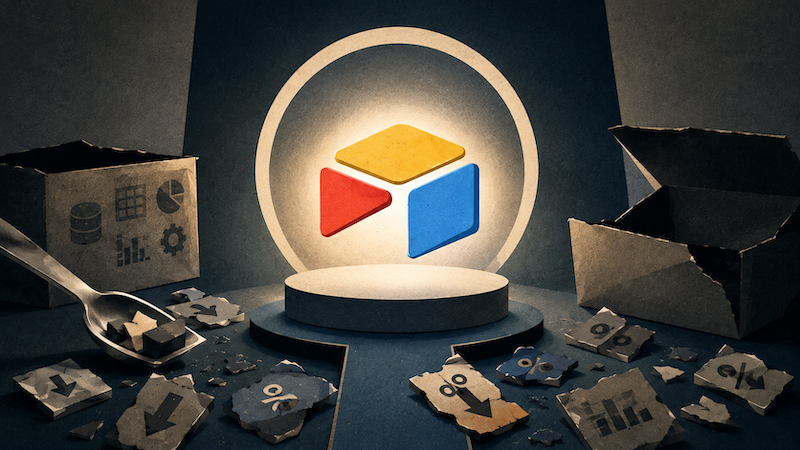
Bending Spoons paid 2.7 times revenue for a company that raised $1.4 billion. The number went viral because it was the first honest brand valuation the software industry has run in a decade.
Make State of Brand one of your go-to sources on Google

A mid-cap enterprise software acquisition should not be the most-shared business story of the week. Airtable is not a consumer product. Most people who forwarded the news on Tuesday have never opened it. The buyer is an Italian holding company that listed on the Nasdaq five weeks ago and that, until about a year ago, most American operators could not have identified.
It moved faster than anything else on the timeline anyway, because the story compresses into one line of arithmetic that needs no context. Raised $1.4 billion, sold for $1.285 billion. No chart, no thesis, no familiarity with the cap table. Anand Sanwal, who made the same argument in 2023 and got called out on a podcast for it, posted a two-line victory lap and let the numbers work.
The mechanics of that spread are the mechanics that govern brand memory. A story travels when it collapses into something the audience can hold in one hand, and when it quietly reprices something the audience already owns. This one does both. Every operator sitting on equity in a company marked in 2021 read that line and ran the math on their own grant. Nobody was consuming news. They were absorbing a personal financial event with a headline on top.
What Bending Spoons actually bought
Strip out the cash and the operating business was priced at $1.285 billion against roughly $480 million of annual recurring revenue growing north of 20 percent, with more than 500,000 organizations on it and 80 percent of the Fortune 100 in the customer base.
The question for a brand desk is not why so low. It is what, specifically, the buyer is paying for.
Not the technology. When Bending Spoons took over Evernote, its engineers reportedly found a Java monolith with user data spread across hundreds of manually provisioned virtual machines, a stack roughly a decade behind the practice of the day. They rebuilt it. Buying broken infrastructure is part of the model.
Not the team. At WeTransfer and Komoot, investigative reporting by Follow the Money found that around three-quarters of the original staff were gone. Shivaram Rajgopal's analysis in Forbes put Evernote's headcount at 341 on acquisition and 60 by the end of 2024.
Not growth. The stated thesis is to buy well-known products that have plateaued.
What is left is the name, the habit, and the cost of switching. Bending Spoons has built an $18 billion company on a single wager: that once you remove the growth premium, the founding story, the engineering org and the roadmap, brand equity plus installed behavior is the only asset still throwing off cash. Evernote's revenue reportedly rose 34 percent in 2024 and about 30 percent again the following year, after the layoffs, on a product people spent two years complaining about, at roughly two and a half times the old price.
That is a brand argument made with a checkbook, at scale, more than fifty times over.
Which means the $1.285 billion is not really a software valuation. It is a brand valuation, run under laboratory conditions by the one buyer in the market who is explicitly not paying for anything else. Airtable's brand, distribution and customer habit cleared at 2.7 times revenue. The industry has spent four years avoiding that number and it is now printed.
The category died before the company did
Airtable's positioning was one of the cleanest in B2B software. People who cannot write code can build the tools they need. It was legible, it was emotionally true for the operations managers who built careers on it, and it created a category, no-code, that Airtable substantially owned.
Positioning is always a claim staked on a scarcity. The promise holds only as long as the constrained thing stays constrained. Airtable's brand was underwritten by the scarcity of engineering time.
That scarcity is gone. A general-purpose model now builds the internal tool on request, free, with no seat license. The positioning did not become wrong. It became a description of a commodity. Anyone doing brand strategy in software should sit with the uncomfortable part, which is that nothing Airtable did to its brand caused this, and nothing it could have done to its brand would have prevented it.
Howie Liu saw it earlier than most of his peers. The refounding announcement in mid-2025, the Omni builder, agent products, a CTO hired out of OpenAI. By any competitive standard that was a fast and coherent response, executed while the company was profitable and still growing. The market paid 2.7 times revenue for it.
So the lesson is not move faster on AI. Airtable moved fast on AI. The lesson is that a positioning built on someone else's constraint carries an expiry date you do not control. The audit question for every brand in the workflow middle layer, the project trackers and form builders and lightweight databases and internal tooling platforms, is what scarcity the promise is renting and who else holds the lease.
The employer brand took the real damage
The equity narrative was the most effective employer-brand instrument of the last fifteen years. Trade cash for upside, join early, believe the story. In the strict sense it was a brand product: a promise about a future outcome, sold to a sophisticated audience, priced entirely on narrative.
Airtable published the terms and conditions this week. Liquidation preferences pay the last money in first, so a $735 million Series F against a roughly $2.25 billion pool most likely comes out close to whole. The early venture positions still return real money. The losses concentrate in common stock and RSUs, which is to say in people who joined in 2021 and 2022 on grants priced against an eleven-billion-dollar mark, at a company that by every operating measure did its job.
The anger circulating since Tuesday is not really about Airtable. A generation of operators has discovered the waterfall exists, in a case where they cannot blame the management team, the product, the growth rate or the AI response. Durability comes from exactly that. A story about a badly run company teaches nothing. A story about a well-run company teaches that the instrument itself was mispriced.
The practical consequence: late-stage equity now gets discounted by candidates as a matter of course, and companies raising at today's AI marks should assume they will pay the difference in cash. The narrative half of the compensation package has lost its pricing power, and no recruiting deck is winning it back.
The buyer has a brand problem it cannot buy its way out of
Bending Spoons has achieved something almost no B2B holding company manages. It has genuine name recognition among people who will never be its customer. Ask a product manager in San Francisco what Bending Spoons does and you will get an answer. Two years ago you would not have.
The recognition is entirely of the playbook, though. Layoffs, then price increases, then a profit step-change. Follow the Money has documented it, so have Forbes and the Pragmatic Engineer, and so does the company's own prospectus, which disclosed more than $78 million of reorganization expense last year and material weaknesses in internal control tied to integrating what it buys.
The brand now travels ahead of the deal. Churn begins at announcement, before a single price changes, because customers have read the last five case studies. Support forums have picked up Evernote users noticing that new acquisitions keep landing while their own tickets sit unanswered. Reputational cost accumulates across the portfolio rather than staying contained inside each brand, which is the characteristic weakness of a house-of-brands strategy operated with one publicly legible playbook.
Bending Spoons' answer, from co-founder Matteo Danieli, is that retention across the portfolio has held remarkably steady, and that the difference from private equity is an intention to hold brands permanently rather than flip them. Both may well be true. Neither helps much with Airtable, because the earlier acquisitions were consumer and prosumer products where an unhappy user has to choose to leave. Airtable is enterprise software with procurement departments, security reviews and renewal committees, staffed by buyers who are professionally obligated to act on exactly the reputational signal Bending Spoons has spent three years generating. This is the first deal where the fame of the playbook is itself a material integration risk.
Airtable customers running mission-critical workflows should be exporting their data this quarter. Not a prediction about Bending Spoons' intentions. Just what the documented record makes reasonable.
What it speaks to
Almost nobody shared this story because they cared about Airtable. They shared it because they recognized the position they were already standing in.
For four years the industry held a shared unspoken position: the 2021 marks were paper, the real number was lower, and nobody had to say so out loud as long as no healthy company tested it. Airtable was among the healthiest in that cohort, growing, profitable, cash-rich, credibly repositioned around AI, and it took 2.7 times revenue. Every board in the cohort now has a comparable it cannot argue with, and the leverage has moved to buyers for good.
Underneath sits the harder read, and it is a brand read. Capital has not left software. It is being raised right now at fifty times forward revenue by companies with a fraction of Airtable's customer base. What moved is the story premium, and the assets left behind are being repriced at what they are worth without one. Take the narrative away and what remains is the name on the tab, the habit of opening it, and the cost of leaving. For a company that raised $1.4 billion, that came to $1.285 billion.
Most of the industry will spend the rest of the decade not acting on it.

If this caught your attention, that’s not accidental.

The best editorial systems don’t happen by accident. Outlever builds them.

If this caught your attention, that’s not accidental.

The best editorial systems don’t happen by accident. Outlever builds them.


Come back for the reason it lands.
Subscribe for the kind of thinking that makes people stop, read and come back.