Google Just Turned Its AI Chips Into a Brand, and Blackstone Is Betting $5 Billion on It
Google and Blackstone are launching a U.S.-based joint venture to sell cloud computing powered by Google's custom TPU chips.
Make State of Brand one of your go-to sources on Google

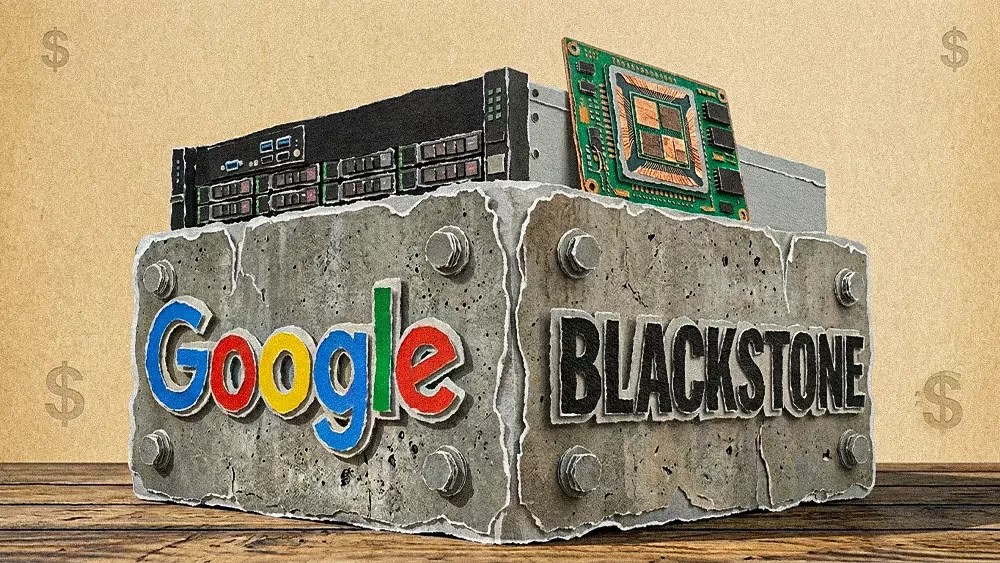
Here are the basics. Google and Blackstone are launching a U.S.-based joint venture to sell cloud computing powered by Google's custom TPU chips. Blackstone puts up $5 billion in equity capital, takes majority ownership, and they plan to bring 500 megawatts of capacity online in 2027 with plans to scale from there. The company will sell compute-as-a-service, giving customers a way to access TPUs outside of Google Cloud.
The infrastructure is interesting, but the repositioning is the actual story.
Google's chips just left the building
Google's tensor processing units have always been internal tooling. The company has been developing and deploying them in production for over a decade, and they power workloads for top AI labs, capital markets firms, and the products Google delivers to billions of users globally, including Gemini. A competitive advantage, never a product line.
Now Google is spinning TPU access into a standalone company with outside ownership. It's positioning its chips as a third option in the AI compute market instead of keeping them as a hyperscaler perk. Google wants its silicon standing next to Nvidia's GPUs on its own merits, building its own identity and its own customer relationships.
The timing is not accidental. Last month at Google Cloud Next, Google split its eighth-generation TPU into two separate chips for the first time: the TPU 8t for training and the TPU 8i for inference. The company is touting 2.8x the performance of its previous Ironwood chip and 80% better performance per dollar on inference workloads. Citadel Securities and all 17 U.S. Department of Energy national laboratories are already running workloads on Google TPUs. Google is building a real customer base for these chips, and this venture gives that base a dedicated commercial vehicle.
They also tapped Benjamin Treynor Sloss to run the new company as CEO. He's a Google veteran with over two decades building and operating Google's global infrastructure. That's not a hire you make for a side project.
The $5 billion credibility stamp
Blackstone doesn't fund experiments. The world's largest alternative asset manager, with over $1.3 trillion in assets under management and already the largest global provider of data centers, just took majority ownership of Google's chip infrastructure. That tells enterprise buyers something specific. This is fundable. This will exist in five years. This won't get quietly shelved if Google's priorities shift next quarter.
CNBC reported that the joint venture has already identified likely data center locations, with some already under construction. That's not a press release promise. That's concrete being poured.
Worth noting that Blackstone has been on an AI infrastructure tear lately. Earlier this month, the firm partnered with Anthropic, Goldman Sachs, and Hellman & Friedman on a separate $1.5 billion venture to deploy AI inside portfolio companies. Blackstone is building positions across every layer of the AI stack, from the silicon to the services. Jon Gray, Blackstone's president and COO, called it "a generational opportunity to invest capital at scale building AI infrastructure."
The real target here is CoreWeave
This venture goes after the "AI cloud" category that CoreWeave has been building. CoreWeave went public in March 2025 at $40 a share, raised $1.5 billion in what was the biggest U.S. tech IPO in four years, and the stock has since climbed past $107 with trailing twelve-month revenue of $6.23 billion. It proved there is enormous demand for dedicated AI compute sold outside the traditional hyperscaler bundle.
Google is now saying: we'll build the same thing, but with our own chips and a private equity war chest funding it. It's a direct shot at the idea that the AI infrastructure layer belongs to fast-moving newcomers.
But there's a vulnerability in CoreWeave's model that Google is clearly watching. CoreWeave runs almost entirely on Nvidia GPUs, and Microsoft accounted for 72% of its revenue in the first half of the year. Meanwhile, enterprise GPU utilization sits around 5% in some deployments, and cloud providers are seeing faster custom ASIC shipment growth than GPU growth in 2026. If inference costs keep falling and hyperscalers bring more of their own capacity online, pure-play GPU clouds face real margin pressure. Google's pitch is different: purpose-built silicon, optimized specifically for efficiency, sold through a dedicated company with deep pockets behind it.
The category lines are getting clearer by the month. Hyperscalers like AWS, Azure, and Google Cloud sit at the top. Nvidia dominates the chip layer. And a new middle tier is forming. CoreWeave, this Google-Blackstone venture, Nebius, Lambda Labs. All of them competing to be the brand that enterprises think of when they need dedicated AI compute. AI infrastructure spending is projected to hit $401 billion in 2026. There's room for multiple winners, but the branding war for that spend is just getting started.
What this means for brand strategy
Google could have expanded TPU availability quietly within Google Cloud. Instead, it created a separate entity with new positioning, a different ownership structure, and a fresh market narrative around it.
As AI moves from experimentation to full enterprise deployment, the companies building the compute layer are figuring out that they need distinct brand identities to lock in long-term contracts. The infrastructure underneath AI models is no longer invisible plumbing. These are named companies fighting for territory and market perception.
The race for AI dominance goes beyond who builds the best model. It's about who owns the brand at every layer of the stack.

If this caught your attention, that’s not accidental.

The best editorial systems don’t happen by accident. Outlever builds them.

If this caught your attention, that’s not accidental.

The best editorial systems don’t happen by accident. Outlever builds them.


Come back for the reason it lands.
Subscribe for the kind of thinking that makes people stop, read and come back.