Universities Punished Students for Using AI for Four Years. Then They Invited Eric Schmidt to Tell Them to Embrace It. The Boos Were Deafening.
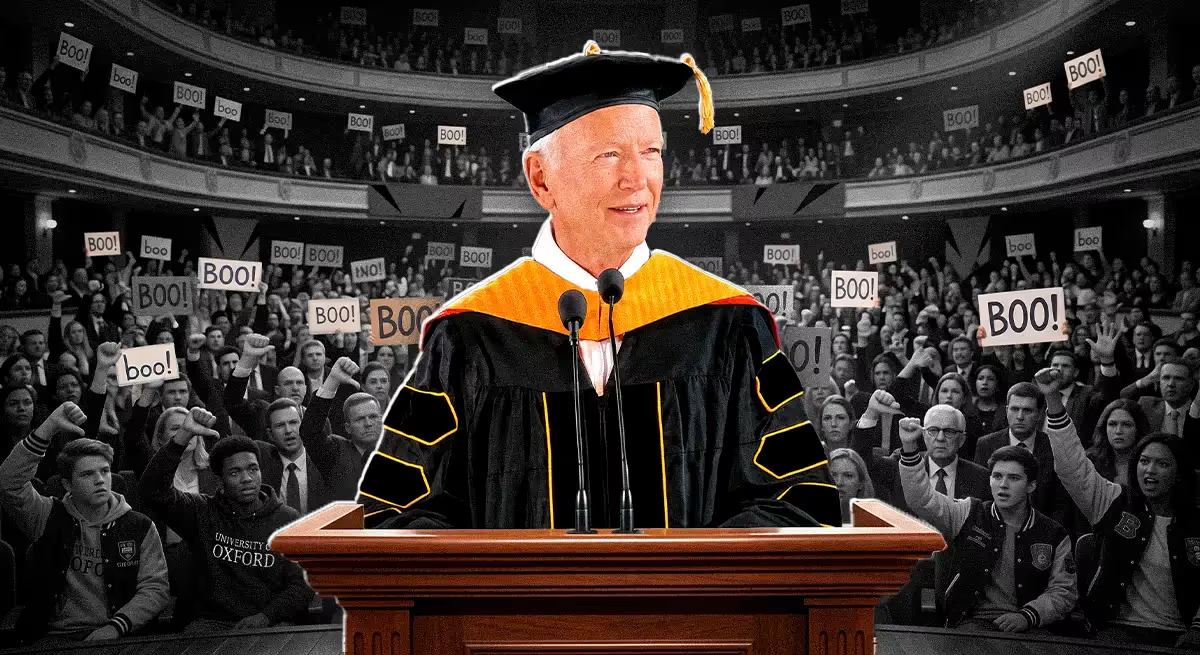
Former Google CEO Eric Schmidt delivered the commencement address at the University of Arizona on Friday and told several thousand graduates that AI "will touch every relationship you have."
Make State of Brand one of your go-to sources on Google

Last week, we covered a real estate VP getting booed off the stage at the University of Central Florida for telling a room full of job-seeking arts and humanities graduates that AI is "the next industrial revolution." We noted at the time that Gloria Caulfield's delivery wasn't the issue. The framing was.
Now it's happened again. Bigger speaker, bigger stage, louder boos.
Former Google CEO Eric Schmidt delivered the commencement address at the University of Arizona on Friday. He traced the arc from the personal computer to the smartphone to the internet, then pivoted to artificial intelligence and told several thousand graduates that AI "will touch every profession, every classroom, every hospital, every laboratory, every person and every relationship you have."
The stadium erupted. Not in applause.
Schmidt tried to push through it. He acknowledged the fear. He told students their generation has the power to shape how AI develops. He compared AI to a rocket ship and told them to get on it. The booing got louder. At one point he paused mid-sentence and said, "If you'd let me make this point, please," and was met with what multiple outlets described as an uproar from the crowd.
This is now a pattern. Three commencement speeches in two weeks have been derailed by the same reaction. Caulfield at UCF. Scott Borchetta, the Big Machine Records CEO who discovered Taylor Swift, told Middle Tennessee State grads that "AI is rewriting production as we sit here" and followed it up with "deal with it." He got booed too. And now Schmidt, the most prominent of the three, drawing sustained hostility from the moment he connected AI to their futures.
But it's not universal, and that's what makes the pattern worth studying. Nvidia CEO Jensen Huang mentioned AI at Carnegie Mellon's commencement and got no audible pushback. The difference isn't subtle. Carnegie Mellon students are studying computer science and engineering. They see AI as something they will build. UCF's arts and humanities graduates, Arizona's broad class, and MTSU's media students see AI as something that will be done to them.
That distinction is doing all the work.
The Commencement Booing and the Sabotage Data Are the Same Story
We wrote recently about the Writer and Workplace Intelligence report showing that 29% of employees are actively sabotaging their company's AI strategy. Among Gen Z, it's 44%. Nearly half. They're feeding proprietary data into public AI tools to poison the well. They're refusing to use mandated tools. They're deliberately generating low-quality outputs to make AI look broken. Some are tampering with performance reviews to skew results against the technology.
The commencement booing is the public-facing version of that same resistance. The sabotage happens quietly inside companies, in daily workflows where nobody is filming. The booing happens on a stage, in a stadium, with cameras rolling. Same energy. Same message. Different venue.
What the executives giving these speeches don't seem to understand is that both responses are rational. Not because AI won't reshape work. It will. But the people delivering the message have a credibility problem that no amount of rhetorical polish can fix.
Eric Schmidt ran Google. He is an investor in AI startups. His family office Hillspire reportedly backed more than a dozen AI companies between 2019 and 2025, and Anthropic is among the portfolio companies. He is, by any measure, someone who benefits enormously from the exact future he's telling graduates to embrace. When he tells a 22-year-old entering a job market where AI-exposed roles are already below pre-pandemic levels according to Goldman Sachs research, that they should see AI as a "seat on the rocket ship," the audience hears a billionaire telling them to be excited about the thing that might eliminate the job they went into debt to prepare for.
That's not an irrational reaction. That's pattern recognition.
The Brand Problem Nobody on Stage Is Solving
Every one of these commencement speeches failed for the same reason bad brand messaging fails. The speaker centered themselves and their worldview instead of centering the audience. Caulfield framed AI as an exciting disruption. Borchetta told graduates to "deal with it." Schmidt told them to get on the rocket ship. All three pitches assumed the audience shared the speaker's relationship to the technology.
They don't.
A Gallup report from last month showed that excitement and hopefulness about AI are declining while anger is rising. Only 18% of Gen Z feels hopeful about AI. An NBC News poll found just 26% of registered voters hold a positive view. Axios Harris data shows 42% of Gen Z specifically believe AI will harm their job opportunities and wages. Among Americans aged 15 to 34, only 43% say it's a good time to find a job, compared to 64% of those 55 and older. A 21-point gap.
These are not people waiting to be inspired by a billionaire's vision of the future. These are people who watched companies directly attribute 55,000 job cuts to AI in 2025 alone, more than 12 times the number just two years earlier. They've seen Accenture cut 11,000 jobs in an AI restructuring. Block laid off 4,000. Pinterest cut 15% of its workforce. Meta, HP, Cognizant, Freshworks, Coinbase. The list runs deep and it keeps growing.
When the message from the stage is "embrace AI" and the message from the job market is "AI is why we're not hiring you," the audience is going to boo. Every time.
What This Actually Means for Companies Talking About AI
The lesson from commencement season is not that you can't talk about AI. It's that how you talk about it reveals whether you understand your audience.
Jensen Huang didn't get booed because he was talking to people who have agency in the AI economy. They're the ones building it. The message and the audience were aligned. Schmidt got booed because he delivered the same message to people who have no such agency and are terrified about what comes next.
This is a brand communication problem. Every company talking about AI externally right now needs to ask a version of the same question these commencement speakers failed to ask: does our audience see AI the way we do?
If you're a B2B company selling to technical buyers who are actively building with AI, you can lead with capability and ambition. If you're a consumer-facing brand talking to customers who are worried about quality declining because you replaced your team with chatbots, that same message will land like Schmidt's did at Arizona.
The companies that will navigate this well are the ones that acknowledge the tension instead of pretending it doesn't exist. The ones that talk about what AI means for their customers, not what it means for their margins.
Schmidt acknowledged the fear from the stage. He told graduates their concerns were "rational." But he followed it with the same pitch every AI-boosting executive has been giving for two years: the future is coming, you should help shape it, get on the rocket ship. Acknowledging fear and then immediately dismissing it is worse than not acknowledging it at all. It tells the audience you heard them and decided their feelings don't change anything.
The Real Angle Nobody Is Covering
The booing isn't just about fear, It's also about hypocrisy.
These graduates were penalized for using AI in their coursework. They were told it's cheating. They were threatened with academic discipline for submitting AI-generated work. And then they sat in a stadium and watched the university give a platform to one of the most prominent AI advocates on the planet, who told them to embrace the same technology their professors spent four years telling them not to touch.
One Arizona graduate told the Associated Press: "We as students are discouraged from using it and penalized for using it. And then to have our speaker be the champion of AI is just like, OK? Why?"
That contradiction is devastating. And it's not limited to universities. Companies are running the same playbook. They're telling employees to adopt AI while simultaneously using AI as the justification for eliminating their roles. They're mandating AI tool usage while cutting the teams that are supposed to use them. The Writer report found that 69% of executives are planning AI-related layoffs. 77% say workers who won't develop AI proficiency won't be considered for promotions.
The message from leadership, whether it's a commencement podium or a company all-hands, boils down to: "Get excited about the thing we're going to use to replace you. And if you're not excited, you're the problem."
That is not a communication strategy. That is a contradiction. And both the sabotage data and the commencement boos are telling you exactly how people respond to it.
The leaders who figure out how to talk about AI honestly, who acknowledge both its power and its cost, who center the people affected rather than the people profiting, who offer something more concrete than "get on the rocket ship," will earn the trust that everyone else is burning through right now.
The rest will keep getting booed.

If this caught your attention, that’s not accidental.

The best editorial systems don’t happen by accident. Outlever builds them.

If this caught your attention, that’s not accidental.

The best editorial systems don’t happen by accident. Outlever builds them.


Come back for the reason it lands.
Subscribe for the kind of thinking that makes people stop, read and come back.