A Real Estate VP Tried to Hype AI to a Room Full of Job-Seeking Graduates. It Went Exactly How You'd Think.
A commencement speaker got booed for celebrating AI last weekend. But the real failure happened long before she walked onstage.
Make State of Brand one of your go-to sources on Google

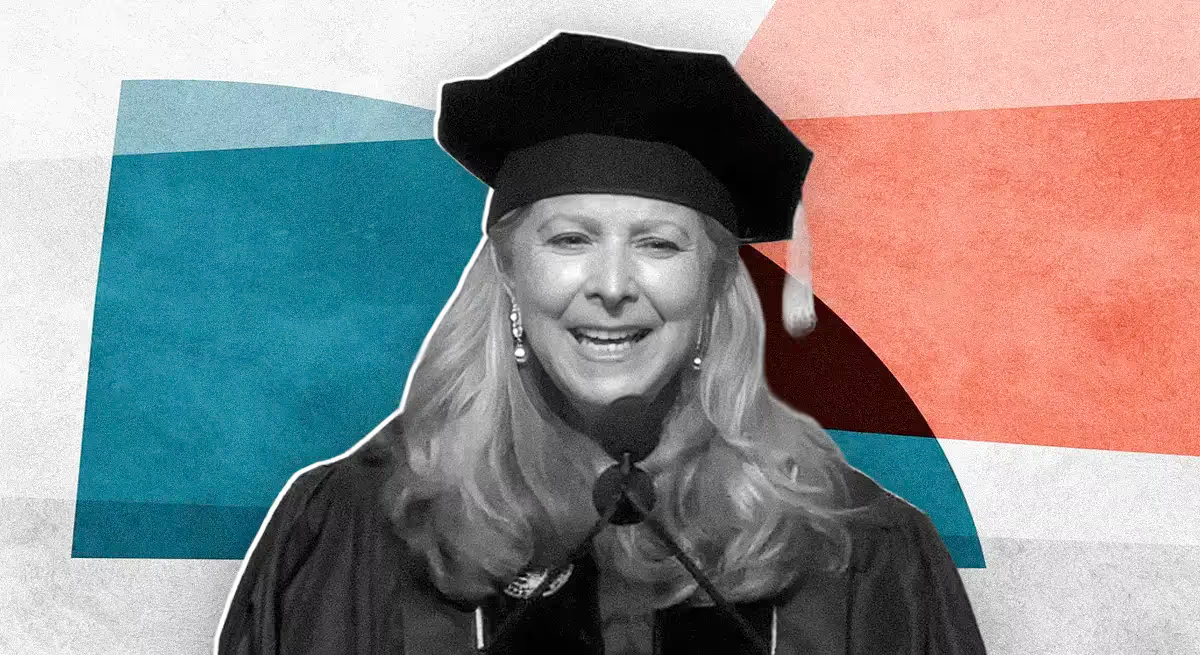
A University of Central Florida commencement speaker told a stadium full of graduates that AI is "the next Industrial Revolution." They booed. Loudly. When she mentioned that "only a few years ago, AI was not a factor in our lives," the same crowd broke into cheers and threw their hands in the air. She stepped back from the podium, visibly confused. "What happened?" she asked.
Forget the booing for a second. Pay attention to the confusion. That's where the actual story is.
Because nothing she said was unusual. This is the kind of AI optimism that plays well in boardrooms, at investor dinners, on conference stages. She'd clearly delivered some version of these talking points before, probably to rooms full of people who nodded along. Nothing about her delivery suggested she expected pushback. Why would she? Every room she'd been in before this one agreed with her.
This time the room didn't. And she had no idea it was coming.
The pattern underneath
Here's what keeps happening, and not just with AI.
Leadership gets excited about something because they're seeing it from the investment side. Cost savings, efficiency, competitive edge. They talk to peers who share that excitement. They go to the same conferences, read the same analyst reports, absorb the same narratives. Over time, that excitement calcifies into an assumption: everyone sees this the way we do. That assumption starts shaping external messaging. It shows up in product launches, on careers pages, in keynotes. By the time it reaches an audience, it's been filtered through so many people who already agree that nobody thinks to ask whether the people on the other end feel the same way.
That's how you end up with a speaker celebrating AI to a room full of people who are terrified of it. Not because anyone made a bad decision, but because the process never had a point where someone outside the bubble could weigh in.
Most of the time, this doesn't play out on camera. It plays out in campaigns that quietly underperform. In messaging that gets screenshotted and mocked in group chats nobody at the company will ever see. In a slow bleed of trust that's hard to pin on any single moment. The UCF clip is just a rare case where the gap between what leadership believes and what the audience feels became audible.
We've watched this before
"Disruption" followed the same arc. Inside companies, it was aspirational. We're breaking the mold, we're changing the game. For the people whose livelihoods were on the other end of that disruption, it sounded like someone celebrating your job disappearing. The word didn't fall out of fashion because executives had a change of heart. It fell out of fashion because it started costing them customers.
COVID-era messaging did the same thing. "We're all in this together" tested well in internal reviews. It felt warm, it felt human. But reception depended entirely on who was saying it. From a local restaurant hanging on by a thread, it meant something. From a Fortune 500 CEO posting from a lake house, it read as parody. Identical words, opposite effect, because one version was tethered to the audience's experience and the other was tethered to the company's self-image.
AI messaging is deep in this same cycle now. Gallup has nearly half of Gen Z saying AI's risks to the workforce outweigh its benefits. Other polling puts AI's overall favorability below that of ICE. This isn't niche skepticism. It's broad, it's growing, and it's especially concentrated among younger consumers and workers. But inside most organizations, the prevailing mood is still excitement, so the messaging keeps reflecting excitement, and nobody flags the mismatch until something like the UCF clip forces the question.
Surprise is the symptom
The most revealing part of that video isn't what the speaker said. It's that she didn't see it coming. When someone is genuinely startled that their audience disagrees with them, it tells you something about the organization behind them: they've been hearing their own voice for so long that they've mistaken it for everyone's.
That's bigger than a communications miss. If you don't know how your audience feels about this, what else are you wrong about? What they'll pay for? What they'll put up with? Where the line is between loyalty and leaving?
The answer isn't to dodge hard topics or pander. The answer is to build in some friction before messaging goes out. Talk to people who aren't already on board. Run the language past someone whose first reaction might be skepticism rather than enthusiasm. Do real audience work, not just sentiment scores and social dashboards, but conversations with people who would actually boo you if they could.
One question
Watch the clip and ask yourself: where in our process would we have caught this?
If you can't point to a specific moment, a specific person, a specific check that would have flagged the disconnect before it went live, then you have the same problem she did. You just haven't been onstage yet.

If this caught your attention, that’s not accidental.

The best editorial systems don’t happen by accident. Outlever builds them.

If this caught your attention, that’s not accidental.

The best editorial systems don’t happen by accident. Outlever builds them.


Come back for the reason it lands.
Subscribe for the kind of thinking that makes people stop, read and come back.