
powered by




What Red Lobster and Cracker Barrel got right and wrong this year comes down to a single principle most brand leaders never price in. Understanding it before a crisis is considerably cheaper than learning it after one.
I did not expect the most clarifying brand lesson of my week to come from a seafood chain and a country kitchen. And yet.
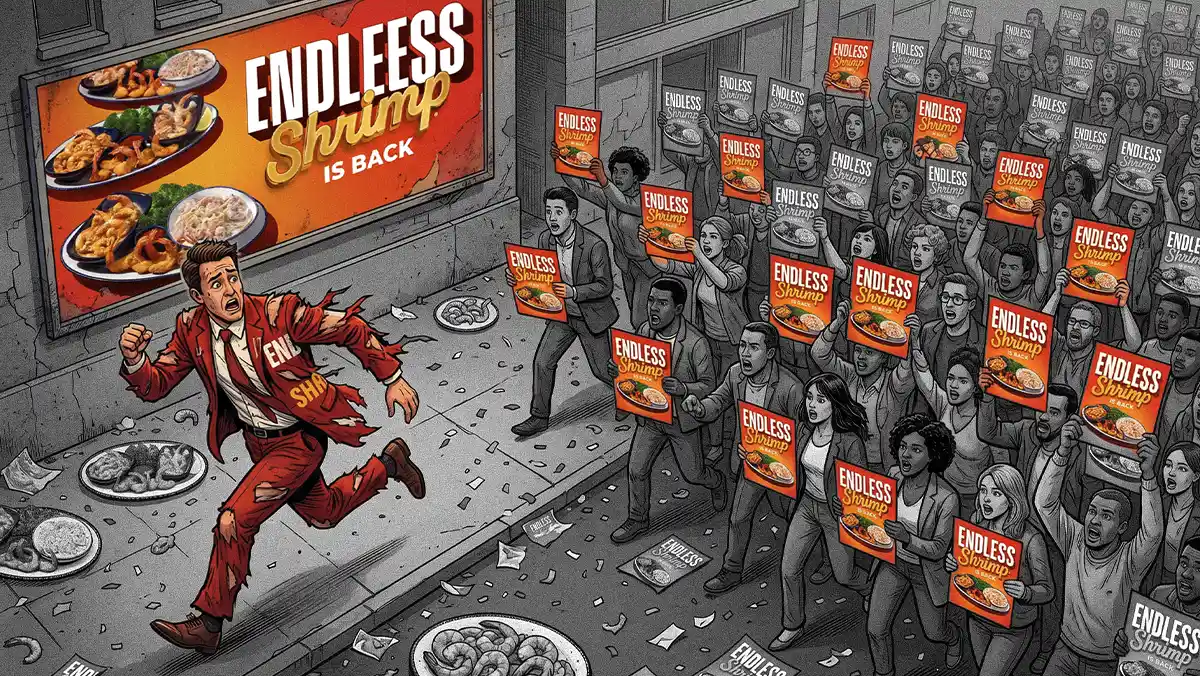
Red Lobster brought back Endless Shrimp this week, two years after the same promotion contributed to an $11 million quarterly deficit and helped drive the company into Chapter 11 bankruptcy. Cracker Barrel unveiled a new text-only logo as part of a $700 million rebrand last year, watched nearly $100 million in market cap evaporate within days, and reversed the whole thing inside a week. Even the President of the United States weighed in with his opinion, leaving CEO Julie Felss Masino feeling "fired by America."
I know how absurd it is to write about shrimp and rocking chairs in a B2B brand publication. Still, the dynamic beneath both is the same one that is bankrupting brand relationships within software companies and enterprise platforms. It just doesn't come with a presidential statement.
Bear with me. The shrimp matters.
There’s a principle underneath both stories, and it applies to B2B as directly as it applies to casual dining.
When a brand gives something to its customers, it becomes part of their identity. It’s an emotional contract that defines what the brand means to them and sets their expectations for the future. A brand can spend twenty years building something customers love and lose it in a single quarter trying to reclaim it. The withdrawal feels like betrayal, regardless of the business reasons behind it.
I've watched enough SaaS companies walk straight into this trap. Preventing it requires one honest question before any generous promise goes out the door: what will it cost us to take this back?
The SaaS pricing change is the Endless Shrimp of the software industry.
There’s a generous free tier and a low introductory price. They give unlimited seats during the early growth phase, and the result is built goodwill. Users evangelize the product. Then the company reaches scale, and the economics need to change. So the free tier gets restricted, and the price goes up. Quietly, "unlimited" becomes "up to 10," and the users who built their workflows around the original promise feel exactly as Red Lobster customers did in 2023.
The companies doing this right are using what I'd call the Adamolekun play. Red Lobster's new CEO spent months saying Endless Shrimp wasn't coming back "because I know how to do math," then listened to thousands of customer voices asking for it and brought it back with the economics rebuilt. Price up 25%. Limited time instead of permanent. Dine-in only. Tighter operational controls. Same thing customers loved, reimagined so the business survives. The spirit of the promise stays intact while the mechanics adjust. Pricing gets explained in terms of what customers gain rather than what they lose. Existing users get grandfathered through transition periods.
Cracker Barrel demonstrates the alternative. New leadership arrives, identifies a real business problem, and "fixes" it by stripping out the thing customers loved without understanding how deeply it was embedded in the relationship.
The same pattern is playing out at platform scale. I covered this a few weeks back in a piece on Meta automating ad strategy: the platform gave advertisers granular manual control for a decade, customers built entire media operations around that control, and now it's being stripped in favor of Advantage+ automation. Brands that depended on the old system lost an operational muscle they'd built around the original promise. Anthropic did the same thing to Figma this month. For years, Claude powered design tools across the ecosystem through partnerships. The promise was that Anthropic would be the model provider underneath. Then Claude Design shipped, and just like that, the partner became the competitor inside a single news cycle.
Every one of these is the same mistake, dressed in a different industry. A brand gives, customers internalize the giving as an expectation, and then the brand reclaims. It’s a betrayal for the customers.
I want to be fair to Julie Felss Masino, because the problem she identified was real. Cracker Barrel's growth had stagnated, net income had fallen sharply, and a $700 million transformation plan was backed by genuine business logic.
Where it went wrong was simpler than the strategy decks suggested. A brand like Cracker Barrel sells a specific, unchanging feeling that people have been returning to for decades. Swapping the logo, brightening the interiors, and stripping out the antiques all at once told the most loyal customers that the very thing they came for was the very thing being thrown out.
Change has to happen, but it needs to be below the threshold of what your most loyal customers notice. The brands that get rebrands right move in increments. The ones that do it wrong change everything at once and discover that "everything" includes the parts their customers considered sacred.
There's one question that would have saved both companies a lot of money. Before giving something, understand what it will cost to take it away.
When a SaaS company is designing a free tier, the honest conversation needs to be about what the conversion path looks like in year three, and whether the company has priced the inevitable restriction into its go-to-market math today. When a platform is promising unlimited seats, the question is whether the word "unlimited" is a marketing line or a commitment the business can sustain at scale. When a brand invests in a visual identity that customers will fall in love with, the question is how that identity evolves over a decade without requiring a rip-and-replace later.
And before hiring a new CEO, CMO, or Head of Product with a mandate to "modernize" or "transform," make sure they understand what's sacred. The rocking chairs might be the whole point. The logo might be the thing holding everything together. The manual controls might be the reason the best customers chose the product in the first place.
The hardest skill in brand leadership is knowing what to leave alone. It's the skill that separates the brand leaders who compound equity from the ones who spend a decade building it and a single quarter destroying it. The lesson cost both of these companies millions. The brands that internalize it now get it for free.


The best editorial systems don’t happen by accident. Outlever builds them.


The best editorial systems don’t happen by accident. Outlever builds them.