What Is Owned Media in B2B? A Complete Guide
Google and LinkedIn send B2B companies less traffic every year. Owned media is how more brands are building audiences they don't have to rent. This guide covers what it is, how it works, and how to get started.

Make State of Brand one of your go-to sources on Google

Owned media in B2B is any channel a company fully controls and uses to reach its audience directly, such as a publication, newsletter, podcast, or event series. Paid media disappears when the budget runs out, and earned media depends on someone else deciding to cover you. Owned media does neither. Its most ambitious version is an industry publication: a news and analysis outlet, run by a company, that covers its market well enough that buyers read it because they want to.
Company blogs, email lists, and websites have always technically counted as owned media. The bar is higher now. With search engines and social platforms sending less traffic to brands, many B2B companies have realized that a blog written to rank on Google never gave them much ownership at all. Most of its readers came from Google, and when Google stopped sending them, they stopped coming.
Owned, earned, and paid media
Marketers usually sort media into three groups.
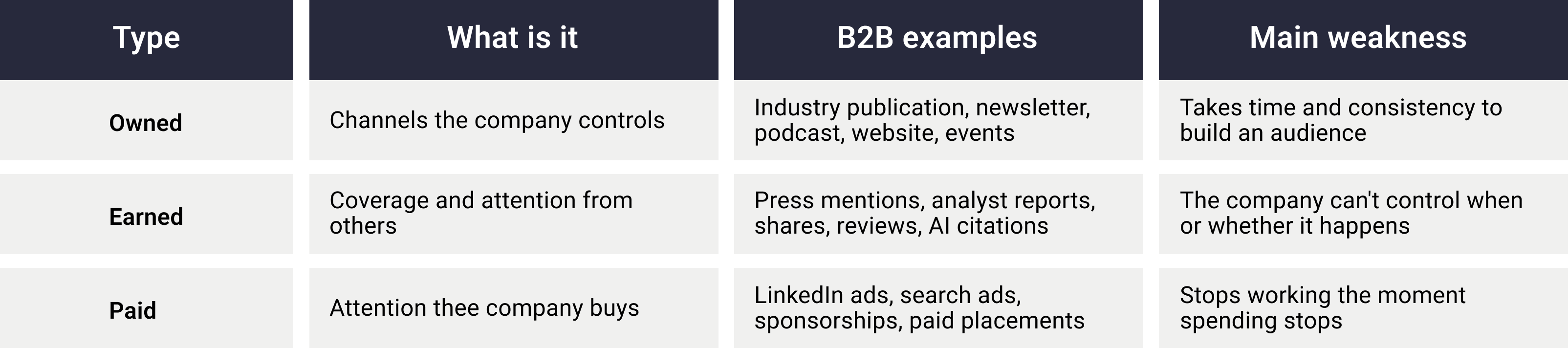
In practice the lines blur. A good owned publication tends to create earned media along the way. People share articles they're quoted in, other outlets cite original reporting, and AI tools pull from credible sources when they answer questions. Paid promotion can also give a publication's best pieces a push. Of the three, though, owned media is the only one that keeps its value after the work is done.
Why owned media matters more in B2B now
Two channels that B2B marketers relied on for years have become much less dependable.
Search is sending fewer clicks. SparkToro's analysis of Similarweb data found that in the first four months of 2026, 68.01% of Google searches ended without a click. AI Overviews now appear on more than 20% of Google searches, and click-through rates drop by nearly 60% when they show up. Publishers have taken the hit first. Chartbeat data in the Reuters Institute's 2026 trends report showed Google organic search traffic to over 2,500 sites falling by a third globally between November 2024 and November 2025, and by 38% in the United States.
Social reach for brands has fallen just as sharply. Richard van der Blom's Algorithm InSights 2025 report, covered by Entrepreneur, found that organic posts by company pages now reach only 1.6% of followers. Ordinal's platform analysis put the drop in organic reach for company content at 60 to 66% between 2024 and 2026.
AI search is growing, but slowly in absolute terms. Similarweb reports that AI platforms drove an average of 770.7 million referral visits per month worldwide between June 2025 and May 2026, more than double the year before. Even so, Chartbeat notes that AI chatbots still account for less than 1% of total pageviews across its network. For B2B brands, chasing AI referrals the way they once chased Google rankings would repeat the same mistake. A better bet is original, well-sourced content that people, other publications, and AI tools all want to reference.
If a platform controls your audience, it also controls your results. Owned media gets some of that control back.
What counts as owned media in B2B
Almost any channel a company runs can count, but some build much stronger audiences than others.
An industry publication, sometimes called a brand newsroom, is the fullest version. The company runs a dedicated outlet that reports news, interviews practitioners, and analyzes trends for a specific market. When it works, buyers visit it the way they'd visit a trade publication.
Email newsletters give a brand the most direct line to readers it can get, with no algorithm deciding who sees what. Podcasts and video series help audiences get to know a company's people and its point of view, and they tend to work best when customers and outside experts get airtime too. Original research, like annual benchmark reports or survey data, can become a reference that others cite for years. Events and communities, from small dinners to online groups, turn readers into participants.
The company website and blog belong on the list as well. But a blog written mainly for search rankings rarely builds loyalty. Most visitors arrive from Google, find their answer, and leave.
How a publication differs from a company blog
A company blog and an owned publication can sit on the same domain and run on the same software. They still work very differently.
Most blogs are planned around keywords. Topics come from search volume tools, articles are written to rank, and success gets measured in organic sessions. Readers are whoever happened to search for a particular phrase that week.
A publication is planned around a beat, meaning a defined area of coverage that a specific audience cares about. Its topics come from what's actually happening in the industry, its articles feature real practitioners, and its success depends on whether the right people read it, come back, and pass it along.
One way to tell them apart is to imagine Google sending zero traffic tomorrow. Most blogs would go quiet. A real publication would keep a good share of its readers through direct visits, newsletters, and people sharing it with colleagues.
How B2B owned media works in practice
Outlever, which builds and operates owned media publications for B2B brands, describes what it does in simple terms. "We basically create news publishers in a box," co-founder Melissa Rosenthal told the Sleight of Brand newsletter. Rosenthal came to the idea from media. She was one of BuzzFeed's first ten employees and built its branded content revenue model in 2010, then led revenue at Cheddar and marketing at ClickUp before co-founding Outlever.
Under Outlever's model, a publication builds on itself over time. The brand covers news in its industry and interviews the people it most wants to reach. Those people share the coverage with their own networks, which brings in new readers. Some of them are potential customers, so an interview can turn into a business relationship without anyone making a sales pitch. And since the reporting is original and properly sourced, newsletters, other outlets, and AI tools pick it up and send more readers back.
Outlever argues this is why owned media merges two budgets most B2B companies keep apart. If the people featured in your publication are your ideal customers, brand building and demand generation stop being separate jobs.
How to build an owned media program
Start with the beat. Look for the overlap between what your market cares about and where your company has real standing to speak. A narrow beat usually beats a broad one, as long as there's enough going on to publish every week.
Give the publication its own name and editorial voice so readers can tell it apart from your product marketing, and say clearly who publishes it. Most readers don't mind that a company is behind a publication, as long as the coverage is useful and they aren't misled about who's running it.
Make interviews with practitioners the backbone of your content. Nobody else can publish the same conversation, the people you feature will usually share it, and you come away with a relationship.
Pick a publishing schedule you can keep up for a year. Readers build habits around consistency, and a schedule that burns out in six weeks does more harm than a slower one that holds.
Make email the center of the program. LinkedIn and other platforms are useful for distribution, but they should point readers back to something you own.
Finally, decide early how you'll measure it, and agree on that with leadership before launch.
How to measure owned media
Attribution trouble ends more B2B editorial programs than weak content does. Brand-building work doesn't show results on the schedule paid campaigns have trained executives to expect.
It helps to measure in two stages. For the first few months, look at who's reading. Are they the buyers you want? Do they come back? Are they sharing it, and are respected people in your industry agreeing to be interviewed? Once the publication has some momentum, add business measures like pipeline that came from editorial relationships, how quickly engaged readers move through deals, and your share of voice in the category.
Traffic on its own can mislead you. A few thousand of the right buyers reading closely is usually worth more than a huge audience that will never buy anything.
Common mistakes
The most common one is renaming a keyword-driven blog a "newsroom" and expecting different results. The name doesn't change who reads it or why.
Another is writing only about your own company. Readers show up for news about their industry, and a publication that mostly covers its owner's products won't keep them.
Broad beats cause trouble too. Topics like "the future of work" put you up against every major outlet and consulting firm in the world.
Many companies also give up too soon. Audiences take time, and programs judged on a paid campaign's timeline often get cut right before they start paying off.
And depending on a single platform, whether that's Google or LinkedIn, leaves you with the same exposure you were trying to get away from.
Frequently asked questions
Is owned media the same as content marketing?
Not quite. Content marketing is the broader practice of creating content to attract customers. Owned media refers to channels the company controls. An owned publication is one form of content marketing, but plenty of content marketing, like guest posts and sponsored articles, runs on channels the company doesn't own.
How long does owned media take to work?
Longer than paid media, but often faster than teams expect. Early signs, like the right people reading, return visits, and interview requests getting accepted, can show up within a few months. Revenue usually takes longer.
Does owned media help with AI search?
It can. AI tools tend to draw from sources with original information, named experts, and clear factual writing, which is exactly what a publication built on reporting and interviews produces.
Can small B2B companies do this?
Yes. One marketer can start by setting aside a section of the company site for industry news and commentary, choosing a narrow beat, and publishing interviews on a steady schedule. You can grow it from there.
Should we build it in-house or work with a partner?
Either can work. An in-house team keeps full control but needs editorial skills most marketing departments don't have. A partner like Outlever brings newsroom processes, journalists, and production tools, which can get a publication running sooner.
Where this leaves B2B marketers
For years, B2B companies judged their reach by how much traffic Google and LinkedIn were willing to send them. That arrangement is falling apart. An owned publication gives a company readers it can reach directly and a body of work that holds its value. Outlever's own publication, The State of Brand, runs on this model. Companies that start building now won't be scrambling the next time a platform changes its rules.
Disclosure: The State of Brand is published by Outlever, which builds and operates owned media publications for brands, including examples referenced in this article.

If this caught your attention, that’s not accidental.

The best editorial systems don’t happen by accident. Outlever builds them.

If this caught your attention, that’s not accidental.

The best editorial systems don’t happen by accident. Outlever builds them.


Come back for the reason it lands.
Subscribe for the kind of thinking that makes people stop, read and come back.