Trump Was Hours Away From the First Real AI Regulation. Then He Killed It Because He Hates Regulation.
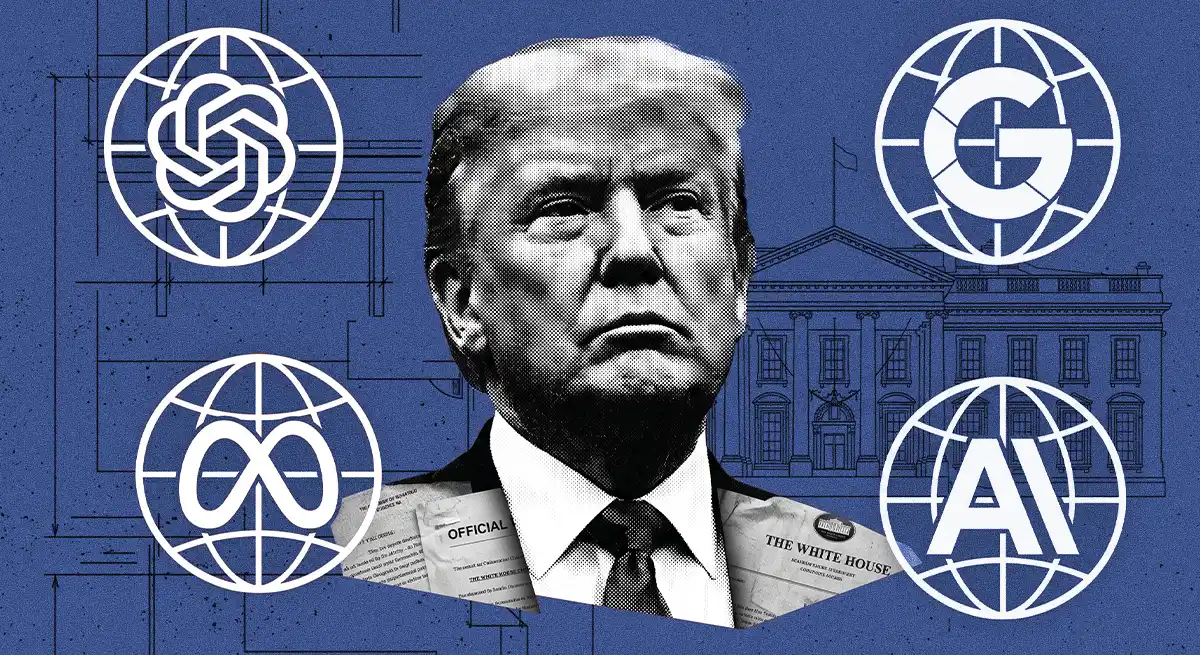
The most consequential AI policy document the White House has produced since taking office was scheduled to be signed Thursday afternoon. CEOs from OpenAI, Anthropic, Google, Meta, Microsoft, and Apple were invited.
Make State of Brand one of your go-to sources on Google

The most consequential AI policy document the White House has produced since taking office was scheduled to be signed Thursday afternoon. CEOs from OpenAI, Anthropic, Google, Meta, Microsoft, and Apple were invited. The photo op was staged. The pens were ready.
Then Trump pulled the order hours before signing, telling reporters in the Oval Office that he "didn't like certain aspects of it" and that it could get in the way of America's AI lead over China.
The executive order would have done two things. First, it would have established a voluntary framework for frontier AI labs to share their most advanced models with the federal government up to 90 days before public release, giving agencies time to test for cybersecurity vulnerabilities. Second, it would have formalized partnerships between the government and leading AI companies on security coordination, creating something resembling a structured review process for the most powerful AI systems on the planet.
Both sections are now shelved. The timeline for anything replacing them is unclear.
What Actually Killed It
Axios reported that the order collapsed because Trump "just hates regulation," and that AI adviser David Sacks also "hated it." A source close to the process called the entire effort "unnecessary" and "just something doomers wanted."
Mark Zuckerberg, Elon Musk, and Sacks all spoke with Trump between Wednesday night and Thursday morning. By Thursday afternoon the signing was dead. Engadget reported that industry leaders warned Trump the order could slow development of AI tech that has become integral to the U.S. economy.
The accelerationist wing of the administration won this round decisively. And they did it by framing even the most voluntary, most industry-friendly version of oversight as a competitive liability.
The executive order did not mandate anything. It did not require compliance. It did not create a new agency. It asked AI labs to voluntarily share models with the government before release, something several of them already do through the Commerce Department's Center for AI Standards and Innovation. CAISI has completed more than 40 model assessments to date, including evaluations of unreleased state-of-the-art systems, with all five major U.S. frontier labs now participating voluntarily. The bar was as low as it could possibly be set, and it was still too high.
The Regulatory Vacuum Is Now Official
Before Thursday, you could argue that the absence of AI regulation was a temporary condition. That the administration was working on something. That the White House was just slow, but that argument is no longer available.
Trump did not delay this order because the details were wrong. He delayed it because the concept of oversight conflicts with his stated philosophy on AI, which is that American companies should be free to build without constraint. David Sacks reinforced that position publicly throughout the spring. Musk and Zuckerberg validated it in private calls the night before.
The practical result is that the United States now has no federal framework, voluntary or otherwise, for reviewing frontier AI models before they reach the public. The existing CAISI agreements are bilateral arrangements between individual labs and a Commerce Department office. They are not a policy and they are not a standard. And as Thursday proved, the political infrastructure above them is hostile to formalizing them into anything more.
This happened three days after Steve Bannon and 60 other Trump allies signed a letter through the conservative group Humans First, urging the president to ensure that frontier AI systems are fully vetted by the government before release. The letter put a vocal faction of the MAGA base directly at odds with the White House's hands-off approach. It did not matter.
The Timing Could Not Be More Loaded
This happened during the most compressed week of AI news in recent memory.
On Monday, Google restructured Search around AI at I/O and declared the era of ten blue links over. On Tuesday, Google Marketing Live revealed that Gemini now runs underneath every major Google ad product, with a new "AI Brief" feature that lets the platform generate your ad creative, target your audience, and optimize your spend with minimal human input.
On Wednesday, NVIDIA reported $81.6 billion in quarterly revenue, with $75.2 billion coming from data center sales alone, up 92% year over year. Jensen Huang told analysts that agentic AI is doing productive work at scale. The same day, OpenAI began preparing a confidential IPO filing at a valuation approaching $1 trillion. SpaceX filed its S-1 two days earlier. Anthropic is targeting October.
And on Thursday, the one document that would have introduced even the lightest form of government involvement in how these systems reach the market got pulled from the president's desk because Elon Musk and Mark Zuckerberg made phone calls the night before.
The infrastructure is scaling at historic rates. The products running on that infrastructure are reshaping how people search, buy, and make decisions. Three of the companies building those products are about to go public at combined valuations north of $3 trillion. And the regulatory response is nothing. Not light-touch. Not voluntary. Nothing.
Who Benefits From No Rules
The obvious beneficiaries are the frontier labs themselves. OpenAI, Anthropic, Google, and Meta can now ship models on their own timelines without even a voluntary review process to navigate. That removes friction, which is what every company wants.
But the more interesting beneficiary is the company that has already been operating as if trust were the only regulation that matters. Anthropic restricted its most capable cybersecurity model earlier this year, limiting access to 12 launch partners while committing $100 million in usage credits to defensive security organizations. It did that voluntarily, with no government framework requiring it. We wrote about that decision in detail and the conclusion holds up: when there is no external standard, the company that sets its own standard owns the category narrative.
Thursday's news makes that dynamic even sharper. Anthropic's self-imposed restraint is no longer a complement to government oversight. It is the only oversight. The gap between "we chose to limit access because the model was too powerful" and "we shipped immediately because nobody told us not to" becomes the defining contrast in how enterprise buyers evaluate AI vendors. The government was supposed to fill that gap. It just confirmed it will not.
What This Means for the Enterprise Buyer
If you are evaluating AI vendors for your company right now, Thursday's news has a direct implication: the question of which AI systems are safe to deploy in critical infrastructure is now entirely a private-sector judgment call. There is no federal review. There is no voluntary testing framework with any political backing. There is no government stamp of approval, even a symbolic one.
That puts enormous weight on vendor trust signals. How does this company handle security disclosures? What is their track record on model safety? Do they restrict access when a model's capabilities outpace the ecosystem's ability to absorb them, or do they ship and let the market sort it out?
Those used to be secondary questions in a vendor evaluation. They are now primary ones, because the government just told you it is not going to answer them for you. We have been tracking this dynamic all year, from the Stanford AI Index proving the capability gap is closing while the trust gap widens to the data showing that B2B buyers choose their shortlist before the first call and only trust gets you on it. Thursday did not change that thesis. It made it the only thesis.
The Infighting Will Continue
One detail in the Axios reporting deserves attention. There were questions about why the Treasury Department was given a leading role in coordinating security vulnerability reviews in the draft order, rather than CISA or NIST, which have traditionally handled that function. A source called the choice "objectively" unclear and questioned Treasury's substantive expertise.
That signals something deeper than a turf war. It suggests the order was drafted in a fragmented process where different parts of the administration were working with different assumptions about what the document was supposed to accomplish. The cybersecurity community wanted a serious review mechanism. The political side wanted something that looked productive without constraining the companies that Trump views as strategic assets. The result was a document that satisfied neither constituency and collapsed under the weight of a few phone calls.
The White House's Office of the National Cyber Director has reportedly been working on additional AI security initiatives separate from the executive order. Whether those survive the same political dynamics that killed this one remains to be seen.
The Absence Is the Policy
There is a tendency in coverage of AI regulation to treat inaction as a pause, as if the government is simply taking its time and will eventually produce something. Thursday's events should end that framing.
The president of the United States had the document on his desk. The CEOs were in town. The framework was voluntary. And he still killed it, on camera, because the philosophical objection to any form of oversight outweighed the practical case for even the lightest version of it.
The absence of regulation is not a gap that is waiting to be filled. It is the policy. And every company building AI products, selling AI services, or trying to figure out which AI vendor to trust just learned that the only standards that exist are the ones companies impose on themselves.
Some companies will treat that as permission to move faster. A few will treat it as a reason to move more carefully. The market will decide which approach it rewards. But nobody should be waiting for Washington to weigh in, because Washington just told you it is not coming.

If this caught your attention, that’s not accidental.

The best editorial systems don’t happen by accident. Outlever builds them.
If this caught your attention, that’s not accidental.

The best editorial systems don’t happen by accident. Outlever builds them.
Come back for the reason it lands.
Subscribe for the kind of thinking that makes people stop, read and come back.