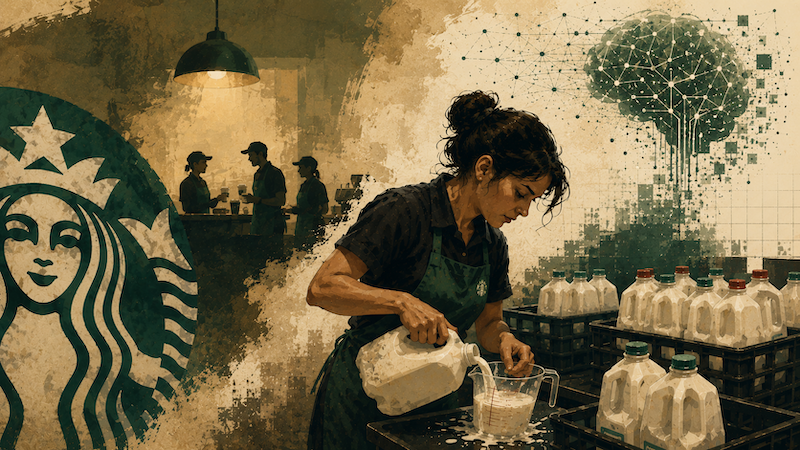
In September 2025, Starbucks finished rolling out an AI tool called Automated Counting to more than 11,000 company-operated stores across North America. The vendor, a Redmond startup called NomadGo, announced it with the kind of numbers that get a deployment greenlit. Ninety-nine percent accuracy. Counts up to eight times faster than doing it by hand. A "unique synthesis" of on-device computer vision, 3D spatial intelligence, and augmented reality. Wave a tablet at a shelf of milk jugs and syrups, and the count appears, validated in AR. Starbucks' chief technology officer framed it as freeing partners from a time-intensive task so they could get back to making drinks and connecting with customers.
On Monday, May 19, 2026, an internal newsletter obtained by Reuters retired the whole thing in one line. Automated Counting was done. Milk and beverage components would now be counted the way every other category in the store is counted, by a person.
That makes it the most prominent enterprise AI rollback in retail so far this year. For anyone in the business of putting a brand behind an operational promise, it's an important one to pay attention to because the failure didn't happen where most people will assume it did.
The number was real. The conditions weren't.
Here is the part that everyone is going to skip past on the way to "AI failed."
The 99% figure was almost certainly true under the conditions it was measured. A clean shelf, good lighting, a tidy backroom, a controlled set of SKUs. That is what a benchmark is. A number generated inside a room someone set up to generate it.
The Starbucks backroom mid-rush is not that room. According to the reporting, the tool frequently miscounted and mislabeled items, confused one type of milk for another, and sometimes skipped products entirely. A shift supervisor of nine years told Fortune the app started off not particularly accurate and got worse over time. There was an early omen nobody clocked. In the official launch video Starbucks posted to announce the partnership, the tool failed to recognize a bottle of peppermint syrup.
So the work landed back on the people it was supposed to free. Baristas re-counted by hand to fix the AI's tallies, which means the system didn't replace the task. It added a second one on top of it. A tool that needs a human to verify every output doesn't deliver efficiency. It delivers two jobs.
The misses weren't cosmetic either. Over-count a product and the store wouldn't get enough of what it was running low on. Under-count it and the same thing happened from the other direction. Product availability is the exact problem the tool was bought to solve, and it was making that problem worse.
Why this is a brand story, not just an AI story
The September announcement was a marketing artifact. The 99% accuracy claim, the "automated, intelligent, and fun" framing, the AR demo video. That was the brand making a promise in public. The May memo was the same brand quietly walking it back. The gap between those two moments is what strikes us.
Starbucks didn't describe the retirement as a failure. It told reporters the move was a decision to standardize how inventory is counted across coffeehouses as it focuses on consistency at scale. NomadGo said it is continuously learning from customer and user feedback. Both statements are careful, and neither one acknowledges the accuracy problems Reuters had documented months earlier, including a February moment where Starbucks told the same outlet the AI was helping product availability.
That is the credibility cost. Not the tool breaking. Tools break. The cost is the distance between what the brand said at launch and what was happening in the room the whole time. When the loudest number you put behind a product is a benchmark, you are betting your credibility on conditions you stop controlling the moment the thing leaves the lab.
What to take from it
A single accuracy number means almost nothing on its own. Before you build a launch, a deck, or a turnaround narrative around one, ask the two questions that actually matter. Under what conditions was this measured, and how does it fall apart at the edges? In the physical world, the boring, repetitive, high-variance tasks are the hardest to automate reliably, and the 1% it gets wrong is precisely where your customer, or your barista, is standing.
Starbucks pushed Automated Counting to 11,000 stores in roughly a month. It did not prove it slowly. The fastest way to turn a marketing number into a brand liability is to scale it before the room you tested it in looks anything like the room it has to live in.
Worth naming the backdrop. Starbucks just posted its strongest comparable-store sales growth in two and a half years, and the stock is up about 24% on the year. The turnaround is working. This one tool wasn't. The lesson sitting underneath that is to avoid pinning a brand to any single piece of tech before it earns the spot.