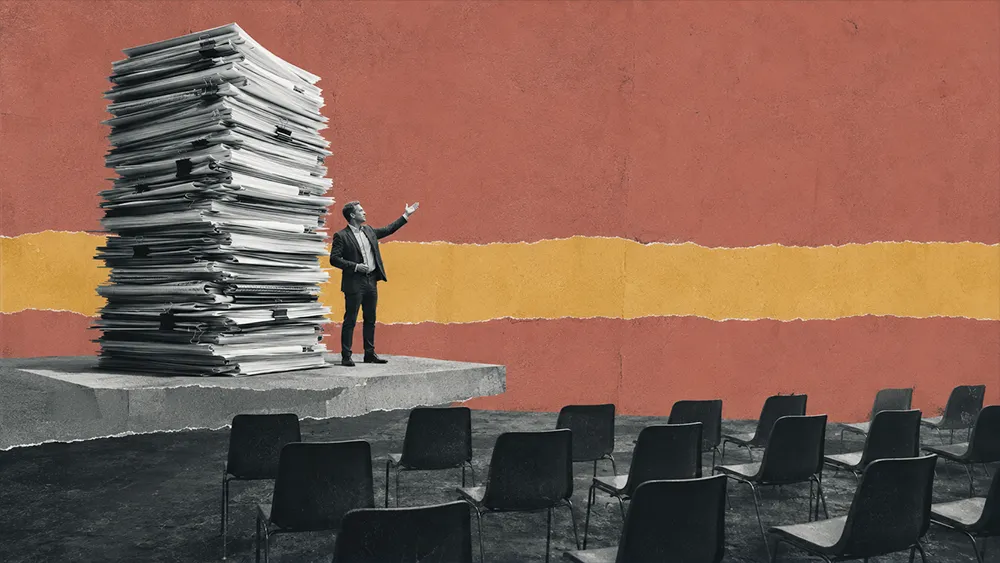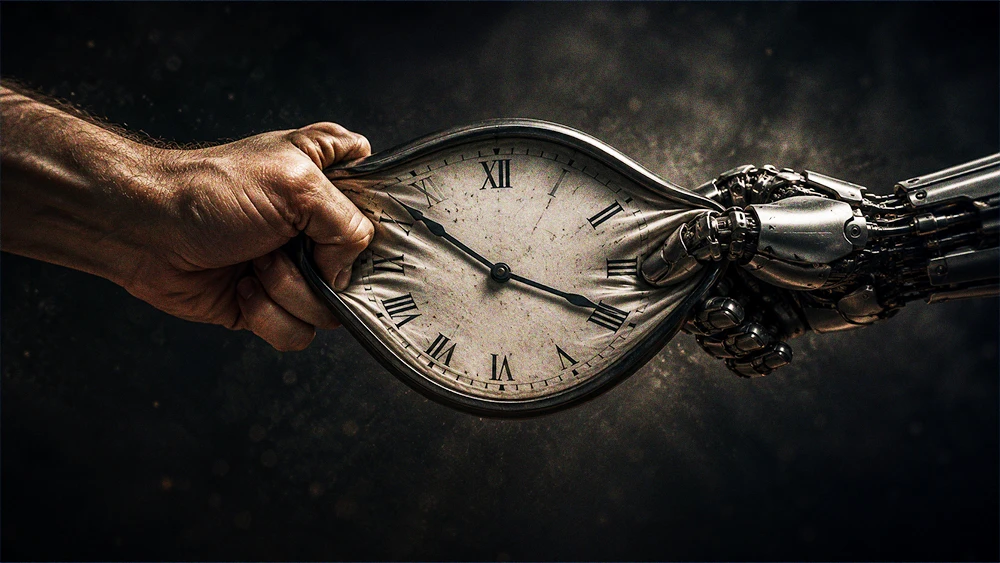
Somewhere in your company right now, a brief is landing in someone's inbox with two requirements that cancel each other out.
The first requirement: make it good. Original. On-brand. Something with a point of view, something a customer would actually remember, something that doesn't read like it fell out of a content mill. Human work, in other words. The kind that takes taste, judgment, and time.
The second requirement: have it by Thursday. Because you have the tools now. What used to take two weeks should take two days. What used to take a team should take a person.
Nobody wrote those two requirements down next to each other, because if they had, someone might have noticed they don't fit. Companies didn't sit down and decide to demand human quality at machine speed. They absorbed the AI productivity narrative into their timelines without absorbing it into their standards. The standards stayed human. The deadlines went algorithmic. And the person in the middle is expected to close the gap on their own.
The math everyone is pretending works
The deal companies think they made goes like this: AI handles the production, humans handle the judgment, everything gets faster and nothing gets worse.
The deal they actually made is different, and the research on it is brutal. The Upwork Research Institute surveyed 2,500 executives, employees, and freelancers and found that 96% of C-suite leaders expected AI to lift their company's productivity. Meanwhile 77% of the employees actually using the tools said AI had added to their workload, and 47% said they had no idea how to deliver the gains their bosses expected. Same companies. Same tools. The people setting the timelines and the people living inside them are describing two different realities.
Why the gap? AI compressed the visible part of the work: the typing, the drafting, the layout. It left the invisible part alone. The thinking didn't get faster. Knowing what to say didn't get faster. Understanding why the third draft is wrong in a way you can't articulate yet didn't get faster. Taste has no API.
But timelines get set against the visible work. A deck that used to take a week now "takes an afternoon," because the afternoon is when the slides get made. The week was never really about making slides. It was about figuring out what the slides should argue. That part still takes a week. It just no longer has a week on the calendar, because the calendar was rebuilt around what the tool does rather than what the human was actually doing all along.
So the thinking gets done anyway, on nights and weekends and in the margins, or it doesn't get done at all and the output ships as a first-draft AI pass with a human signature on it. Upwork's data shows where the first path leads: 71% of full-time employees report burnout, 81% of executives admit they've raised demands on their workers in the past year, and one in three employees says they're likely to quit within six months.
The second path has a name now too. Researchers at Stanford's Social Media Lab and BetterUp Labs call it "workslop": AI-generated output that looks finished but lacks the substance to move a task forward. Their survey of 1,150 U.S. desk workers found that 40% had received workslop from a colleague in the past month, and that each incident cost nearly two hours of rework. For a 10,000-person company, they estimate the bill at roughly $9 million a year. The same researchers point to it as one explanation for MIT's finding that 95% of enterprise AI pilots deliver zero measurable return.
Both paths trace back to the same origin. Somebody was handed a human-quality expectation on an AI-speed deadline, and something had to give. Either the person gave, or the work did.
The tell is in the hiring
If human work at AI speed were actually achievable, you'd expect the market to stop paying premiums for humans. The opposite is happening. Anthropic, a company whose entire product is an AI that writes, currently lists a Head of Copy and Content role at $320,000 to $400,000, part of a full in-house creative studio it's building from scratch, and OpenAI is staffing up its own creative and marketing operation alongside it. Mercury put $335K on the table for what reads like an editor-in-chief job. The companies with the most direct financial interest in proving writing can be automated are paying senior-engineer money for people who do it by hand.
That's the market admitting what the timelines won't: when production is nearly free, the scarce thing is knowing what's worth producing. Judgment has been repriced upward at the exact moment production has been repriced toward zero. Companies are paying more than ever for the human part of the work while scheduling as if the human part disappeared.
You can't pay judgment prices and set autocomplete deadlines. Eventually one of those numbers is lying, and it's usually the deadline.
Klarna already ran this experiment at full scale. The company cut roughly 700 roles on the promise that AI could cover the work, then had to hire people back when the output wasn't good enough. The savings were real and immediate. So was the quality bill. It just arrived later, the way quality bills always do.
What this does to brand, specifically
Brand is where the contradiction gets expensive fastest, because brand is the one function where "fine" is a failing grade.
AI has made "fine" infinite and free. Every competitor has the same models, the same output floor, the same ability to flood every channel with competent, forgettable material. Which means the entire remaining value of brand work lives above that floor, in the distinctive, the specific, the stuff that sounds like it came from somewhere. That's precisely the work that doesn't compress.
A brand voice that survives 2026 is one that AI demonstrably didn't write, in a market where AI wrote almost everything else. That's a differentiation strategy. It's also a time budget. When leadership demands the differentiation while confiscating the time budget, the result isn't faster brand work. It's slower brand erosion: output that's 80% as good, shipped twice as fast, compounding quietly until someone in a planning meeting asks why nothing the company puts out seems to land anymore.
The answer will be that the company spent two years asking for human work on an AI timeline, and got exactly what that produces: AI work with human overhead.
The companies getting it right made one decision
The organizations handling this well aren't the ones with the best tools or the loudest AI mandates. They're the ones that did something almost embarrassingly simple. They decided, explicitly, which work is production and which work is judgment, and they only accelerated the first kind.
Production work gets the AI timeline: variants, resizes, first drafts, summaries, the long tail of assets nobody will remember. Full compression, no apologies. Judgment work keeps a human timeline: positioning, voice, the campaign idea, the naming, anything a customer will use to decide what this company is. That time gets defended on the calendar like a budget line, because it is one.
The Stanford and BetterUp researchers land in the same place. The organizations avoiding workslop, they found, are the ones that set clear guardrails, define specific use cases, and reinforce human judgment, rather than issuing blanket "use AI everywhere" mandates and hoping the org chart sorts out the rest.
The blanket-mandate companies aren't avoiding the tradeoff. They're delegating it to whoever got the brief on Thursday, and that person resolves it the only way an individual can: by cutting the thinking, or by burning out doing it off the clock. Some are resolving it a third way. A 2,400-person survey by Writer and Workplace Intelligence found that 29% of employees admit to actively sabotaging their company's AI strategy, a figure that jumps to 44% among Gen Z. In the same survey, 60% of executives said they plan to lay off employees who won't adopt AI, and nearly half called their company's AI adoption a massive disappointment. Those two findings are not unrelated.
The bottom line
"Human work on an AI timeline" sounds like a productivity target. It's actually an unpriced demand: a request for the most expensive kind of work at the newly discounted rate, with the gap billed to people whose exhaustion won't show up in a dashboard until it shows up in the brand.
AI genuinely changed the timeline for a lot of work. It changed the value of the rest. The companies that win the next few years will be the ones honest enough to keep two clocks. The companies that spend those years wondering why everything they make feels slightly off will be the ones still insisting there's only one clock, and that it runs at machine speed.
The work will tell you which kind of company you are. It always does. It just takes a little longer than a Thursday deadline to say it.