Your Marketing AI Is Waiting For Instructions. This AI Search Company Is Betting That’s a Death Sentence.
Search Atlas COO Sophia Deluz-Bhan explains why the AI tools companies keep will act on problems, not just answer questions, and how to know which content can scale.

Make State of Brand one of your go-to sources on Google


If you look at a lot of the tools in the market, and this is a bit why people talk about the SaaS apocalypse, they're really reporting tools that have maybe added an extra layer of an agent. But it's really a question chatbot.

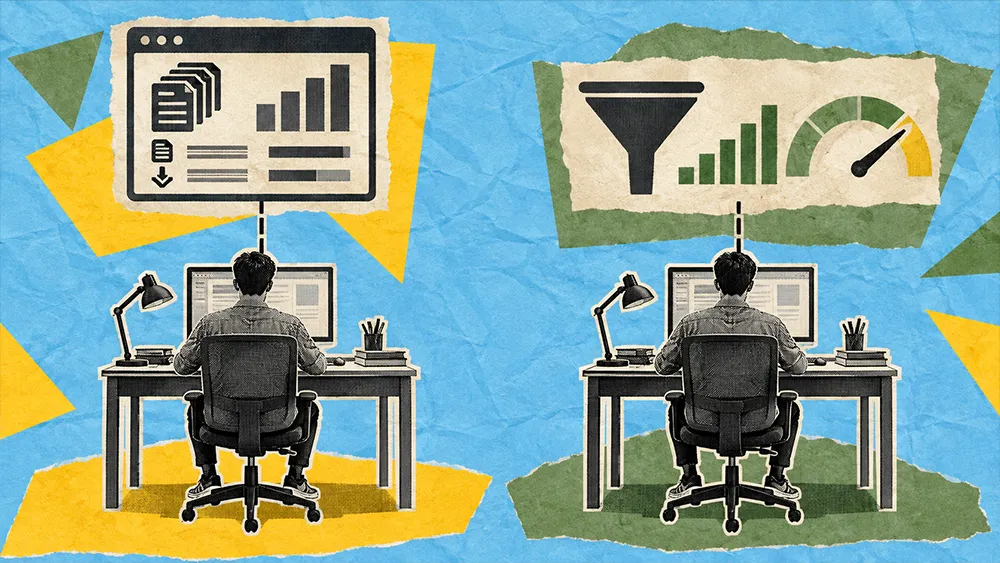
Most marketing software waits to be asked, then answers a question about what already happened. The agent layers vendors are bolting onto those dashboards mostly perform the same trick with a friendlier interface. An agent will tell a team its cost per click. It will not change the cost per click. The split between reporting and acting separates the tools worth renewing from the ones that get slashed at contract's end. For leaders working out budgets, the question about any AI tool has shifted from whether it can answer, to whether it will move the needle.
Sophia Deluz-Bhan is the COO and Co-Founder of Search Atlas, an AI-powered search marketing platform she scaled from $2M to $35M in annual recurring revenue over two years, profitably and entirely remote. Before building software, she and her co-founder ran an enterprise SEO agency serving clients like Shutterfly, using their own operational pain as the product spec. That history sharpens how she reads the current wave of agentic tools, and where they fall short.
"If you look at a lot of the tools in the market, and this is a bit why people talk about the SaaS apocalypse, they're really reporting tools that have maybe added an extra layer of an agent. But it's really a question chatbot," Deluz-Bhan says. She picks the word carefully. A reporting tool with a chatbot still depends on the marketer to notice a problem, frame the right question, and then go do something about the answer. The survivors, she expects, close that loop on their own. She knows because she has already created it.
The reporting tool with a chatbot stapled on
The market has converged on a comfortable pattern: take a dashboard, add a conversational layer, call it an agent. Deluz-Bhan sees a thin upgrade to an old model, and a vulnerable one. The survivors catch a problem and resolve it on their own, which is the standard she holds Search Atlas to.
"Search Atlas is proactive, meant to really replace a lot of the manual work on your team. It acts as a co-worker that proactively surfaces issues, trends, and opportunities, and then acts upon those things," she explains. She chose the language of co-worker over assistant for a reason. An assistant executes orders, while a co-worker spots the gap and fills it.
Most of the category has settled for the assistant model because it is the easier thing to build, a layer that responds when spoken to. Deluz-Bhan is betting that the responsive model is a dead end, and the bet is well timed. It arrives as SaaS vendors tighten access to the very data these agents need to function, which rewards the platforms that already act on what they can see rather than waiting to be asked about it.
Meeting marketers where they already?
Her second bet is on placement. The tool has to live where the work already happens, usually Slack, ClickUp, or Microsoft Teams, rather than asking a team to leave those rooms and log into one more destination.
"Creating this co-worker has allowed us to proactively listen, monitor, and engage on those conversations," she says. The payoff goes past convenience to context. A tool listening where a campaign is being debated sees what a separate login misses.
This is the part of her thinking that separates the durable products from the disposable ones. A platform a team has to remember to open is a platform a team eventually forgets to open. By embedding the co-worker in the rooms where decisions are already being argued, she sidesteps the slow death most marketing software dies, the one where adoption fades because the tool was always one tab away from being ignored.
She knows not every marketer wants the same interface. Some want a conversational interface; others want a standard layout they can navigate by habit. What she is solving underneath both is the artifact shuffle, the loop of building something in one tool, exporting it, posting it elsewhere, then teaching a teammate how to retrieve it. Removing that friction is less glamorous than the agent demos that get attention, and it is closer to what actually determines whether a team keeps using a product six months in.
Where a frontier model stops being enough
The obvious objection is that a marketer could skip the specialized platform entirely and ask a general-purpose model to write the strategy and the content. Deluz-Bhan agrees, to a point, and then draws a line around where that approach breaks.
"Claude and other frontier models are trained on the information that exists online. And the information that exists online is often wrong," she says. Take schema markup. Countless articles and LinkedIn posts treat it as essential for showing up in AI-generated answers. Her research team ran the data and the consensus collapsed. A general model trained on that corpus repeats the conventional wisdom anyway, confident and wrong.
The implication runs well past SEO, and it is the most useful thing here for any marketer leaning on AI. A model is a consensus engine that returns the average of what has been published, which means it is most confident exactly where the published record is most repetitive, and repetition is not the same as truth. On any tactic where the internet agrees loudly and the results quietly disagree, a frontier model will hand back the loud answer in a fluent, authoritative voice. Her whole company runs on the corollary: knowing the consensus is now free, so knowing where it breaks is the asset.
Wide and deep are different problems. General models go wide, and that range carries a lot of ordinary marketing work on its own. Knowing what actually outranks a competitor takes proprietary testing, and a general model has none of it. The companies that endure, in her telling, pair the breadth of frontier models with verified depth that the models do not get from the open web.
The content most marketers can let go of, and the content they cannot
Going deep is not the same as fussing over every word, and Deluz-Bhan is unsentimental about scale. Search Atlas may produce hundreds or thousands of pieces of content a month, and she rejects the instinct to inspect each one with a magnifying glass.
"You can't let perfect be the enemy of good," she says. "Getting something 80 or 90% of the way there with AI and maybe putting a couple tweaks on it at the end is better than getting one tenth of the amount of things done." The line that follows is the one most marketers skip, and it is where her judgment shows. The balance is different for a scrappy startup than for a brand with a decade of equity to protect. A small brand can often publish AI-assisted work with light guardrails and find real success. An enterprise that has invested years in a distinct brand voice cannot one-shot its social calendar without paying for it.
That caveat matters more now than when she first learned it, because the market is starting to price the difference. When consumers can tell that brand content was produced by AI, they are roughly four times more likely to trust the brand less rather than more. Most teams are about to learn that lesson by overcorrecting in one direction or the other, drowning in unread synthetic content or refusing to scale at all. Deluz-Bhan has already found the seam between them, and the answer is to sort by tier. Some content exists to be found by a crawler and skimmed by no one, and at that tier the 80% rule is correct. Some content is the brand meeting a customer, and at that tier 80% is a liability. No one has yet cracked how to make a model not sound like a model. Until someone does, the discipline is knowing which tier a piece belongs to, and never letting the cheap tier set the standard for the expensive one.
Delegating to agents instead of to people
The shift she cares about happens in the org chart, well upstream of the output queue. She used to coach her leadership to delegate to their people, and now she coaches them to delegate to agents. She frames it as a relief rather than a loss.
"One of the most draining parts of managing a team is when you hand off a piece of it to someone and then you have to wait a certain amount of time to find out if that piece got done properly and on time," she says. Delegating to an agent removes the waiting and the guesswork. It also revives a role she thinks AI quietly restores, the individual contributor who can carry a project end to end without routing it through three handoffs that each invite a chance to derail it.
Here is where her optimism separates from the cynical version of the same story, because she does not pretend the human disappears. She insists on the opposite, and it is the most clarifying thing she says about where this is heading. Fewer seats, and a higher bar for who fills them. A team of ten running a process becomes a team of one or two running the same process through agentic loops, and the people with real skill are the ones least at risk, because someone still has to catch the model when it is confidently wrong about schema markup. Most companies are running the opposite play, cutting bodies and hoping the software covers the gap, and the numbers do not back the trade. Her version is harder and honest. The wait disappears and the judgment stays put, exactly where the stakes are highest.
For repeatability, her answer is unfussy and practical. She talks through the instructions once, saves them as a reusable skills file, and stops re-explaining herself every week. She points to Emily Kramer and the MKT1 newsletter as a sharp source on exactly this kind of operational AI practice, the unglamorous work of teaching a model to do marketing the way a particular team actually does it.
The tool you cannot turn off
The whole bet bends toward reliance, the threshold where a tool stops being software and becomes the thing the workday runs on in the background. The same bar makes a clean buying test, which matters when half the market is subscriptions that may not survive the year. Reliance is the thing most vendors want and few earn, and Deluz-Bhan knows it is earned the slow way, by being useful every day.
Her bluntest complaint is about the cold open that greets so many new AI products. A blank chatbot asking what a user wants to do places the entire burden of imagination on someone who has not yet learned what the tool can do.
"Logging in and seeing a chatbot that says, hi, what should we do today? I don't know you, and I hate that," she says. "You tell me what to do." The better experience, in her view, is a platform that opens by laying out the landscape, naming the highest-priority moves, and waiting for a single approval before it gets to work. That single approval is the entire design philosophy in miniature. The software does the surfacing and the work; the human keeps the decision. It is also the cleanest answer to the fear hanging over every one of these conversations, the one about people being replaced. The measure of a mature AI tool, in her telling, is how confidently it tells a team what to do next, and how completely the call still belongs to them.

If this caught your attention, that’s not accidental.

The best editorial systems don’t happen by accident. Outlever builds them.

If this caught your attention, that’s not accidental.

The best editorial systems don’t happen by accident. Outlever builds them.


Come back for the reason it lands.
Subscribe for the kind of thinking that makes people stop, read and come back.