The Quiet Churn Problem Nobody in B2B Is Modeling Yet
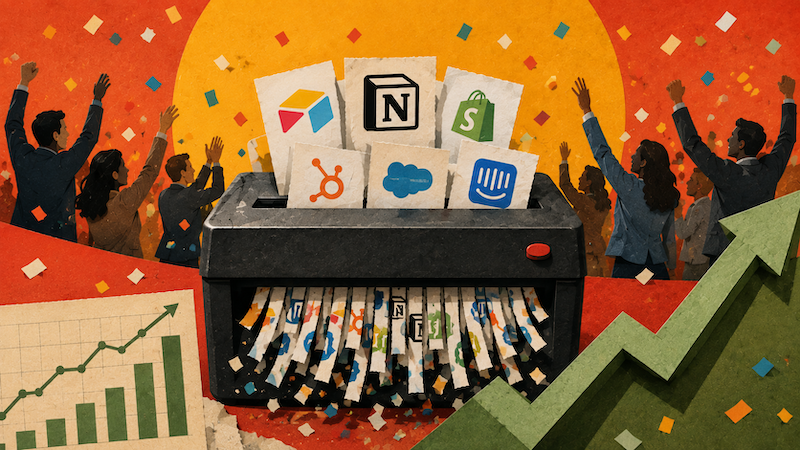
SaaStr cancelled Notion after seven years without a single complaint. Quiet churn is what happens when an AI agent absorbs your product's last job.
Make State of Brand one of your go-to sources on Google

SaaStr had been on Notion for seven years. No complaints, no feature requests, no escalations. The relationship was warm enough that one of Lemkin's team was invited to present at Notion's own user conference, which is the sort of customer a brand team screenshots for the board deck.
Then they cancelled. Lemkin's own summary of why: they stopped needing it.
Retention teams have a model for the angry customer and a model for the customer who gets outbid. Neither one describes what happened here, and the version of this that is coming will not be rare enough to ignore.
The email that closed the account
The trigger was not a competitor's pitch or a procurement review. It was Notion's own re-engagement email, the one that opens with a line about not having logged in for a while.
Amelia on Lemkin's team read it, agreed with it, and went and cancelled.
A campaign written, approved and automated by a marketing team, in the brand's own voice, worked as a cancellation prompt. It reminded her of the line item instead of the value.
Win-back email is built on an assumption that has quietly stopped being reliable, which is that a dormant customer has forgotten you and wants to come back. The other possibility is that they moved on months ago and forgot they were still paying you. Every dormancy send is a coin flip between those two readers, and almost every lifecycle program is written for only one of them.
Absorption, not competition
What replaced Notion at SaaStr is an internal agent they call 10K, described as their AI VP of Revenue. It became the source of truth and now runs the Monday staff meeting. By the time it did, Notion was down to a single job in the company, and that job disappeared.
Competitive displacement is a decision. Somebody runs an evaluation, sits through demos, builds a grid, picks a winner. That moment is where brand pays out, as the tie breaker and the trust premium and the reflex to go with the name everyone knows.
Absorption skips the decision entirely. Nobody at SaaStr was unhappy or shopping. A workflow moved somewhere else and a tab stopped getting opened. There was no moment of choosing for the brand to win.
Preference only cashes in when someone has to choose.
Why there is about to be much more of this
The reason to treat this as a trend rather than an anecdote has nothing to do with Notion and everything to do with cost.
Building an internal agent that reads your billing system, your accounting software and your CRM, then reports back in plain language on a Monday morning, used to be a project with a budget and a vendor attached. Now it is closer to a long weekend for one competent operator. The connectors are sitting there already. Most companies wired up Brex, QuickBooks, Slack and their CRM years ago for other reasons.
Point that capability at a software portfolio assembled during the 2020 to 2022 buying years and it finds a lot of tools doing one job each. Single job tools are exactly what gets absorbed first, because there is only one thing to replicate and no political fight about who owns the replacement. Meanwhile finance is looking for something to cut in order to fund an AI budget, and seat licenses on quiet products are the softest target in the stack.
The part that should worry vendors most is that none of this will show up cleanly in reporting. Absorption never appears in a win/loss review because there was no competitor to lose to. It arrives as unexplained decay in accounts with no open tickets, which is the exact profile most health scores treat as safe.
The mirror, which is worse
Lemkin published the reverse case as well, and it is the sharper half of the story.
Once 10K was connected to Brex and QuickBooks, it found two customers still paying $300 a month for SaaStr Pro, a product SaaStr stopped supporting six years ago. Nobody complained. Nobody churned. SaaStr had no idea it was billing them.
Same failure running in the opposite direction. In one case a quiet, healthy account walked out without anyone noticing. In the other, a quiet, abandoned account kept paying without anyone noticing.
The second one carries a real cost. Silent churn takes revenue off the table. Silently billing someone for a dead product takes trust, and it takes it from the customers who trusted you the most passively.
What to do before it lands on you
Stop reading silence as health. No ticket accounts get scored as satisfied because the alternative reading is expensive to act on. Usage decay does catch this eventually, but by the time it fires the replacement is already live and running the staff meeting. Silence is an absence of information rather than a positive signal, and it should route to a person instead of to another automation.
Count jobs per account rather than logins. The most useful line in Lemkin's post is that Notion had been down to one job. An account doing one job for you is not retained, it is one automation away from zero. Job breadth is a more honest leading indicator than seat count or NPS, and hardly anyone tracks it.
Run every dormancy email through a simple test: what happens if the reader agrees with the premise? If agreeing leads them to the billing page, the email is a churn driver with your logo on it. Give it something that stands on its own, like what changed since they were last in, what their team actually produced in there, or what rebuilding it would cost.
Get present where the agent is. Clean APIs, MCP support, real exports, integration depth. If a customer's internal agent is going to be the front door, the goal is to be the system it depends on rather than the tool it copied over a weekend. That is a product decision with brand consequences, which means brand ought to have an opinion about it.
Reconcile your own billing against your own supported products, then refund anyone in the gap before they find it themselves. That is a brand moment sitting there for free, and it expires the day the customer works it out on their own.
Where this gets overstated
This is one company, and Lemkin argues the agent case with some enthusiasm, which is worth naming. Notion is not in trouble because SaaStr left. Shelfware, seat decay and quiet non renewal have been part of software since software was sold by the seat.
What is new is the substitute. It is not a cheaper vendor. It is something the customer assembled themselves, which never shows up in a competitive review because it was never a competitor, and which gets cheaper to build every quarter. That last part is what turns a familiar failure mode into a forecasting problem.
Brand has been taking credit for retention that daily presence and workflow lock in were actually doing. When those go, the affection stays and the account leaves anyway.
Notion did nothing wrong here, which is the difficulty. There is no complaint to resolve, no save play to run and nothing to fix, and that is a far harder brief than an angry customer on the phone.

If this caught your attention, that’s not accidental.

The best editorial systems don’t happen by accident. Outlever builds them.

If this caught your attention, that’s not accidental.

The best editorial systems don’t happen by accident. Outlever builds them.

Come back for the reason it lands.
Subscribe for the kind of thinking that makes people stop, read and come back.