


powered by




When your model provider becomes your competitor, the moat you thought you had turns out to be a feature they hadn't gotten around to building yet.
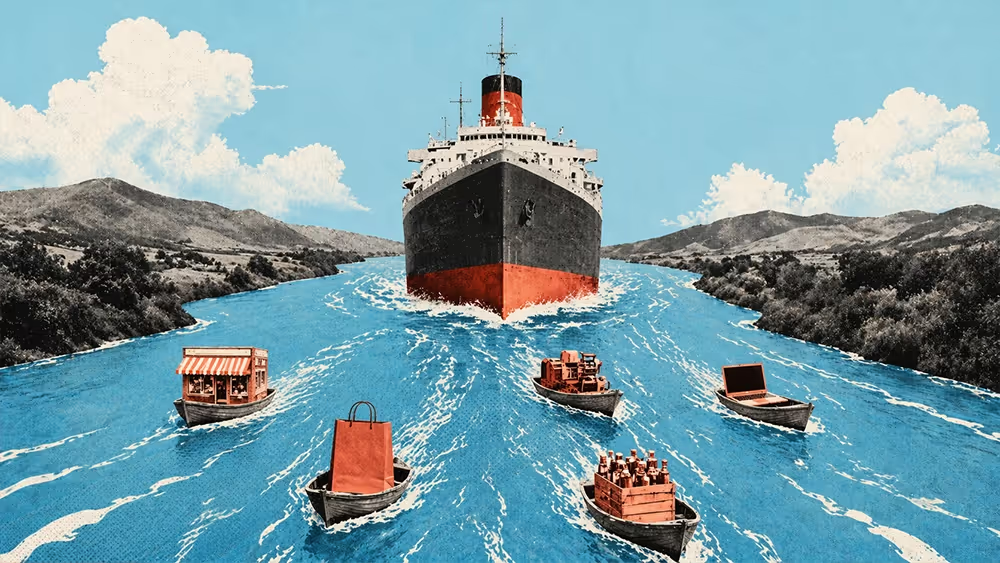

Anthropic shipped Claude Design on April 17, and Figma's stock dropped 7% inside the hour. The Register called it a shot across the bow of Lovable, but that framing might be generous to Anthropic.
Lovable hit $400 million in ARR with fewer than 100 employees, building a product that lets anyone describe an application in plain language and get a working, deployable app back. Lovable's value is everything built around Claude: the prompting, the iteration, the deployment pipeline, the UI that makes the whole thing feel inevitable.
Then Anthropic started building the same application layer.
Elena Verna, Lovable's head of growth, saw this coming. She told Harry Stebbings on the 20VC podcast that she worries about "the big boys and girls in the world, so, OpenAIs, Anthropics, Googles, Apples, more so than our competitors that spring up from the bottom or from sideways." Seeing the threat and surviving it are different skills.
Lovable takes a user's prompt, sends it to Claude, wraps the output in a deployment pipeline, and delivers a working application. Claude Design does something similar for visual work, and Claude Code already handles raw development. Anthropic is building the application layer directly on top of its own model, closing the gap that companies like Lovable exist in. When the model underneath a product improves, and the model provider ships its own interface, the switching cost for users turns out to be surprisingly low. There’s no data migration or retraining for teams; it’s just typing the same prompts into a different box.
For Lovable, the honest answer to "what do you have that Anthropic doesn't" is community, muscle memory, and a head start.
Claude Design is signaling beyond Lovable, no matter how much the industry wants to avoid it. It clarified, in a single afternoon, which AI-native companies are actually defensible and which are one product launch away from an existential question.
Interface companies wrap model capabilities in better design opinions, workflow conventions, and user experience polish. Lovable, v0, Bolt.new, and Gamma all fit here, and they scaled fast on the strength of capabilities that were new at the time. The problem is that the interface is the layer the model provider can replicate most easily, and Claude Design just proved it. The platform eventually builds the interface, and it just took Anthropic a week to do it.
Workflow companies have accumulated something harder to replicate. Figma is a collaborative system with component libraries, version history, design systems, developer handoff protocols, and a decade of conventions an entire profession has internalized. That accumulated knowledge is defensible in a way UI polish never was, which is why Mike Krieger stepping down from Figma's board three days before Claude Design shipped felt like a tell worth reading.
Data companies derive value from proprietary data that the model doesn't have and can't synthesize from the public web. Think Ramp's corporate spending data. Bloomberg's financial data. Any vertical SaaS company sitting on a deep industry-specific dataset. When models improve, that data becomes more valuable because better models can do more with it. Data is the one position in this market that compounds as AI gets better.
Most AI-native startups that launched in the past two years are interface companies. Claude Design didn't create that vulnerability. It just made it undeniable.
Lovable isn't dead. I've spent enough time watching fast-growing AI companies operate to know that $400 million in ARR buys significant room to reposition, and the builder community Lovable cultivated is valuable in ways that a competitive analysis won't capture. The question, now, is whether Lovable treats that community as the product going forward or as a byproduct of product-market fit, because those are not the same company.
On the product side, the move is from "better interface for Claude" toward workflow and data depth that Claude can't replicate. Deployment infrastructure, hosting optimization, analytics on how AI-built apps perform in production, a marketplace of components and templates whose collective knowledge compounds over time. That's a different company from the one Lovable is today, and the window to become it is closing quickly.
The brand angle is the clearest opening. Anthropic owns AI safety, research depth, and enterprise capability, leaving the builder end of the market wide open. The community of non-technical founders, indie hackers, and operators who want to ship ideas without writing code becomes a moat only if Lovable invests in it structurally. The events, the education, and the shared identity that make builders feel they belong to something rather than just use something. That's the brand Anthropic will never build.
The pricing question is where the strategic choice becomes hardest to reverse. Charging for access to Claude's capabilities is a margin problem that compounds with every improvement Anthropic makes to the model. Charging for hosting, deployment, and the operational layer that turns a prototype into production software retains its value regardless of what lies beneath. Lovable already knows which one it needs to be.
Lovable is the most dramatic version of a stress test that applies to every company that shipped an AI-native product in the past two years. What happens when the models get ten times better?
If the product becomes less necessary as the model improves, it's an interface company with a structural problem that growth can mask but not solve. If it becomes more powerful because of the workflow depth the model doesn't own, there's a real path. If it becomes more valuable because better models unlock more from proprietary data and the community, the company is in a rare category that actually wins as AI improves.
Which version of the Lovable story gets written from here depends entirely on which kind of company Lovable chooses to become. Every AI-native brand faces the same question. The ones still deciding have an advantage they won't have for long.


The best editorial systems don’t happen by accident. Outlever builds them.


The best editorial systems don’t happen by accident. Outlever builds them.

Subscribe for the kind of thinking that makes people stop, read and come back.