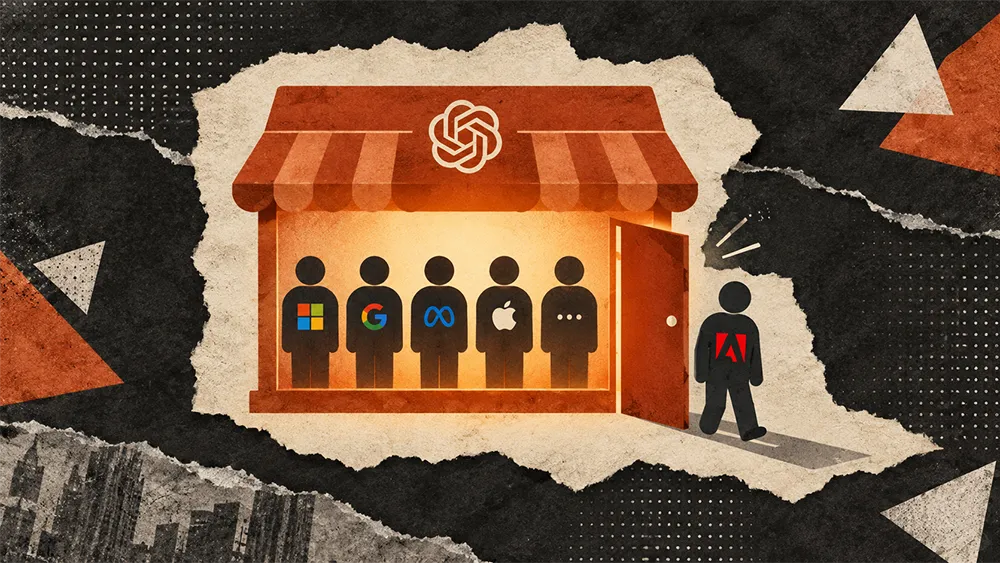
Adobe was among the logos OpenAI lined up when ChatGPT advertising went live in February, alongside Ford and Target, and it spent the pilot promoting Acrobat Studio and Firefly, its generative image tool. It can no longer promote the second of those. The Information reported this week that OpenAI has told business partners it will stop approving ChatGPT ads for image- and audio-generating products that compete with features OpenAI now ships itself. The policy was never announced and does not appear in OpenAI's published ad policies; advertisers found out when their campaigns stopped clearing review. Adobe's senior director for Americas media, Doug Wyatt, has spoken about it publicly, and Investing.com summarised the reporting for anyone outside the paywall.
The restriction landed in the same stretch as ChatGPT Images 2.5 and the unveiling of ChatGPT Live voice, which is the part that should worry anyone with a media plan. Adobe did not change. Its products did not change. What changed was that OpenAI started selling something similar, and the eligibility rules moved to accommodate that.
Video is still allowed
Ads for video-generation tools are still going through, at least at the time of writing, which is the detail that gives the game away. No workable principle admits Runway and excludes Firefly. The only thing separating them is where OpenAI's own product line currently sits: images and voice are places it has just arrived, video is a fight it is picking differently this quarter.
That makes the policy unpredictable as a rule and completely predictable as a schedule, and the second reading is the one that matters if you are the person signing off spend. Several hundred advertisers sit in the blast radius here, across image and audio generation, video editing, design tooling, transcription, dubbing and stock libraries. For all of them, access to the largest consumer AI interface in the world now depends on a roadmap they cannot see. The criteria are unpublished. They were not flagged in advance. They can move whenever OpenAI ships.
The links went too
The paid restriction got the headlines. The other half of the reporting deserves more attention from anyone who has spent this year funding AI visibility work.
ChatGPT has also stopped returning outbound citations and external links for action-oriented image queries, which covers searches for photo editors and image generators. Both routes into the category, the one you pay for and the one you earn, shut at once.
Search kept those things apart. Different systems, different teams, and a wall between them that regulators have spent two decades policing, because maintaining it is expensive and dismantling it pays. Google has been fined and sued over exactly that boundary. There is no equivalent boundary in ChatGPT, where one company runs the auction, the index, the generated answer and the product being recommended against, and moved on all of them in the same category within a fortnight.
What makes it sting is the sequence. Back in May, OpenAI started putting brand links prominently inside answers instead of burying them in footnotes. Similarweb's panel caught the result as a step change rather than a curve, with homepage referral share jumping from the high twenties as a proportion of ChatGPT referral traffic to somewhere north of 60 percent, and holding there. Plenty of this year's answer-engine budget got approved on the back of that move. Four months on, the links are being pulled again wherever OpenAI has an interest.
That does not make AI referrals worthless. It does mean they are the wrong shape for a media plan. Whatever you call the thing OpenAI is doing here, it is closer to app store featuring than to a channel you own.
The ad business is behind plan
You would assume OpenAI has weighed advertising revenue against product defence and picked product defence. The numbers make that harder to believe.
Axios reported in April on the projections OpenAI has been showing investors: roughly $2.5bn in ad revenue this year, then $11bn in 2027, $25bn in 2028, $53bn in 2029, and $100bn by 2030, all resting on an assumption that its products reach 2.75 billion weekly users. Advertising becomes something like 36 percent of company revenue by the end of the decade on those figures.
Actual performance is some way off it. OpenAI said in early September that ChatGPT Ads had hit a $1bn annualised run rate as sales expanded into India, Europe, the Middle East and North Africa, which is quick by any historical comparison and still under the 2026 target. eMarketer is less generous. Its June forecast puts the whole US standalone chatbot advertising category, ChatGPT plus its direct rivals, at under $1bn this year and a little over $5bn by 2030, which Adweek wrote up as OpenAI tracking to miss its own five-year forecast by about 90 percent. Taking every dollar in the segment would still leave a very large gap.
Which puts OpenAI in an odd position. It is behind on a revenue line it has described to investors as its biggest future business, and it has responded by turning away enterprise software budgets, a category that spends heavily and converts well.
There is a reading of this that assumes advertising is the point, and it does not really work. The reading that does work is that the ad system exists mainly to govern who gets to reach the user, and revenue is a welcome side effect. That distinction has commercial consequences, because a good deal of agency positioning right now runs on the idea that ChatGPT Ads is Google Search circa 2003 and early money wins. Google got rich selling access to its own competitors. Rivals bid. Travel sites outbid Google Travel, repeatedly. Neutrality there was a pricing decision rather than a moral one, since an auction with more bidders is an auction with higher prices. OpenAI has just shown it will accept less for its inventory in order to protect a feature, and that is a different business with different economics.
OpenAI is making the opposite argument in Brussels
In October 2025, Bloomberg reported that OpenAI had taken its complaints about Google, Microsoft and Apple to the office of EU competition chief Teresa Ribera, setting out the difficulties it faced competing against entrenched incumbents and pressing for intervention against customer lock-in by large platforms. Access to key data, the company argued, was essential to preserving competition in AI.
It won that argument. On 16 July 2026 the Commission issued two sets of binding specification measures to Google under the Digital Markets Act. The first requires that competing AI services get access to Android features on terms equivalent to Gemini's. The second forces Google to share search data with rival search engines and chatbots. OpenAI is an obvious beneficiary of both. Article 6(5) of the DMA separately bars a designated gatekeeper from ranking its own services above equivalent third-party ones, and requires transparent, non-discriminatory ranking conditions, which is a rule OpenAI currently enjoys the protection of without being subject to.
That is changing. The Commission designated ChatGPT a Very Large Online Search Engine under the Digital Services Act on 31 August, working from OpenAI's own disclosure of about 159 million average monthly EU users for the six months to March against a 45 million threshold. Its reasoning was that a service answering prompts by searching the live web functions as a search engine for regulatory purposes. Designation starts a four-month clock on obligations that include systemic risk assessment, independent audit and a public repository of advertising. Tech Policy Press pointed out that this arrived weeks after OpenAI opened European ad sales, and that a DMA gatekeeper designation is no longer a stretch.
Running an unpublished policy that removes a named competitor from both paid and organic discovery, while regulators actively assess whether you should be treated as a gatekeeper, is the kind of thing that ends up in an annex.
The counterargument
Broadcasters do not sell airtime to rival broadcasters, and supermarkets do not rent shelf space to competing chains. Refusing to bankroll a competitor's customer acquisition is ordinary commercial conduct, and OpenAI is under no particular obligation to help Adobe sell Firefly. That defence works on the paid side.
It works considerably less well once you add the rest. NBC does not also maintain an index of the open web, and a viewer who dislikes NBC has several alternatives on the same remote. Nor has any broadcaster gone to regulators asking them to prise open its distribution partners while quietly closing its own surface. Plenty of companies behave this way. Very few are simultaneously arguing the opposite in front of a competition authority, and in this area of law that context tends to be the thing a case turns on.
Planning around it
The question worth asking about ChatGPT placements is no longer what they cost or how they convert. It is whether OpenAI intends to build your product. That is a platform dependency risk and should be handled the way you would handle a distribution partner that has just announced a private label line, which means contingency, not outrage.
The related point is that discovery inside an assistant, bought or earned, can be withdrawn without notice and by category. It does not belong in the same part of the plan as anything you own. And the regulatory picture is unsettled enough to be worth tracking, since a gatekeeper designation would probably make this policy untenable in Europe and awkward to hold elsewhere.
Adobe reports third-quarter results on 10 September, down roughly a quarter for the year, with the thinnest analyst conviction of its modern life as a public company. Somewhere in that deck is a slide about AI-driven demand generation.