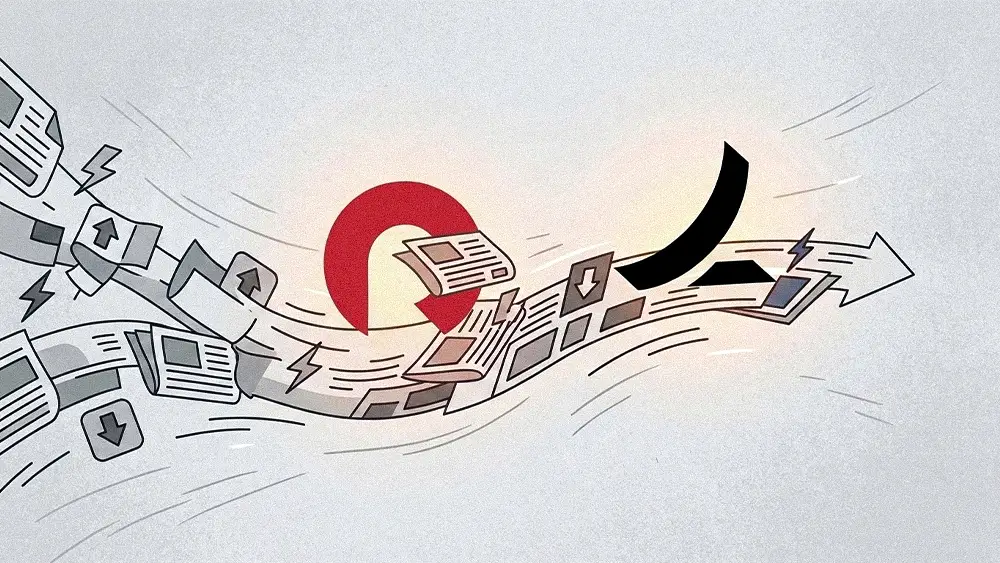
Leadership Teams Started Running Every Decision Through AI to Raise the Bar. Now Nothing Ships.
The most dangerous question in business right now is four words long: "What's wrong with this?"

Make State of Brand one of your go-to sources on Google

A post blew up on Reddit the other day, and it's the comment section you need to read.
The setup was ordinary enough. Someone described watching their leadership team quietly fall apart because the people at the top had started running every decision through an AI. Nothing got built. Nothing got approved. The replies came in fast, and they all said the same thing.
One of the most-upvoted comments described a CEO who feeds everything into an AI and asks it one question: "What is wrong with this?" The AI obliges, because that's the only thing it can do with a prompt that vague. It invents a flaw. Six months without shipping a feature. Marketing budgets frozen. The company struggling to make payroll, because nothing was ever good enough for the machine, so nothing ever moved.
Another person described coming in on a Monday to find the founder had spent the weekend generating 40-page manifestos about how every department was underperforming and what each one needed to do to fix itself.
A third, working in marketing inside a software company, put it more bluntly. Everyone above them had, in their words, gone insane.
If you think this is a one-off, it isn't. The same pattern is showing up in marketing teams, where bosses now run every piece of copy past a chatbot they call their "best buddy" and won't review a draft until you've already fed it to the machine (documented here). And it's showing up in engineering orgs, where leaders generate thousands of lines of code overnight and confuse activity for output, a habit that's earned its own name: "AI psychosis" (covered here). Box founder Aaron Levie put it well in that second one. CEOs are uniquely exposed because they sit far enough from the actual work that they never see where the machine quietly gets it wrong.
It's easy to read all that, exhale, and think: thank god my boss isn't like that.
But that's the wrong conclusion to draw, and it's the reason I'm writing this.
You don't need psychosis for AI to corrupt your judgment
The viral examples are extreme on purpose. They're the ones that make good screenshots. The mechanism underneath them isn't exotic, though, and it isn't rare. All those leaders are doing is trusting the AI.
That's the whole story. There's no madness required. There's just a tool that produces fluent, confident, authoritative-sounding output on demand, and a human who treats that output as a verdict instead of a suggestion.
I'd bet you've done a softer version of the same thing. I know I have. You paste in your strategy, your copy, your plan, and you ask the model what it thinks. The moment it raises an objection, some part of you defers. Not because the objection is right, but because it sounds right, and it arrived in the tone of someone who knows.
The Reddit CEO and the rest of us are standing on the same spectrum. The only difference is how much authority we've handed over.
The trap is built into the question
Look again at that first example, because it's the sharpest thing in the whole thread. "What is wrong with this?"
That prompt cannot fail to produce a problem. You've instructed the AI to find a flaw, so it finds one. If there isn't a real one, it manufactures a plausible substitute. The model isn't checking your work against reality. It's generating the most likely continuation of the sentence "here is what's wrong with this," and that is not the same activity. Confusing the two is exactly how a company ends up frozen for half a year.
This is the part that should worry you more than the manifestos. A leader writing 40-page screeds is obviously off the rails, and people will eventually push back. But a leader who quietly runs everything past a tool that always finds a reason to say no looks, from the outside, like someone with high standards. The dysfunction is invisible. It shows up later as a pipeline full of approved-but-never-shipped work and a team that's stopped bringing ideas forward.
There's a narrow band where AI is actually trustworthy, and it's narrower than you think
After a lot of time spent in the research and in the day-to-day reality of using these tools, here's the conclusion I keep landing on. AI is genuinely reliable, but only inside a tight set of conditions. When a task meets all three, you can lean on it hard. When it misses even one, you're in confabulation territory.
First, the output has to be cheap to verify. You can look at what it produced and confirm it's right in seconds. A reformatted table. A summary of text you can re-read. A draft you were going to edit anyway. Code you can run. The cost of catching an error is close to zero, so the occasional error is survivable.
Second, you have to supply the ground truth. The model should be working on the information you gave it, not on facts it imagines about your business, your customers, or your market. Ask it to tighten a paragraph you wrote and it's reliable. Ask whether your strategy will work and it's guessing, dressed up as analysis. It has no access to your reality. It only has the average of everything ever written.
Third, you have to stay the decision-maker. The AI drafts and you decide. It generates options and you judge them. The instant that relationship flips, the instant its output becomes the verdict and your job becomes carrying it out, you've left the safe band, no matter how good the prompt was.
The Reddit CEO's process breaks all three at once. "What's wrong with this?" produces something unverifiable, asks the model to reason about a reality it can't see, and then treats the answer as a ruling. Three for three. Of course nothing ships.
The part nobody wants to hear
The leaders in those comments aren't a different species. They're a preview. The same tool that quietly improves your first drafts will, if you let the relationship drift, start making your decisions, and it'll do it with so much confidence that you won't notice the handoff happening.
The fix isn't to stop using AI. It's to know exactly where the band ends, and to treat everything outside it as input from a very articulate stranger who has never seen your business and has every reason to sound certain.
Trust it to do the work. Don't trust it to do the thinking.

If this caught your attention, that’s not accidental.

The best editorial systems don’t happen by accident. Outlever builds them.

If this caught your attention, that’s not accidental.

The best editorial systems don’t happen by accident. Outlever builds them.


Come back for the reason it lands.
Subscribe for the kind of thinking that makes people stop, read and come back.