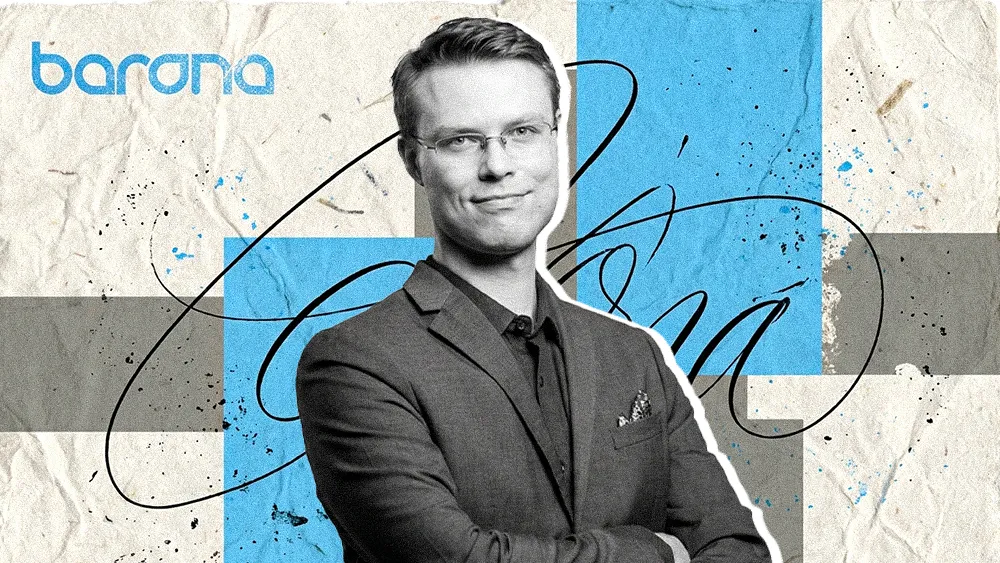
"Your most powerful brand asset is your humans. The AI should amplify their distinct voices, not iron them flat."
 Joni HelminenChief Marketing Officer @ Barona
Most AI implementation in marketing follows a familiar arc. A committee forms, consultants are brought in, a pilot launches, a deck gets made, and six months later, nothing is in production. One CMO skipped all of it and built his team's system from scratch.
Joni Helminen is the Chief Marketing Officer at Barona, a Finnish working life company that employs over 30,000 people annually across Finland and the Nordics. He joined the company nearly five years ago and progressed from Head of Digital Marketing through Head of Marketing Strategy and MarTech before taking on a Director of Marketing role in 2024 and assuming the CMO role in 2025. Before Barona, he spent five years at OMD Finland, where he led performance marketing and programmatic advertising for major clients. The result of his build is a structured knowledge architecture, managed through Claude, that gets his team 70 to 80 percent of the way to a finished draft on any piece of content before a human touches it.
Helminen built the system because he saw a structural problem worth solving.
"Your most powerful brand asset is your humans. The AI should amplify their distinct voices, not iron them flat."
This is the core tension in almost every AI content program right now. Content produced by large language models tends to converge, producing outputs more similar to one another than human-created content, with measurable effects on consumer engagement and brand distinctiveness over time. Helminen calls this the great flattening, and his system is designed specifically to counter it. Every company is now one prompt away from sounding like every other company, and the solution is not to avoid AI but to build something deeper beneath it.
The Instinct to Overload the Foundation
The impulse when building this kind of system, Helminen said, is to put everything in. He tried that first.
"The honest answer is I probably overdid it. I put in a lot of stuff and then later realized that maybe not all of this stuff is relevant."
What he settled on was a foundation covering brand style, tone of voice, visual identity, brand architecture, and a baseline company description. Beyond that, each service line gets its own file describing what it does and how it is positioned. ICP definitions are broken out by business unit. Go-to-market playbooks are drawn from actual customer and sales interviews, which is where most companies are most under-documented. The institutional knowledge exists, but it lives in people's heads.
"A lot of that stuff lives in people's heads. Forcing it, when you're building a system like this, actually puts it on paper. And that helps a lot."
The documentation is worth doing on its own. Companies that force this kind of clarity onto paper end up with sharper alignment across the board, before any AI is involved at all.
Why a Style Guide Is Not the Same Thing as a Voice
Pasting a brand style guide into a prompt and hoping for consistency is, in Helminen's view, a reliable path to generic output. His approach to encoding voice runs three layers deep.
The first is grounding the voice in the brand's "why." Rather than a list of rules, his tone of voice file explains what the company stands for, what moments matter, and how those commitments translate into language. "The AI generates better when it understands the why, not just the rules," he said.
The second layer is real examples. The system is trained on over 100 articles the team has actually published, so it pattern-matches against real output rather than abstract descriptions.
The third layer is differentiation by voice context. Each sub-brand gets its own file, and individual thought leaders have their own profiles, because a person from one background writes very differently from someone from another. A single company voice applied across all of them is just a faster way to sound like no one.
"The test I would do is a blind read of the draft. If you can't tell that it sounds like the voice you're trying to make it sound like, then the system has sort of failed."
The 70 Percent Problem Is Structural
Getting to 70 to 80 percent is the easy part to quantify. The harder conversation is about what AI fails to do, and why that gap is likely to stay.
"AI tends to default to safe, balanced, and comprehensive, unless you sort of prompt that into it. And you tend to want a sharper edge."
The failures are structural, not random. AI gravitates toward the safe, balanced read and misses the specific observation that makes something worth reading. It also fails on accuracy in ways that aren't always obvious, producing numbers that sound right but aren't. Helminen's framing is simple: "Treat the AI draft like a strong outline. Rewrite the hook. That's where the spike lives. The expert marketer adds the spikes and removes the overpolish. Both halves matter."
A significant portion of marketing work is already being automated. The work that remains is the work machines are worst at: noticing something true and knowing how to say it.
Builders Ship. Committees Don't.
On the question of who should own this, Helminen's answer is not the obvious one.
"Committees tend to fail and die and not do stuff. Builders tend to ship. I've watched too many companies form AI councils or run a pilot and produce something beautifully designed in PowerPoint, and then, six months later, nothing is in production."
Delegation looks efficient until you realize what's actually being handed off. Tone of voice, ICP definitions, and positioning all go with it when a CMO outsources the encoding to a vendor. "When you encode your tone of voice, that's a brand call. What you decide to put into your foundation, that's a strategic call. If you're putting that to an agency or somebody else, you're outsourcing strategy," he said.
A systems-minded head of marketing ops can copilot the build. But a CMO who fully delegates never develops a feel for what AI can and cannot do, and that calibration is increasingly part of the job. For non-technical CMOs who want to start, Helminen's advice is to begin with documentation. Brand, audience, and GTM playbooks written into clean files require no technical skill and represent most of the actual value.
What He Is Actually Measuring
Helminen was direct about what he can and cannot measure. The clearest signal is time to first draft. Campaign briefs that used to take three to four hours now take around 15 minutes. Beyond that, content velocity at consistent quality, and brand voice consistency across the team, a more qualitative read, but a real one.
"Right now, I don't have pipeline impact or ROI or quality scores. If you claim you have that, I think you're exaggerating."
Phase two connects CRM data, meeting transcripts, and engagement analytics into selective tool calls that pull only what is relevant for each content type. Selective beats comprehensive, here as much as anywhere. "The temptation is to load everything into context just in case. But that's a slow and increasingly expensive system that probably produces worse output," he noted.
The long-term vision is a system that learns. Better outputs this month than last, without more human hours behind them. That requires feedback loops from real performance data, and those loops are still being built.
The Marketer on the Other Side of This
Helminen's view of what this shift means for hiring cuts against several things the industry has treated as stable. He expected smaller, more senior teams doing the work of larger ones. Juniors who have never learned the old workflow are learning AI-native from the start. The system itself increasingly absorbs channel-specific tactical expertise. Experience from more than four or five years ago matters less than it used to.
What he is actively hiring for is systems thinking, editorial judgment, and a strong personal point of view.
"AI tends to flatten everything. So if you have a human who has an edge, a perspective worth amplifying, that's really valuable."
New roles are already emerging. Marketing engineers, AI workflow architects, GTM architects, and AI editors whose job is to bring drafts to publishable quality. Profound recently bet $96 million that the marketing engineer is the next significant role in the industry, which closely aligns with what Helminen is building toward within his own organization. The question for most marketing teams is whether they are designing the system or waiting for someone else to do it first.
"Pick a workflow, pick a problem, and try to solve it from a few different angles. Maybe it'll fail. But the experience of doing and learning will probably lead to a lot better result than looking at the world go by."