Reddit Lost 86% of Its ChatGPT Citations in Four Days. Nobody Can Tell You Why.
Reddit had a signed licensing deal with OpenAI and still lost most of its visibility overnight, with no warning and no explanation. That should worry anyone currently budgeting against AI search.
Make State of Brand one of your go-to sources on Google

Somewhere around August 14, ChatGPT stopped citing one of the most-cited domains on the internet.
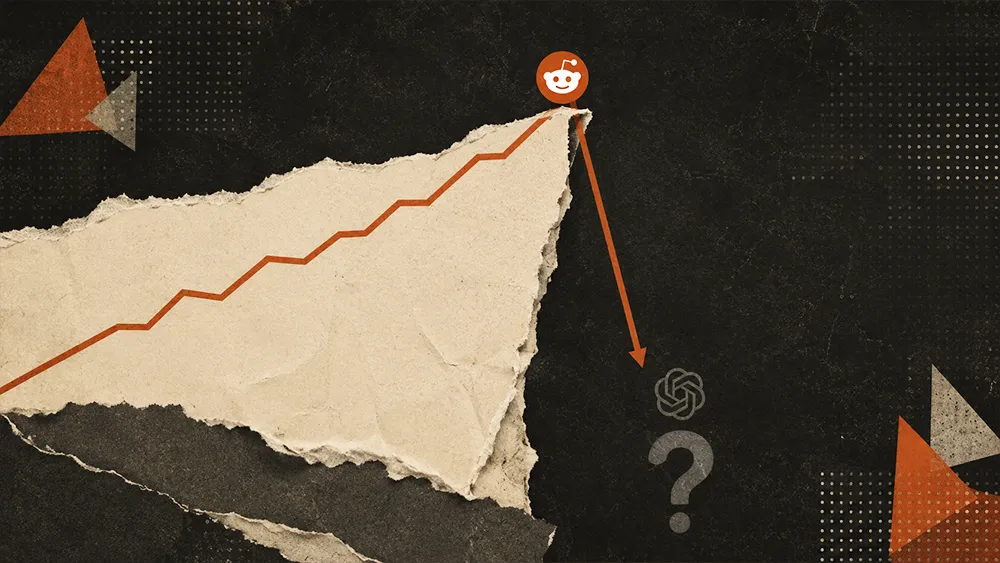
Tracking data from Promptwatch shows Reddit held a steady 3.83% share of all ChatGPT Search citations from July 18 through August 7. On August 14 it fell below 1%. Through August 17 it averaged 0.52%, a relative decline of 86.4% in roughly four days. Gizmodo put the pre-drop figure as high as 4.5% of outputs and asked OpenAI to explain. OpenAI didn't respond. Reddit pointed to competing datasets that still rank it among the most-cited domains anywhere.
The market moved before anyone clarified anything. RDDT dropped roughly 10% in an afternoon session as the charts circulated on X.
On LinkedIn, practitioners reached for the obvious word. One called AI search a "constant moving target". Another told brands to "stop building strategies" around holes in the system.
They have a point, though the problem runs deeper than most of the coverage suggests. An entire discipline now sits on top of this ranking system: budgets, dashboards, job titles, agency retainers. The company that owns the system won't explain how it works. The vendors measuring it can't agree on what the numbers were before they moved. The rules change overnight and nobody gets told. Marketing teams are being held accountable for a number they have no authority over, which is a familiar shape and rarely ends well.
The explanation doesn't survive the timeline
Here's the version making the rounds. On August 8, OpenAI changed ChatGPT Search's query fanout behavior, meaning the background searches the model runs while assembling an answer. Promptwatch observed the model leaning hard on site-scoped searches, which jumped from 0.37% to 16.8% of all fan-out queries, with fan-outs per response nearly doubling. Co-founder Klaas Foppen described a system now "deliberately going to specific sites" rather than casting into the open web.
Clean story. It also doesn't quite hold. Search Engine Journal points out that the August 8 change produced only a modest slide, from the high 3% range into the mid-2s. The cliff came six days later, and nothing published so far explains it. Search Engine Land notes that Promptwatch has been careful here: the data shows when the shift happened, not why, and the firm calls its finding provisional while it keeps monitoring. It won't even rule out a collection artifact on its own end.
Add that up. The most-tracked visibility metric in marketing moved 86% in four days, the best available explanation covers part of it, the platform responsible has said nothing, and the vendor measuring it isn't certain the number is real.
The dashboards don't agree on the baseline
Before a company can lose 86% of something, somebody has to establish what it had. The industry is nowhere close to consensus on that.
Promptwatch put Reddit's pre-drop baseline at 3.83%. Ahrefs' July 2026 dataset had Reddit as the single most-cited domain in ChatGPT at 16.7% of citations, more than four times higher. Earlier Semrush work put it near 60% at ChatGPT's peak. Gizmodo said 4.5%. These aren't rounding differences. They come from different prompt sets, different model tiers, different account states, and different definitions of what counts as a citation in the first place.
There's also a gap between being read and being credited. An Ahrefs study across 1.4 million prompts found ChatGPT pulling Reddit pages constantly while citing them under 2% of the time, using the content to build context and gauge consensus without attributing any of it. So the citation share everyone tracks was never a measure of influence. It measured what the interface chose to display.
A number nobody can define, audit, or reconcile across vendors doesn't function as a KPI.
It already happened once, for a completely unrelated reason
Eleven months ago Reddit's ChatGPT citations collapsed in almost the same shape. An analysis of more than three million citations found Reddit peaking at 14.29% in early August 2025 and hitting 0.21% by mid-September, a 95% decline in a month. RDDT fell 14.4% in a week as investors absorbed it.
The leading explanation had nothing to do with OpenAI's intentions. Google removed the num=100 parameter that let scrapers pull 100 results per request. OpenAI buys search data from third parties that relied on it. With the visible window shrunk to the top 10 or 20 results, and 57.8% of Reddit's keywords ranking outside the top 20, most Reddit pages stopped existing as far as the pipeline was concerned. Semrush wasn't convinced by that account either, arguing the drop looked more like a deliberate effort to stop over-citing a handful of domains.
Put the two events side by side. The same company lost roughly the same share of the same metric twice in under a year, through two mechanisms with nothing in common. One originated inside OpenAI's retrieval logic. The other originated at Google, a company that isn't party to the relationship at all. Reddit did nothing differently in either case, got no warning either time, and still has no explanation for either.
There's no repeatable practice to build against a system that can break a company two different ways in a year and mention neither.
The asymmetry is the point
Reddit is the best-positioned company in this story and it still got flattened.
It was among the first platforms to license its user-generated corpus to AI companies. It holds a commercial agreement with OpenAI, a public market cap, a legal department, a communications team. By volume it's one of the most valuable text repositories in existence. When the retrieval logic changed, Reddit found out the way you would: from a third-party dashboard, after the fact, with nothing to appeal to.
That licensing deal, as explainx points out, governs data access for training and product use rather than live citation weighting. The contract and the visibility were never the same asset. Reddit held one and made assumptions about the other.
Scale that down to a normal company. If a signed agreement with OpenAI doesn't buy a heads-up, it's fair to ask what a GEO retainer buys. Brands aren't partners in this arrangement. They're inventory, priced unilaterally and retroactively, with no changelog.
Every model release re-ranks the web
Platforms aren't working to fix this volatility. It's what shipping new models looks like from the outside.
The mechanism is visible in the fanout change itself. When site-scoped searches jump from 0.37% to 16.8% of fan-out queries inside a single update, the model has stopped casting into the open web and weighing what comes back. It's deciding in advance which sites to ask. That's a reallocation of who counts as an authority, shipped inside a model version, affecting every company on either side of the line and notifying none of them.
What replaced Reddit in those answers isn't public. OpenAI hasn't said, and no vendor has produced a before-and-after that holds up to scrutiny. What's observable is the shape of the loss: the most aggregated, least attributable corpus on the internet lost most of its share in four days, and the company that owns the ranking function won't say what took its place.
There's no single game to play across platforms either. A synthesis of nine separate studies, covering everything from Similarweb's citation dataset to Evertune's 200-million-prompt analysis, found each engine favoring a different source mix. Fandom over-indexes in Google AI Mode. Perplexity skews toward LinkedIn and G2. Gemini tracks closest to classic SEO. Even during Reddit's ChatGPT wipeout, Perplexity kept citing it steadily and Google's AI surfaces eroded only gradually.
Most of the tactics sold against this problem don't hold up under testing. A controlled Ahrefs study of 1,885 pages that added JSON-LD markup, matched against 4,000 control pages, found no meaningful citation uplift on any platform. The most widely recommended technical intervention in the category produced nothing measurable.
Where the line actually falls
None of this argues for ignoring AI search. Referral volume from AI surfaces is climbing quickly and the behavior shift underneath it is real. Paying attention makes sense.
Over-indexing doesn't, and the distinction comes down to what kind of thing AI visibility is. A channel is something a company buys into, operates, and holds. AI visibility is an outcome, granted by a third party on criteria it won't publish and can revise on a Tuesday.
Managing an outcome as though it were a channel is where the insanity starts: a dedicated budget line, a quarterly target, and a vendor invoice attached to a number that just moved 86% for reasons nobody can identify at a company that won't return a reporter's call. The team ends up optimizing against a baseline four tools measure four different ways, chasing a scoring function that gets replaced with the next release.
Citation share behaves like a live ranking signal that can be re-weighted overnight, closer to a rankings position than to a backlink profile that erodes over months. That makes it useful as a lagging indicator of authority. Read it that way and it tells you something real. Manage it directly and you're managing somebody else's product roadmap.
What survives a re-ranking
No AI search strategy survives a re-weighting, because the strategy was never the asset.
The companies that didn't have an August weren't running better citation tactics. Their distribution didn't route through a citation layer at all. Whatever they'd built existed independently of the surface that displayed it, which is the only reason the surface changing didn't cost them anything.
That's the test for any marketing investment right now. If OpenAI changed its fanout logic tomorrow, would this still be worth having? Original research, first-party data, a defensible editorial position, an audience reachable directly, a brand people search for by name: all of it passes. It's the same move as going from renting attention to owning it, applied to a channel most brands haven't yet admitted they're renting. It compounds when the model favors you and it keeps working when the model forgets you exist. That's why owned media keeps outperforming the alternatives, and why operators like Outlever build the editorial engine rather than the optimization layer. The engine is the part no platform can repossess.
Reddit's exposure was structural rather than strategic. It let a platform it doesn't control become the distribution assumption underneath its valuation, and it found out what that costs in four days.
Most companies reading this have some version of the same exposure. The only real question is how much of the strategy is sitting on top of it. Chasing citations means optimizing for a number somebody else owns. Being the source is the only position that survives the next release.
Correction, August 21, 2026: An earlier version of this article cited a source-category comparison of ChatGPT citations that had been shared on X, including a claim that citations to third-party review sites had fallen to zero. The post has since been removed by its author, who said she had not verified the underlying data. That passage has been removed.

If this caught your attention, that’s not accidental.

The best editorial systems don’t happen by accident. Outlever builds them.
If this caught your attention, that’s not accidental.

The best editorial systems don’t happen by accident. Outlever builds them.
Come back for the reason it lands.
Subscribe for the kind of thinking that makes people stop, read and come back.